Cayuga Lake is one of our community’s most precious natural assets. Not only does it offer a large array of recreational opportunities, but it also provides the drinking water for over 100,000 people. As global warming accelerates and fresh water sources become increasingly scarce, we are fortunate to have such a plentiful resource available. In addition, as Assemblymember Anna Kelles points out, the $3-billion-dollar local agritourism economy, which employs 60,000 people, depends on the lake.
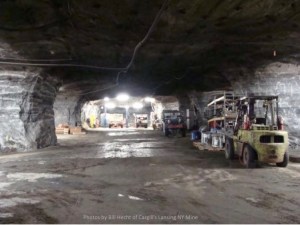
Little wonder, then, why there is growing concern about the future of the Cargill Salt Mine after reports surfaced that the company is looking to sell the operation. Cargill has been operating the mine since 1970. It produces roughly 2 million tons of road salt each year and ships it to over 1,500 locations throughout New York and the Northeast. The mine goes down 2,300 feet, making it the deepest salt mine in North America, and it runs for more than seven miles underground.
Lack of Environmental Safeguards
Despite pressure from local environmental organizations, the Cargill Salt Mine has never been required to carry out an environmental impact statement. The New York State Department of Environmental Conservation (NYSDEC) has only required Cargill to post a $3.5 million bond to insure the mine in the event of a potential flood, an amount that clearly falls far short of what would be needed in such an instance.
Make no mistake: the collapse of one of Cargill’s salt mines is not a theoretical proposition. A roof collapse in December 2020 killed two miners at its Avery Island mine in Louisiana. Cargill shut down the mine in June 2022 and intentionally flooded it.
Time to Speak Out
Geologic experts have warned that a similar event could take place at Cargill’s salt mine under Cayuga Lake. Members of Cayuga Lake Environmental Action Now (CLEAN) are calling for the company to put in place a financial guarantee bond of $10 billion in event of a catastrophic event. Aside from this awful possibility, the Community Science Institute findings underscore the fact that the current salt concentration of the lake water is already reaching unhealthy levels. It doesn’t take a lot of imagination to see that a mine collapse would dramatically worsen the situation.
We are fortunate to have local legislators such as State Senator Lea Webb and Assemblymember Anna Kelles who are not afraid to take a stand and are calling on Governor Hochul and the NYSDEC to halt the reported sale of the Cargill Salt Mine and undertake a review process that would include contingency plans with a financial commitment in the event of a disaster.
 Rebooting the Future