 avoided accountability. It is time for this to stop. The bill doesn’t ask Big Oil to pick up the entire tab, just a fair share of it. Taxpayers should not have to cover the entire cost of destruction caused by the fossil fuel industry.
Besides the Climate Change Superfund Act, unfinished business from the last session includes the NY HEAT Act, which seeks to eliminate subsidies for new gas hookups, eliminate the “obligation to serve” gas to neighborhoods, and ensure that no low-income household would pay more than 6% of its income for energy. The NY HEAT Act passed in the Senate this year by a wide margin, but never came to a vote in the Assembly due to the controversy over congestion pricing that erupted in the final days of the session.
Another big piece that needs to be put in place is the Cap and Invest Program. By applying a price to the amount of pollution, the Cap and Invest Program incentivizes consumers, businesses, and other entities to transition to lower-carbon alternatives. Assemblymember Anna Kelles (D -125th District) is the lead sponsor on a version of this program that would put in place guardrails to keep it from devolving into a vehicle for cap and trade, and would also ensure that an appropriate share of the revenue raised by the program goes to projects in frontline communities.
As Kelles points out, the Climate Change Superfund Act and the Cap and Invest Program work together, with the former addressing past damage and the latter looking forward to future destruction incurred as a result of carbon pollution. Together with the NY HEAT Act, adoption of this legislation would send a strong message to Washington and the other states that progress on the climate and clean energy transition cannot be stopped.
avoided accountability. It is time for this to stop. The bill doesn’t ask Big Oil to pick up the entire tab, just a fair share of it. Taxpayers should not have to cover the entire cost of destruction caused by the fossil fuel industry.
Besides the Climate Change Superfund Act, unfinished business from the last session includes the NY HEAT Act, which seeks to eliminate subsidies for new gas hookups, eliminate the “obligation to serve” gas to neighborhoods, and ensure that no low-income household would pay more than 6% of its income for energy. The NY HEAT Act passed in the Senate this year by a wide margin, but never came to a vote in the Assembly due to the controversy over congestion pricing that erupted in the final days of the session.
Another big piece that needs to be put in place is the Cap and Invest Program. By applying a price to the amount of pollution, the Cap and Invest Program incentivizes consumers, businesses, and other entities to transition to lower-carbon alternatives. Assemblymember Anna Kelles (D -125th District) is the lead sponsor on a version of this program that would put in place guardrails to keep it from devolving into a vehicle for cap and trade, and would also ensure that an appropriate share of the revenue raised by the program goes to projects in frontline communities.
As Kelles points out, the Climate Change Superfund Act and the Cap and Invest Program work together, with the former addressing past damage and the latter looking forward to future destruction incurred as a result of carbon pollution. Together with the NY HEAT Act, adoption of this legislation would send a strong message to Washington and the other states that progress on the climate and clean energy transition cannot be stopped.
Time for New Leadership on Climate and Energy
With the coming change in administration in Washington, it’s safe to say we’ll be seeing some dramatic shifts in climate and energy policy, none of which is likely to result in lower greenhouse gas emissions.
Consequently, it is critical that local communities and states step in to lead the way on climate resiliency and adaptation, as well as the clean energy transition.
Given the huge transformation of the political landscape at the national level, New York must move forward decisively. The biggest indication that it will do so would be if Governor Hochul signs the Climate Change Superfund Act passed at the end of the last session. This act adopts the “polluter must pay” principle. The fossil fuel industry has known for decades that its product is responsible for the climate damage we’ve experienced, and through its campaign of misinformation and outright deception it has avoided accountability. It is time for this to stop. The bill doesn’t ask Big Oil to pick up the entire tab, just a fair share of it. Taxpayers should not have to cover the entire cost of destruction caused by the fossil fuel industry.
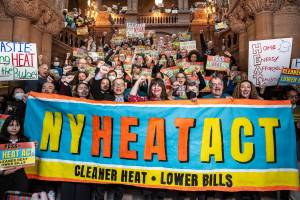
Besides the Climate Change Superfund Act, unfinished business from the last session includes the NY HEAT Act, which seeks to eliminate subsidies for new gas hookups, eliminate the “obligation to serve” gas to neighborhoods, and ensure that no low-income household would pay more than 6% of its income for energy. The NY HEAT Act passed in the Senate this year by a wide margin, but never came to a vote in the Assembly due to the controversy over congestion pricing that erupted in the final days of the session.
Another big piece that needs to be put in place is the Cap and Invest Program. By applying a price to the amount of pollution, the Cap and Invest Program incentivizes consumers, businesses, and other entities to transition to lower-carbon alternatives. Assemblymember Anna Kelles (D -125th District) is the lead sponsor on a version of this program that would put in place guardrails to keep it from devolving into a vehicle for cap and trade, and would also ensure that an appropriate share of the revenue raised by the program goes to projects in frontline communities.
As Kelles points out, the Climate Change Superfund Act and the Cap and Invest Program work together, with the former addressing past damage and the latter looking forward to future destruction incurred as a result of carbon pollution. Together with the NY HEAT Act, adoption of this legislation would send a strong message to Washington and the other states that progress on the climate and clean energy transition cannot be stopped.
avoided accountability. It is time for this to stop. The bill doesn’t ask Big Oil to pick up the entire tab, just a fair share of it. Taxpayers should not have to cover the entire cost of destruction caused by the fossil fuel industry.
Besides the Climate Change Superfund Act, unfinished business from the last session includes the NY HEAT Act, which seeks to eliminate subsidies for new gas hookups, eliminate the “obligation to serve” gas to neighborhoods, and ensure that no low-income household would pay more than 6% of its income for energy. The NY HEAT Act passed in the Senate this year by a wide margin, but never came to a vote in the Assembly due to the controversy over congestion pricing that erupted in the final days of the session.
Another big piece that needs to be put in place is the Cap and Invest Program. By applying a price to the amount of pollution, the Cap and Invest Program incentivizes consumers, businesses, and other entities to transition to lower-carbon alternatives. Assemblymember Anna Kelles (D -125th District) is the lead sponsor on a version of this program that would put in place guardrails to keep it from devolving into a vehicle for cap and trade, and would also ensure that an appropriate share of the revenue raised by the program goes to projects in frontline communities.
As Kelles points out, the Climate Change Superfund Act and the Cap and Invest Program work together, with the former addressing past damage and the latter looking forward to future destruction incurred as a result of carbon pollution. Together with the NY HEAT Act, adoption of this legislation would send a strong message to Washington and the other states that progress on the climate and clean energy transition cannot be stopped.
 Rebooting the Future