NYS Moves Closer to Banning Gas in New Buildings

To say the least, there’s not a lot of good news these days regarding efforts in the U.S. to reduce greenhouse gas emissions. So we should make a point of highlighting what positive news there is to avoid falling into despair.

On Feb. 28, New York state took an important step to ban fossil fuels in new buildings when the State Fire Prevention and Building Code Council voted to recommend major updates to the state’s building code, including rules requiring most new buildings to be all electric starting in 2026, as mandated by a law passed two years ago.The law bans fossil fuel combustion in most new buildings under seven stories starting in 2026, with larger buildings covered starting in 2029.

Environmentalists and climate activists breathed a sign of relief following the state council’s approval given that the state council had cancelled meetings twice in recent months, leaving some supporters concerned that the state might be backing away from the gas ban. With the rules now released for public comment, New York looks to be the first state to implement such a ban.

Buildings are New York’s largest source of emissions, amounting to nearly one-third of all climate pollution. In fact, according to the national clean energy nonprofit RMI, New York’s buildings burn more fossil fuels for heat and hot water than any other state, contributing not only to global warming but also to local air pollution that poses serious public health problems.

Although the proposed new codes do not delay the ban on fossil fuels, they fail to include mandates to require EV charging infrastructure, energy storage, and solar at new buildings. The state’s 2022 climate plan listed these three provisions as “key strategies” to achieve New York’s legally binding emissions targets.

Not surprisingly, the fossil fuel industry fought at every level against these changes in the buildings codes. Industry trade groups, in particular, led a major campaign to keep provisions such as the EV-charging requirement out of the national building code that provides a model for states, including New York.

Despite these shortcomings, the key development is that the NYS Building Council has backed the ban on fossil fuels in new construction. That’s a victory worth celebrating.
Time to Move Forward on Cap-and-Invest

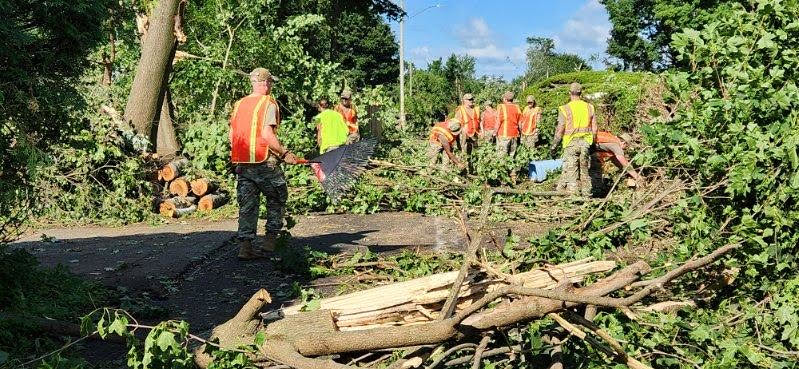
Last year saw a string of costly extreme weather events fueled by climate change across New York, including record rainfall, flash flooding, and tornadoes in upstate communities. This past August Tropical Storm Debby’s remnants caused flash flooding and widespread damage in the Finger Lakes.

These events altogether caused over $1 billion in damages in New York in 2024. In the face of escalating costs, by implementing a good cap-and-invest system, the state has an important opportunity to bring in much-needed funds to pay for climate damage going forward, while also reducing emissions from major polluters.

New York Air Guard Airmen help clear debris in Rome, NY following tornado in July 2024. The state National Guard activated 60 soldiers and airmen to help clear debris in the city. Courtesy photo by Major Ryan Marquette.

A Strong Cap-and Invest Program Needed

A strong cap-and-invest program will impose limits on the amount of emissions allowed by polluters and charge them to do so. With those funds, New York can more seriously invest in upgrades to homes to make them more energy efficient and run on clean, renewable energy while also boosting our local economy.

These measures will be especially important as residents absorb the costly increases in energy charged by NYSEG and other state utilities.

The Time for Delay is Over

Cap-and-invest is critical to meeting the targets of the state’s Climate Law. It also ensures New York can provide the level of investment necessary to make energy affordable while also boosting our economy.

Done the right way, Gov. Kathy Hochul, the DEC, and NYSERDA can lead New York into a new year that makes corporate polluters pay. At the same time, cap-and-invest could unlock billions of dollars for investments that drive sustainable economic development, increase energy efficiency, improve public health, and direct funds into neighborhoods to support community-led clean energy transitions.

Unfortunately, while draft regulations were originally due to be issued by now, with revenue beginning to flow by later in the year, Gov. Hochul recently announced that draft regulations won’t be issued until the end of 2025, and even then it appears these will only be partial.

Gov. Hochul’s delay in rolling out the program’s regulations ignores the urgency of the moment: the climate emergency has arrived and we must deal with it immediately. By continuing to stall, the governor increases the burden on disadvantaged communities, worsens harmful emissions, and allows polluters to go unchecked.

The governor first promised the cap-and-invest program over two years ago as the foundation of New York’s climate strategy. Now it appears that instead of promised regulations, we will see at least another year of delays. This move is part and parcel of a growing legacy of inaction and broken commitments on the most urgent crisis of our time.

We need leaders in Albany who are willing to take bold, decisive action to cut air pollution and lower greenhouse gas emissions. It is time to push for faster action from Gov. Hochul. Especially with a new administration in Washington actively hostile to climate policy, and with the state’s utility rates skyrocketing, it is critical that the cap-and-invest program be implemented as soon as possible.

In doing so, we can protect the residents of Ithaca and Tompkins County, as well as future generations, from the most harmful effects of the climate crisis.