Weakening NY’s Climate Law Is the Wrong Move

Gov. Hochul is signaling that she wants to revise or delay parts of New York’s landmark 2019 Climate Law. Her justification for doing so involve  concerns about energy affordability and implementation challenges. To put it bluntly, weakening the Climate Leadership and Community Protection Act (CLCPA) would be a mistake. Doing so would undermine climate progress, create policy uncertainty, and ultimately cost New Yorkers more in the long run.
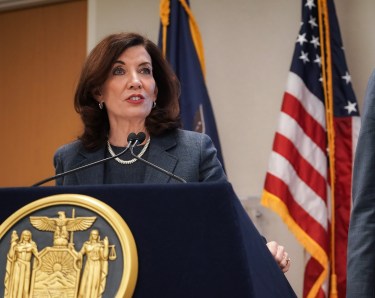
Gov. Kathy Hochul

When the CLCPA passed, it placed the state at the forefront of national and global leadership in climate policy. The law was designed not just to cut emissions but also to drive innovation, investment, and job creation in clean energy industries. By setting ambitious targets, the state signaled to businesses, utilities, and communities that the future would be built on renewable power and electrification.

 If the state retreats from those commitments now, it will send the opposite message, declaring that climate goals are negotiable when political pressure rises. This kind of backtracking could discourage clean-energy investment and slow the development of industries such as offshore wind, energy storage, and green infrastructure.

Critics argue that New York’s climate targets are unrealistic or too expensive. But in many cases the state’s challenges stem from delays in implementation rather than flaws in the law itself. Reports have found that state agencies have fallen behind in issuing regulations and coordinating policies required to meet the law’s mandates.

Changing the targets now would reward bureaucratic delay instead of addressing the underlying issue: the state has not moved quickly enough to build the renewable energy projects, transmission lines, and electrification programs needed to meet its goals.

Rather than weakening the law, the Hochul administration should accelerate permitting, invest in grid infrastructure, and coordinate state agencies to deliver the clean-energy transition that lawmakers already promised.

The governor has pointed to rising energy costs as a reason to reconsider aspects of the climate law. A state analysis suggested that compliance could increase household energy costs in some scenarios. But focusing only on short-term costs misses the larger economic picture.

Climate change already imposes enormous costs on New York through extreme weather, flooding, heat waves, and infrastructure damage. Investing in renewable energy, electrification, and resilience now is far cheaper than dealing with the escalating consequences of a runaway climate crisis.

Moreover, renewable energy technologies continue to decline in price. Solar, wind, and battery storage are becoming increasingly competitive with fossil fuels. Delaying the transition could lock New York into expensive fossil infrastructure that will eventually have to be replaced anyway.

The legislation was designed not only to reduce emissions but also to address environmental inequities. It requires that at least 35 percent of clean-energy investments benefit disadvantaged communities that have historically suffered from pollution and industrial activity.

Rolling back climate commitments risks prolonging the harmful effects of fossil fuel infrastructure in those same communities, especially urban neighborhoods near highways, power plants, and industrial facilities. Weakening the law would mean delaying the health benefits of cleaner air, lower asthma rates, and reduced exposure to pollution.

Major infrastructure transitions do not happen overnight. Transforming an energy system takes decades of planning, investment, and policy stability. Businesses, utilities, and local governments make decisions based on the expectation that climate policies will remain in place.

If New York begins rewriting its climate law just a few years after passing it, that stability disappears. Investors may hesitate to finance renewable projects, and communities may question whether the state will follow through on its promises.

The CLCPA was never meant to be easy. It was designed to meet the scale of the climate challenge facing New York and the world. Instead of weakening the law, state leaders should focus on implementing it effectively, addressing affordability concerns through smart policy, and ensuring that the transition to clean energy benefits all New Yorkers.

In the face of a global climate crisis, the worst possible response would be to retreat from the bold commitments that once made New York a leader.
Endangerment at Home and Abroad

At first glance, climate policy rollbacks and a military strike on Iran may seem unrelated: one deals with environmental regulation at home, the other with foreign policy and conflict abroad. But in 2026, they share deep connections in how the current administration frames U.S. national priorities.

Repealing the Endangerment Finding

Let’s start with the rescinding of the endangerment finding by the Environmental Protection Agency (EPA).

Earlier this month the EPA under President Trump finalized the repeal of the 2009 endangerment finding, the scientific and legal determination that greenhouse gases such as carbon dioxide and methane endanger public health and welfare. The 2009 ruling gave the EPA its authority to regulate these emissions under the Clean Air Act.

The endangerment finding became the foundation of virtually all U.S. federal climate policy. It empowered the EPA to establish vehicle emissions standards, regulate powerful industrial polluters, and curtail greenhouse gas emissions from power plants and oil and gas facilities.

By rescinding that finding, the Trump EPA has unraveled that legal foundation, effectively eliminating federal greenhouse gas regulation and significantly weakening the agency’s ability to enforce climate policy. The final rule also eliminates reporting and measurement requirements for vehicle emissions.

This move represents one of the most consequential environmental policy rollbacks in U.S. history, undermining protections for air quality and climate health while rejecting a long-standing scientific consensus.

Without the authority of the 2009 finding, the EPA loses its central statutory basis for most climate regulations, opening the door to increased emissions, less federal oversight, and deeper disparities between state and federal policies. It also signals a clear ideological position against federal climate engagement and in favor of oil and gas companies.

The Attack on Iran

Both the repeal of the endangerment finding and the Iran conflict reflect a broader political agenda emphasizing the central influence of the U.S. fossil fuel industry. The EPA rollback is justified politically as removing what the Trump administration and its supporters call “overreach,” presenting less federal control as central to economic freedom and growth. On the other hand, the unprovoked military assault on Iran strengthens the power of the White House to act unilaterally in carrying out its foreign policy.

What unites the two is the unprecedented influence of big oil and gas corporations. Iran has the world’s second-largest reserves of natural gas and the third-biggest oil reserves. U.S. oil producers see Iran as a much better prospect than Venezuela and offered last month to be a “stabilizing force” in Iran if the regime there falls.

“You can imagine our industry going back there — we would get a lot more oil, a lot sooner than we will out of Venezuela,” a U.S. energy and geopolitics consultant observed, practically licking his chops. “That’s more conventional oil right near infrastructure, and gas as well.”

The Interplay of Domestic Politics and Foreign Policy

Climate policy and military strategy both shape global perceptions of U.S. leadership. The rollback of climate regulation obviously weakens U.S. influence in international climate cooperation. At the same time, war with Iran will undoubtedly further strain alliances and diplomatic partnerships important to tackling climate change collectively. In both cases, the U.S. is continuing to isolate itself globally.

Rescinding the EPA’s endangerment finding and launching a war against Iran are deeply related actions on the part of the Trump administration. Each represents a pivotal shift, one in how the U.S. engages with the science and policy of climate change at home, and the other in how it projects power abroad.

While different in substance, both illustrate how the fossil fuel industry exerts unchecked environmental and foreign policy influence in ways that endanger the long-term interests of the U.S. In a world increasingly interconnected by climate risk and geopolitical instability, these recent domestic and foreign policy decisions carry profound significance for the U.S and the world.