When the CLCPA passed, it placed the state at the forefront of national and global leadership in climate policy. The law was designed not just to cut emissions but also to drive innovation, investment, and job creation in clean energy industries. By setting ambitious targets, the state signaled to businesses, utilities, and communities that the future would be built on renewable power and electrification.
If the state retreats from those commitments now, it will send the opposite message, declaring that climate goals are negotiable when political pressure rises. This kind of backtracking could discourage clean-energy investment and slow the development of industries such as offshore wind, energy storage, and green infrastructure.
Critics argue that New York’s climate targets are unrealistic or too expensive. But in many cases the state’s challenges stem from delays in implementation rather than flaws in the law itself. Reports have found that state agencies have fallen behind in issuing regulations and coordinating policies required to meet the law’s mandates.
Changing the targets now would reward bureaucratic delay instead of addressing the underlying issue: the state has not moved quickly enough to build the renewable energy projects, transmission lines, and electrification programs needed to meet its goals.
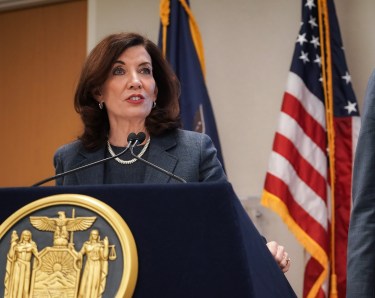
Rather than weakening the law, the Hochul administration should accelerate permitting, invest in grid infrastructure, and coordinate state agencies to deliver the clean-energy transition that lawmakers already promised.
The governor has pointed to rising energy costs as a reason to reconsider aspects of the climate law. A state analysis suggested that compliance could increase household energy costs in some scenarios. But focusing only on short-term costs misses the larger economic picture.
Climate change already imposes enormous costs on New York through extreme weather, flooding, heat waves, and infrastructure damage. Investing in renewable energy, electrification, and resilience now is far cheaper than dealing with the escalating consequences of a runaway climate crisis.
Moreover, renewable energy technologies continue to decline in price. Solar, wind, and battery storage are becoming increasingly competitive with fossil fuels. Delaying the transition could lock New York into expensive fossil infrastructure that will eventually have to be replaced anyway.
The legislation was designed not only to reduce emissions but also to address environmental inequities. It requires that at least 35 percent of clean-energy investments benefit disadvantaged communities that have historically suffered from pollution and industrial activity.
Rolling back climate commitments risks prolonging the harmful effects of fossil fuel infrastructure in those same communities, especially urban neighborhoods near highways, power plants, and industrial facilities. Weakening the law would mean delaying the health benefits of cleaner air, lower asthma rates, and reduced exposure to pollution.
Major infrastructure transitions do not happen overnight. Transforming an energy system takes decades of planning, investment, and policy stability. Businesses, utilities, and local governments make decisions based on the expectation that climate policies will remain in place.
If New York begins rewriting its climate law just a few years after passing it, that stability disappears. Investors may hesitate to finance renewable projects, and communities may question whether the state will follow through on its promises.
The CLCPA was never meant to be easy. It was designed to meet the scale of the climate challenge facing New York and the world. Instead of weakening the law, state leaders should focus on implementing it effectively, addressing affordability concerns through smart policy, and ensuring that the transition to clean energy benefits all New Yorkers.
In the face of a global climate crisis, the worst possible response would be to retreat from the bold commitments that once made New York a leader.
 Rebooting the Future