A Victory (for now) on the NYS Climate Action Front

There is so little good news in the world these days, especially regarding the climate crisis, that it’s worth paying attention when some comes along. Not just happy, greeting card talk, but substantive, positive developments.

Well, there was good news last Friday (October 24) and it’s worth focusing on. A state supreme court judge ruled that New York is violating its own 2019 climate law, the Climate Leadership and Community Protection Act (CLCPA).

CLCPA Mandates

How can this possibly be good news?

Here’s why: it’s been clear for months now that Governor Hochul and her administration have been working hard at slow-walking the effort to to implement the CLCPA. This law mandated – not suggested, recommended, or advised, but legally stipulated – the following climate and clean energy targets: a 40% reduction in greenhouse gases by 2030; an 85% reduction in greenhouse gases by 2050; and 70% renewable electricity by 2030; and 100% carbon-free electricity by 2040.

Cap and Trade Rules

Under the law, the State Department of Environmental Conservation (DEC) had until the start of 2024 to issue regulations that would “ensure” New York met its binding greenhouse gas emissions targets. A year and a half later, no such regulations had been issued.

Behind the scenes, the DEC and NYSERDA had apparently completed draft rules at the beginning of this year for cap and invest, the emissions program that is critical to theimplementation of the climate law. But the governor, instead of releasing these rules for public comment, pulled the plug on them.

In response, Citizen Action of New York, PUSH Buffalo, Sierra Club, and WE ACT for Environmental Justice filed suit in March. In his decision Judge Julian Schreibman gave the DEC until February 6 to issue the cap and trade regulations. “While DEC notes that it has taken other, commendable regulatory steps to reduce greenhouse gas emissions,” the judge said, “it candidly concedes that the impact of those regulations would fall far short” of the targets set out in the climate law.

Echoing Governor Hochul’s concerns about cap and trade, the DEC argued in court that issuing the regulations was “infeasible” because it “would require imposing extraordinary and damaging costs upon New Yorkers.”Judge Schreibman, to his credit, dismissed that argument. “It is undoubtedly true that the task placed before the DEC is very complicated indeed,” he observed. “But as a legal argument, this is unavailing.”

Two Paths

The judge said there were two paths ahead: the DEC can release regulations to meet the requirements of the law or the legislature can change the law. Of course, the DEC could also appeal the decision, which would lead the case to drag on for months longer, if not more. The DEC would only say that it was reviewing the decision.

Governor Hochul took a less ambiguous position on the decision, indicating that she was considering the possibility of pushing the state legislature to change the CLCPA.

NY Renews, a statewide climate justice coalition, spoke out in strong opposition to this possibility. In its words, “changing the climate law would be a massive step in the wrong direction, allowing polluters across New York to proceed with business as usual, unfettered and unchecked, and condemning us to an ever-worsening climate crisis.”

As if on cue, Hurricane Melissa roared through the Caribbean, leaving a trail of death and massive destruction in its wake. One of the strongest hurricanes on record, Melissa slammed into Jamaica on October 28 with winds of 185 mph. Closer to home, New York City suffered extensive flooding and at least two deaths on October 30 as rainfall broke 100-year records and submerged streets and subways.

The message couldn’t be clearer: the climate crisis isn’t going away and, in fact, will only get worse. Those of us who recognize this likelihood must hold the governor and state legislators accountable during the next session beginning in January, making sure that any efforts to weaken the climate law are defeated.

The New York Draft Energy Plan Falls Woefully Short

It wasn’t that long ago New York achieved national prominence for its ambitious renewable energy push. But with NYSERDA’s recent release of its draft energy plan state officials are openly acknowledging that New York will fail to meet the clean energy targets mandated by the Climate Leadership and Community Protection Act of 2018. The state climate law stipulates that 70% of the energy produced in New York should be zero-emissions by 2030.

The plan recognizes the need for more renewable energy and greenhouse gas emissions reductions. To say the least, however, it sends a disappointing message by calling for continued reliance on fossil fuels as well as new investments in new natural gas pipelines and the repowering of fossil fuel plants.

The plan also concludes that New York’s goal of reaching a 40% reduction in emissions from 1990s levels by 2030 is probably not achievable. So far the state has only reduced its emissions by 10% with just five years to go.

Not surprisingly, the plan blames some of the state’s failures on the increasingly aggressive opposition to renewable energy by the Trump administration, but as environmental activists point out, the state was already behind before these attacks.

To its credit, the plan calls for accelerating the deployment of energy efficiency measures such as home weatherization and power-saving appliances. According to its projections, up to 25% of homes by 2040 will have heat pumps and over half the cars could be zero-emission vehicles.

The plan also seeks to increase solar power and battery storage, and notes that New York could increase its renewable electricity generation by 80% over the next 10 years. Of course, the Trump administration’s irrational effort to pull the plug on offshore wind casts a shadow over this possibility.

With the right kind of strong, visionary leadership, New York could accelerate its adoption of solar energy, battery storage, and geothermal energy while retiring its fossil fuel system and electrifying transportation and buildings. The key problem clearly lies with Gov. Kathy Hochul’s reluctance to meet the moment and provide such leadership.

Thousands of comments have been submitted by the public focusing on the flaws in the draft energy plan and its lack of commitment to the CLCPA. Later this year, the state will publish a final plan. Let’s hope it responds to these comments, keeping New York on the path to a renewable energy future.

Time to Tackle Methane Emissions from Landfills

The following is an expanded and revised version of a piece published in the Ithaca Times in June.

When it comes to fighting climate change, it’s hardly news that time is growing short. What is news, however, is the fact that methane is our best way to buy more time.

A groundbreaking new study using aircraft-based emissions monitoring equipment just confirmed that landfills are the largest source of methane in New York State. Researchers flew over more than 100 waste sites, power plants, and farms, measuring real-time emissions. What they found was staggering: landfills were emitting methane at levels dramatically higher than state and federal estimates.

Methane Emissions Need to be Cut

A garbage scow at Fresh Kills Land Fill on Staten Island. Photo by R36 Coach licensed under CC BY 2.0.

In fact, Seneca Meadows, the biggest emitter of any landfill in the state, was more than four times higher than previously reported.

So what’s the big deal? It’s this: methane is over 80 times more potent than carbon dioxide over a 20-year period. So cutting it is one of the fastest ways to slow global warming.

Makes sense, right? But, frustratingly enough, New York is dragging its heels, continuing to delay action on this vital issue.

Time to Put Rules in Place

Despite passing the Climate Leadership and Community Protection Act in 2019, our state still lacks enforceable methane rules for landfills. That’s unacceptable; more than enough time has occurred to put such rules in place.

The Department of Environmental Conservation (DEC) itself identified this problem in the 2023 Solid Waste Management Plan, which committed to minimizing landfill greenhouse gas emissions through updating regulations and deploying effective monitoring technology. Yet more than two years later, no rulemaking has begun. Further delay hampers New York State’s ability to meet the goals set out in the state’s Climate Law and is a missed opportunity to protect overburdened communities.

Methane by itself is bad enough, but we know methane doesn’t travel alone. It comes with toxic co-pollutants like benzene and other volatile organic compounds (VOCs) that contribute to poor air quality and respiratory illness, especially for the low-income and Black and brown communities disproportionately living near landfills.

States like California and Colorado are already implementing strong landfill methane regulations. This spring, California launched a first-in-the-nation satellite program to track large methane leaks, and Colorado just released what could become the country’s most effective landfill methane standard. The proposed rule, if enacted, would require Colorado landfills to manage their emissions by installing a gas collection and control system. In addition, they would also have to phase out open flares (systems that burn methane gas into the open air) and instead use enclosed systems that more effectively control pollution.

The benefits of taking action are too great to be ignored. Strong rules would deliver significant public health, climate, and economic gains. By contrast, the price of inaction is steep—rising health care costs and worsening climate impacts that New Yorkers cannot afford. New York must get on board with these critical efforts to fight for climate and environmental justice. The Department of Environmental Conservation must initiate rulemaking now. The need for action has never been clearer.

Why are NY Taxpayers Subsidizing Big Oil & Gas in this Day & Age?

New York State currently subsidizes the fossil fuel industry by exempting it from paying $1.6 billion of Sales & Use Taxes and Petroleum Business Taxes every year. When I first learned of these subsidies, I was astonished. How could New York, which established some of the most aggressive targets in the nation for reducing greenhouse emissions in its climate law of 2019, still be handing out taxpayer dollars to businesses that continue to pump more of these emissions into the atmosphere?

Besides this obvious reason for taking a good, hard look at the subsidies, there are at least two more reasons why they no longer make any sense. First, the fossil fuel industry has been making enormous profits in recent years. In 2023, the global oil and gas industry earned a record income of more than $2.7 trillion, while they invested just 4% of capital expenditure on clean energy. Clearly, big oil and gas no longer need to be supported by these tax breaks, especially when they are turning around and investing so little in clean energy.
Second, New York passed the Climate Change Superfund Act last year in an effort to hold the fossil fuel industry accountable for the damage that its reckless business practices inflicted on the state. In other words, we are handing out subsidies to the same industry that we have just decided to impose stiff penalties on for its destructive behavior.

The Stop Climate Polluter Handouts Act (S3389/A7949), currently being considered by the state legislature, seeks to pull back on the incentives that benefit the most highly polluting fuels and their most unreasonable uses, including high-emission commercial airline fuel and low-grade shipping “bunker” fuel, the operation of fracked gas infrastructure, industry research and development, and more.

The bill targets fossil fuel corporations’ most egregious actions and protects ordinary New Yorkers by preserving some tax breaks that benefit the public such as the home heating credit for low and middle-income households and an agricultural exemption that helps small- to mid-sized farmers. In total, the legislation would end over $330 million in fossil fuel subsidies. At a time when Washington is taking steps to make huge cuts in the federal budget, cuts that would be extremely damaging to New York, the bill would also help to close the state’s budget deficit.

In short, the Stop Climate Polluter Handouts Act is a commonsense bill, raising revenue for the state while aligning state spending with New York’s 2018 climate law targets and holding fossil fuel companies accountable to pay the taxes from which they have been exempted for decades. There are only a few days left in this year’s legislative session, so time is running out. The legislature needs to move quickly to approve this measure and send it on to Gov. Hochul for her signature.

Let’s Keep the Inflation Reduction Act Powering Upstate New York

The following was originally published in the Ithaca Times on April 20, 2025.

Upstate New York has always been a place where hard work and innovation go hand in hand, going back to the building of the Erie Canal. Now, thanks to the Inflation Reduction Act (IRA), our region is seeing a surge in clean energy investments that are creating jobs, lowering energy costs, and strengthening local economies.

The IRA Drives Economic Benefits

We can see firsthand how federal policies like the Inflation Reduction Act (IRA) are driving tangible benefits for our communities.Ithaca’s groundbreaking plan to decarbonize the city’s buildings, for example, is tapping into federal incentives to make the transition affordable and sustainable.

Meanwhile, the IRA’s Rural Energy for America program is helping farms and small businesses across the Southern Tier invest in energy efficiency upgrades and clean energy projects for affordable energy they can generate on their own land.

Key to Private Investment Growth

Throughout our region and the nation, clean energy projects are delivering economic growth and hundreds of new jobs. Since the passage of the IRA, the U.S. has added more than 400,000 new clean energy jobs and seen over $422 billion in private investment. And in New York alone, federal clean energy tax credits have driven $115.47 billion in investments and created nearly 29,000 jobs since they were passed. Here in our region, the impact is clear: new, good-paying jobs in manufacturing, more reliable, locally-produced clean energy, and strengthened economic opportunities in both urban and rural communities. Despite this momentum, some in Washington want to roll back these critical investments. Repealing clean energy tax credits would mean turning away billions in future investment, increasing energy costs for businesses and families, and slowing the progress we have worked so hard to achieve.

That’s why we need Rep. Josh Riley, Rep. Nick Langworthy, and Rep. Claudia Tenney to stand up for Upstate New York and protect the Inflation Reduction Act. Our region is already seeing the benefits, and by maintaining this momentum, we can build a future that is both economically and environmentally resilient. Now is the time to double down on our progress, like the early canal builders, not turn back.

NYS Moves Closer to Banning Gas in New Buildings

To say the least, there’s not a lot of good news these days regarding efforts in the U.S. to reduce greenhouse gas emissions. So we should make a point of highlighting what positive news there is to avoid falling into despair.

On Feb. 28, New York state took an important step to ban fossil fuels in new buildings when the State Fire Prevention and Building Code Council voted to recommend major updates to the state’s building code, including rules requiring most new buildings to be all electric starting in 2026, as mandated by a law passed two years ago.The law bans fossil fuel combustion in most new buildings under seven stories starting in 2026, with larger buildings covered starting in 2029.
Environmentalists and climate activists breathed a sign of relief following the state council’s approval given that the state council had cancelled meetings twice in recent months, leaving some supporters concerned that the state might be backing away from the gas ban. With the rules now released for public comment, New York looks to be the first state to implement such a ban.

Buildings are New York’s largest source of emissions, amounting to nearly one-third of all climate pollution. In fact, according to the national clean energy nonprofit RMI, New York’s buildings burn more fossil fuels for heat and hot water than any other state, contributing not only to global warming but also to local air pollution that poses serious public health problems.

Although the proposed new codes do not delay the ban on fossil fuels, they fail to include mandates to require EV charging infrastructure, energy storage, and solar at new buildings. The state’s 2022 climate plan listed these three provisions as “key strategies” to achieve New York’s legally binding emissions targets.

Not surprisingly, the fossil fuel industry fought at every level against these changes in the buildings codes. Industry trade groups, in particular, led a major campaign to keep provisions such as the EV-charging requirement out of the national building code that provides a model for states, including New York.

Despite these shortcomings, the key development is that the NYS Building Council has backed the ban on fossil fuels in new construction. That’s a victory worth celebrating.

Time to Move Forward on Cap-and-Invest

Last year saw a string of costly extreme weather events fueled by climate change across New York, including record rainfall, flash flooding, and tornadoes in upstate communities. This past August Tropical Storm Debby’s remnants caused flash flooding and widespread damage in the Finger Lakes.

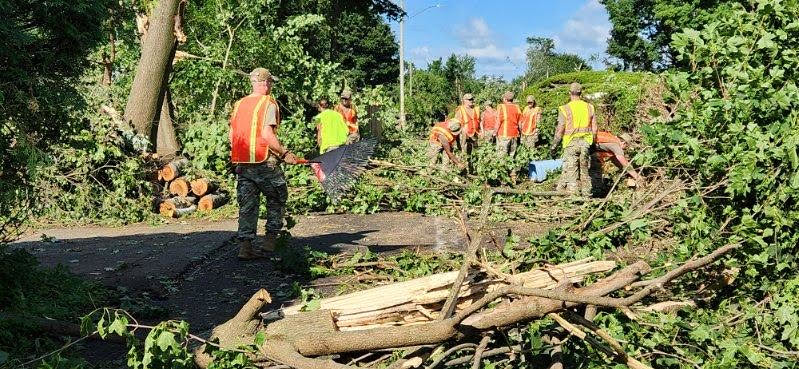
These events altogether caused over $1 billion in damages in New York in 2024. In the face of escalating costs, by implementing a good cap-and-invest system, the state has an important opportunity to bring in much-needed funds to pay for climate damage going forward, while also reducing emissions from major polluters.

New York Air Guard Airmen help clear debris in Rome, NY following tornado in July 2024. The state National Guard activated 60 soldiers and airmen to help clear debris in the city. Courtesy photo by Major Ryan Marquette.

A Strong Cap-and Invest Program Needed

A strong cap-and-invest program will impose limits on the amount of emissions allowed by polluters and charge them to do so. With those funds, New York can more seriously invest in upgrades to homes to make them more energy efficient and run on clean, renewable energy while also boosting our local economy.

These measures will be especially important as residents absorb the costly increases in energy charged by NYSEG and other state utilities.

The Time for Delay is Over

Cap-and-invest is critical to meeting the targets of the state’s Climate Law. It also ensures New York can provide the level of investment necessary to make energy affordable while also boosting our economy.

Done the right way, Gov. Kathy Hochul, the DEC, and NYSERDA can lead New York into a new year that makes corporate polluters pay. At the same time, cap-and-invest could unlock billions of dollars for investments that drive sustainable economic development, increase energy efficiency, improve public health, and direct funds into neighborhoods to support community-led clean energy transitions.

Unfortunately, while draft regulations were originally due to be issued by now, with revenue beginning to flow by later in the year, Gov. Hochul recently announced that draft regulations won’t be issued until the end of 2025, and even then it appears these will only be partial.

Gov. Hochul’s delay in rolling out the program’s regulations ignores the urgency of the moment: the climate emergency has arrived and we must deal with it immediately. By continuing to stall, the governor increases the burden on disadvantaged communities, worsens harmful emissions, and allows polluters to go unchecked.

The governor first promised the cap-and-invest program over two years ago as the foundation of New York’s climate strategy. Now it appears that instead of promised regulations, we will see at least another year of delays. This move is part and parcel of a growing legacy of inaction and broken commitments on the most urgent crisis of our time.

We need leaders in Albany who are willing to take bold, decisive action to cut air pollution and lower greenhouse gas emissions. It is time to push for faster action from Gov. Hochul. Especially with a new administration in Washington actively hostile to climate policy, and with the state’s utility rates skyrocketing, it is critical that the cap-and-invest program be implemented as soon as possible.

In doing so, we can protect the residents of Ithaca and Tompkins County, as well as future generations, from the most harmful effects of the climate crisis.

Two Steps Forward, One Step Back

With the Trump administration taking office on January 20, it’s become clear that efforts to stave off runaway climate change will have to focus on state and local policy.

Trump has promised to halt federal support for clean energy technology and electric vehicles, and he has pledged to withdraw the U.S. from the Paris climate accord, reverse a key regulation aimed at reducing emissions from power plants, and roll back other rules aimed at curbing climate change and air and water pollution.

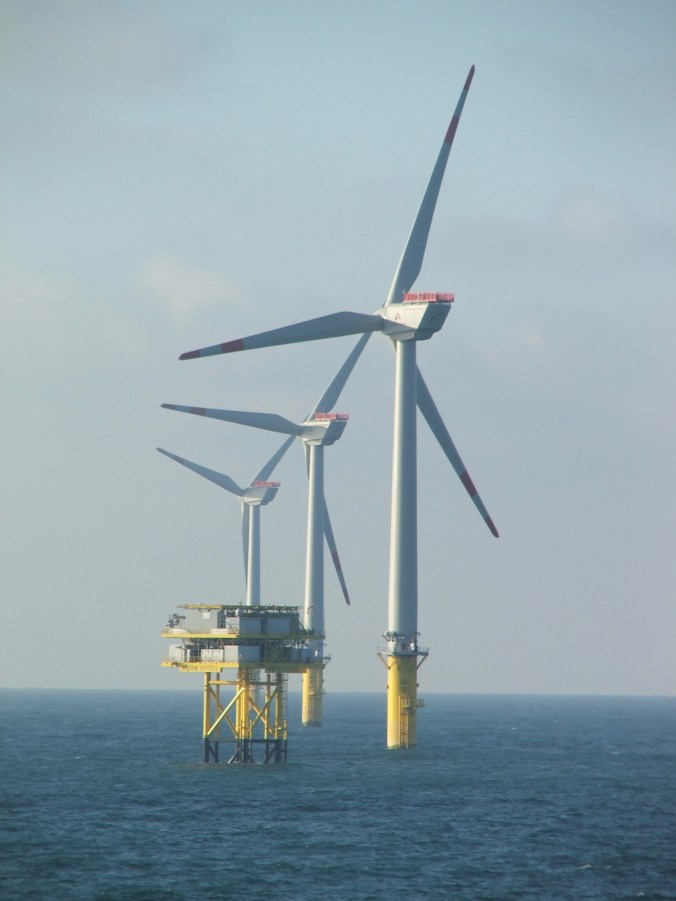
Offshore wind is a crucial component of New York’s attempt to achieve 70 percent of its electricity from renewable energy by 2030. Photo by David Dixon/Walney Offshore Windfarm licensed under CC BY-SA 2.0.

Clean Energy’s Rapid Growth Continues

One bright light, though, is the fact that Trump can slow down progress, but he can’t stop the transformation of the domestic and global economies sparked by the clean energy revolution.

More than 40 percent of all global power in 2023 came from renewable sources, and investments in renewable energy are accelerating because prices have dropped dramatically. In fact, more than 80 percent of new electricity capacity around the world comes from carbon-free sources.

NY’s Leadership Role

Nonetheless, action at the state and local levels will be imperative going forward. With Gov. Kathy Hochul’s signing of the Climate Change Superfund Act, New York has taken on a leadership role that will give the state an opportunity to defy the president-elect’s attempt to reverse climate action. This new law, as explained above, will require the biggest oil and gas companies to contribute to a fund that will be used for infrastructure projects meant to protect New York residents from increasingly dangerous climate disasters like storms and sea level rise.

Another major step in the state’s climate fight took place when Hochul, at the same time, signed into law a prohibition on using carbon dioxide for fracking, closing a loophole in New York’s existing hydraulic fracturing ban (also reported above). This legislation, introduced by Assemblymember Anna Kelles in March, signals a determination to keep the fracking industry out of the state.

These two steps forward should be applauded, while at the same time recognizing the importance of continuing the push on climate action and clean energy in Albany when the state legislature opens its new session on January 8. Efforts to ensure that New York obtains 70 percent of its electricity from renewable energy by 2030, as called for by the 2019 Climate Leadership and Community Protection Act (CLCPA) are especially critical.

Expanding offshore wind, implementing congestion pricing in New York City, eliminating subsidies for new gas hookups as well as the Public Service Commission’s obligation to provide gas service, reducing state tax breaks provided to the fossil fuel industry, putting in place a true cap-and-invest program with guardrails to keep it from devolving into cap-and-trade, increasing the kinds of containers covered by the state’s bottle law, and addressing the issue of plastic packaging are just some of the ways New York can continue to strengthen its leadership role on the climate and clean energy fronts.

At the local level, we’ve seen a disappointing step backward with the continued attempt by Cornell University to install synthetic turf fields on campus. Given the recent finding that 2024 is set to become the hottest year on record, the massive rollout of plastic undertaken by Cornell at its athletic facilities is a bad look, to say the least.

Equally dismaying is the apparently superficial investigation by the city planning board as part of the approval process. The board’s negative declaration of environmental significance, precluding the need for the kind of thorough environmental impact statement (EIS) called for by Zero Waste Ithaca, is hard to fathom in light of existing scientific research outlining the harmful public health and environmental effects of synthetic turf. We can only hope that the lawsuit launched by this activist organization will result in greater transparency regarding the risks involved.

Time for New Leadership on Climate and Energy

With the coming change in administration in Washington, it’s safe to say we’ll be seeing some dramatic shifts in climate and energy policy, none of which is likely to result in lower greenhouse gas emissions. Consequently, it is critical that local communities and states step in to lead the way on climate resiliency and adaptation, as well as the clean energy transition. Given the huge transformation of the political landscape at the national level, New York must move forward decisively. The biggest indication that it will do so would be if Governor Hochul signs the Climate Change Superfund Act passed at the end of the last session. This act adopts the “polluter must pay” principle. The fossil fuel industry has known for decades that its product is responsible for the climate damage we’ve experienced, and through its campaign of misinformation and outright deception it has avoided accountability. It is time for this to stop. The bill doesn’t ask Big Oil to pick up the entire tab, just a fair share of it. Taxpayers should not have to cover the entire cost of destruction caused by the fossil fuel industry. Besides the Climate Change Superfund Act, unfinished business from the last session includes the NY HEAT Act, which seeks to eliminate subsidies for new gas hookups, eliminate the “obligation to serve” gas to neighborhoods, and ensure that no low-income household would pay more than 6% of its income for energy. The NY HEAT Act passed in the Senate this year by a wide margin, but never came to a vote in the Assembly due to the controversy over congestion pricing that erupted in the final days of the session. Another big piece that needs to be put in place is the Cap and Invest Program. By applying a price to the amount of pollution, the Cap and Invest Program incentivizes consumers, businesses, and other entities to transition to lower-carbon alternatives. Assemblymember Anna Kelles (D -125th District) is the lead sponsor on a version of this program that would put in place guardrails to keep it from devolving into a vehicle for cap and trade, and would also ensure that an appropriate share of the revenue raised by the program goes to projects in frontline communities. As Kelles points out, the Climate Change Superfund Act and the Cap and Invest Program work together, with the former addressing past damage and the latter looking forward to future destruction incurred as a result of carbon pollution. Together with the NY HEAT Act, adoption of this legislation would send a strong message to Washington and the other states that progress on the climate and clean energy transition cannot be stopped.

The Days of Reckoning Are Just Ahead

There’s no need at this stage to press the point that the coming U.S. election will be pivotal, not just in terms of whether our constitutional republic will survive, but also whether we can manage to avoid catastrophic, runaway climate change. Regular readers of this column readily grasp what’s at stake with both of these issues.

A report just released by World Weather Attribution (WWA), an international research group, closely examines how the 10 deadliest weather disasters since 2004, including three tropical cyclones, four heatwaves, two floods and a drought, killed an estimated half million people, and probably many more. It makes for sobering reading and, on the eve of Tuesday’s election, is a reminder that our choices at the ballot box will affect not just this nation but the entire planet.

Flooding in Valencia, Spain. Photo by Eidursson – Own Work licensed under CC BY 4.0.

Role of Fossil Fuels
The WWA study investigates how all of these events were intensified by global warming, which was, in turn, caused by the burning of fossil fuels and deforestation. The main finding is simply put: “with every ton of coal, oil and gas burned, all heatwaves get hotter, and the overwhelming majority of heavy rainfall events, droughts, and tropical cyclones get more intense.” In other words, there is no such thing as a “natural” disaster anymore.

Polluters Must Pay
As if to underscore the truth of this observation, horrific flooding in Spain that claimed at least 158 deaths took place just as the WWA analysis was issued. According to Spain’s national weather service, it rained more in eight hours in Valencia, the hardest hit region, than it had in the preceding 20 months. Imperial College climate scientist Friederike Otto, who helps run the WWA, said it was “very clear that climate change did play a role.”

The flooding in Europe and across the U.S. Southeast this fall also underscores why the effort to hold the fossil fuel industry responsible for the havoc that it has caused is so critical, especially in light of the overwhelming evidence that Big Oil was aware of the potential consequences.

At the federal level, Sen. Chris Van Hollen (D-MD), Rep. Jerry Nadler (D-NY), and Rep. Judy Chu (D-CA) have recently introduced bills in Congress to do so. The Polluters Pay Climate Fund Act would assess companies based on their global carbon dioxide emissions, and it authorizes the U.S. Treasury Department to charge the largest polluters in proportion to their past carbon emissions, in excess of 1 billion metric tons, an estimated $100 billion each for ten years.

Closer to home, the New York Climate Change Superfund Act, still sits on Gov. Kathy Hochul’s desk, awaiting her signature to become state law. Both the General Assembly and State Senate passed the legislation during the last session. Public pressure has mounted on the governor to act, and it’s a certainty that this pressure will increase exponentially after the election.

Under the bill passed by lawmakers, New York would seek to collect about $3 billion a year for the next 25 years, for a total of $75 billion. The state Department of Environmental Conservation would be tasked with identifying the oil and gas companies that should be held responsible for greenhouse gas emissions and it would investigate how much they should each pay the state.

Regardless of the outcome of these events, one thing is for sure: the days of reckoning are upon us, and we each have the obligation as democratic citizens to make our voices heard. If there ever was a time to make sure that we become subjects in history and are not just objects of history, it is now.