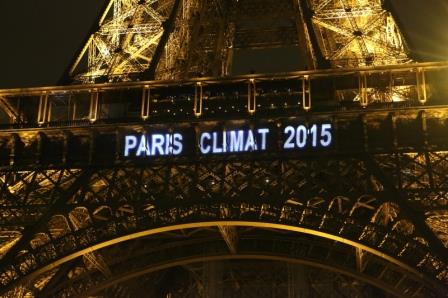
Hope and Despair as 2015 Draws to a Close

Things can feel pretty bleak on a gray, rainy afternoon in late December as one considers the impact our greenhouse gas emissions will have on the planet for the generations ahead. It’s important to keep in mind, however, that we are making progress.

Although it certainly has its flaws, including the lack of any legally binding commitments, the climate agreement reached in Paris earlier this month by nearly 200 countries is historic, marking the most significant progress yet made in the effort to reduce greenhouse gas emissions.

After years of obstructionism, the U.S. actually played a positive role in the Paris talks. In the run up to COP 21, President Obama set the tone for the negotiations by exercising his executive authority to reject the Keystone XL pipeline and announcing the Clean Power Plan, a crucial step to reduce carbon pollution from power plants

At the same time, China is moving forward decisively to reduce emissions from coal and renewable energy has become an economically viable alternative to fossil fuels. Government investigations into Exxon’s cover up of its own climate research have clearly put the oil industry on the defensive and the divestment movement gathers increasing momentum.

Closer to home, as the talks in Paris got underway, Gov. Andrew Cuomo issued a directive that 50 percent of electricity generated in our state come from renewable technologies by 2030. This mandate sends a strong signal that New York needs to accelerate its transition to renewable energy.

In the last 10 years, New York’s renewable energy has increased from about 19 percent to 25 percent of total electricity use. The state’s renewable portfolio standard, which expires today, helped make this possible. Now the challenge is clear: we need double the share of renewable energy to 50 percent in the next 15 years.

The Road to and from Paris

All eyes are on the upcoming climate talks in Paris. Set to begin November 30, the UN Climate Change Conference is widely viewed as the last chance for a substantive international agreement to head off runaway climate destabilization. It seems likely that a deal will be struck, but the real question is whether it will be enough to do the trick.

Over the past several months, about 150 countries — including China, the United States, the European Union, and India — have made voluntary pledges to reduce their greenhouse gas emissions after 2020, when the deal is supposed to take effect. Negotiations in Paris will seek to build upon those commitments and create a structure to monitor and strengthen them.

The major problem facing negotiators is that the commitments made so far are not sufficient to hold the world under 2 degrees C of warming. The general scientific consensus is that anything over 2 degrees C runs the risk of triggering dangerous changes that could cause global havoc.

This news comes as a flurry of new reports remind us that the road we are on currently will lead to disaster and that changes already underway will have terrible consequences, especially for the world’s most vulnerable populations, the poor, young, old, and sick, to say nothing of other nonhuman species, many of which are vital to the health of the world’s ecosystems.

A study issued just days ago by the National Academy of Sciences, for example, warned that greenhouse gas emissions will cause a dramatic collapse of the ocean’s marine life unless we reverse course. A massive coral bleaching event that is sweeping across oceans from Hawaii to India to the Caribbean is among several developments underscoring the report’s findings.

Another recently published analysis estimates that, given carbon emissions to date, the world has probably committed to at least 1.6 meters of long-term sea-level rise, more than five feet. This level of locked-in increase will submerge most of the homes in over 400 U.S. towns and cities, including New Orleans and Miami. Among cities tbat will experience similar fates if they do not take drastic action soon are New York City, Philadelphia, and Jacksonville.

Even as scientists point out that we have already experienced a global temperature rise of almost 1 degree C since the Industrial Revolution, many of them maintain that the worst effects of global warming can still be avoided. “The climate change problem is one that can be solved,” insists climate expert Professor Chris Field of Stanford University. “We have the technologies, the resources – we just need to make the commitment.”

The rapid drop in the cost of producing wind and solar energy is certainly among the most hopeful developments. As a result, the International Energy Agency earlier this month projected that by 2020, 26 percent of the world’s energy will be generated by renewable sources. That’s definitely good news.

The talks in Paris will make it clear whether we can avoid pushing the temperature up another 1 degree C. If not, the road from Paris will be much more difficult than anything we have had to deal with on the road to Paris. Let’s hope that our leaders recognize this and act accordingly.

“The Climate is a Common Good”

Pope Francis’s just released encyclical on climate change and the environment, as expected, issued a hard-hitting warning about the “unprecedented destruction of the ecosystem” and the need to reject the “throwaway culture,” “extreme consumerism,”  and excessive profit-seeking that has led to this life-threatening degradation.

As I noted in my last post, although the Vatican has spoken out on the environment many times before, this is the first encyclical dedicated to the issue. The key theme of this historic document is that climate change and inequality are inextricably linked. In the pope’s words, “we have to realize that a true ecological approach always becomes a social approach; it must integrate questions of justice in debates on the environment, so as to hear both the cry of the earth and the cry of the poor.”

In the encyclical, Pope Francis called for the phasing out of fossil fuels, insisting that the responsibility for paying the cost of this transition belongs to the developed countries, “which are more powerful and pollute the most.” He pointed out that developing nations will probably experience “the worst impact” of climate change, and they lack the resources to “adapt to climate change or to face natural disasters, and their access to social services and protection is very limited.”

While the groundbreaking encyclical has received wide coverage in the media, it remains to be seen what its longer-term impact will be. In particular, the climate agreement negotiations in Paris at the end of this year will provide a telling indication of whether world leaders will have taken to heart the pope’s powerful declaration that “the climate is a common good.”

Underscoring the serious consequences at stake, the very next day a new study appeared cautioning that, unless we reversed our climate change trajectory soon, the planet was on course for its sixth mass species extinction. The key difference this time is that it will be the first one induced by human behavior, especially the burning of fossil fuels and the adoption of industrial-scale agriculture.

“Unless we do something radically different soon,” observed Gerardo Ceballos, an ecologist at the National Autonomous University of Mexico and lead author of the study, “we may end up having a big catastrophic collapse of humans, not only animals.”

Together, the religious and moral pronouncements of Pope Francis and the scientific analysis of six leading researchers provide a sobering picture of our future. Still, as the pope pointed out, “human beings, while capable of the worst, are also capable of rising above themselves, choosing again what is good, and making a new start, despite their mental and social conditioning.”

The Pope Speaks Out on Climate Change

Earlier this week Pope Francis convened a major conference in Rome on climate disruption. It is one of several events planned by the Vatican ahead of his much-anticipated encyclical on global warming and the environment. The conference included speeches by U.N. Secretary-General Ban Ki-moon and leaders of the pontifical academies, along with panels on the relevant scientific, moral, and economic issues.

Pope Francis

The Vatican did not pull its punches In the run up to the conference or at the conference itself, signaling its determination to move the conversation to a new level of urgency.

Last month Cardinal Peter Turkson, who helped write the first draft of the encyclical, declared that global inequality and the destruction of the environment “are the greatest threats we face as a human family today.” “A changing of human hearts in which the good of the human person, and not the pursuit of profit, is the key value,” he insisted, would be required to meet these threats.

Striking a similarly resolute tone, the Vatican issued a statement at the close of the conference on Tuesday, emphasizing that “human-induced climate change is a scientific reality, and its decisive mitigation is a moral and religious imperative for humanity.” Pointing out that the climate summit in Paris later this year “may be the last effective opportunity to negotiate arrangements that keep human-induced warming below 2-degrees C,” it called for a rapid transition “to a world powered by renewable and other low-carbon energy and the sustainable management of ecosystems.”

The Pope’s encyclical on climate change will not be the first time that the Church has addressed this issue. But it is the first time that it will be the subject of an encyclical, which carries great authoritative weight for Roman Catholics.

The Vatican’s sustained engagement with the threat of global warming underscores the fact that science and technology can only take the discussion so far. They can explain the causes and consequences of climate destabilization and pose technical solutions. But it is values, especially a commitment to the generations that come after us, that will provide the motivation to implement the solutions, which are likely to be expensive and politically fraught.

Building a sustainable world, in short, is as much a cultural and ethical project as it is a scientific and engineering endeavor. It is a task that requires imagination, compassion, collaboration, and creativity, a willingness to live our lives differently. In Pope Francis’s words, “We need to care for the earth so that it may continue, as God willed, to be a source of life for the entire human family.”

Getting from Here to There

2014 turned out to be a momentous year for the climate protection effort, culminating in the historic march on September 21 in New York City that brought more than 400,000 people, including many from Tompkins County, to join in a demand for action from world leaders. The news on November 12 that the U.S. and China, which together account for 45 percent of global greenhouse gas emissions, had struck a deal to limit these emissions suggested that perhaps they were listening.

Then, on December 17, Governor Andrew Cuomo announced that his administration would ban fracking in the state largely because of concerns over risks to the public’s health. The watershed decision came after years of citizen activism insisting that the state should leave its considerable fossil fuel reserves in the ground because of the threats fracking posed to the air, water, and soil of its communities.

The call for leaving carbon in the ground also came from a rapidly growing divestment movement.

Beginning with students at U.S. colleges and universities, the movement soon encompassed, among others, higher education institutions in Scotland and Australia as well as the Rockefeller Brothers Fund, the World Council of Churches, and Ithaca’s Park Foundation. As a result of this campaign, according to Fossil Free, more than $50 billion in assets have been divested so far. Building on this momentum, 350.org and its partners have begun organizing a Global Divestment Day for February 13-14, 2015. Stay tuned.

At the same time, renewable energy rapidly gained traction throughout the world. As the year wound to a close, reports out of Germany indicated that the country had generated a record 25 percent of its electricity from renewable energy sources during 2014, with wind and solar leading the way. On May 11, almost 75 percent of Germany’s overall electricity needs were met by renewable energy.

All of these impressive developments, however, took place against the backdrop of a rapidly worsening outlook for the planet’s climate. According to climate scientists, all indications are that 2014 will be the hottest year on record for the planet, marking 38 years in a row of higher-than-average temperatures.words,

In Rebecca Solnit’s words,”It’s hard to see how we’ll get there from here.” But, she notes, that’s how it felt to lots of ordinary 18th-century Europeans when they contemplated overthrowing the divine right of kings and becoming citizens rather than subjects. It takes sustained, concentrated effort on the part of lots of people working together to create a new reality.

Closer to home, Cornell’s purchase of community-owned wind power, the doubling of residential solar power in Tompkins County, the growing recognition that economic development and greenhouse gas emission reductions are not mutually exclusive, and new initiatives to make our commercial buildings more energy efficient all serve as examples of how to build this new reality. May those examples continue to multiply and grow in 2015.

Will Alaska Be the New Florida?

The current debate over the proposed construction of the West Dryden Road natural gas pipeline raises a fundamental question: at what point will we acknowledge that we can no longer conduct “business as usual”?

Implicit in this question is another one: what does it actually mean to put this understanding into operation? Are we willing to move in a radically different direction, as uncomfortable and anxiety-producing as that may be? When will we stop saying, “yes, but …” and recognize that the time to act is now?

The County target of an 80 percent reduction in greenhouse gas emissions by 2050 is not just a nice idea; it’s the minimum necessary to avoid runaway climate disruption. If we can’t accomplish this task in Tompkins County, then where in the U.S. will that target be met?

Oroville Lake, California, in 2011 (top) and the same lake in 2014 (bottom).

A New York Times article in late September examined the issue of climate refugees, not in Bangladesh or the South Pacific, but in the United States. At current rates of global warming, one of the climate researchers observed, “Alaska is going to be the next Florida by the end of the century.”

Matthew E. Kahn, an environmental economist at the University of California, Los Angeles, predicts that “millions of people” will be moving inland to cities such as Minneapolis, Milwaukee, and Detroit to escape coastal flooding in the East and Gulf Coast. By the middle of this century, California and the Southwest will be experiencing catastrophic water shortages and extreme heat.

Aside from the upper Midwest, the Pacific Northwest and Alaska will be among the few refuges left. Even in these places the weather will be dramatically altered. “Summer in Minnesota is projected to be like the climate is in northern Oklahoma – the trees and the forests there, the crops that farmers plant,” according to Thomas C. Peterson, principal scientist for the National Oceanic and Atmospheric Administration (NOAA)’s National Climatic Data Center.

We still have time to avoid the worst effects of climate change, but only if we recognize that the decisions we make now will determine whether we do so or not.

“Hope is a Verb With Its Sleeves Rolled Up”

Since its founding six years ago, TCCPI has advanced the notion that the only effective way for communities to fight climate change is by working together. The many challenges we face in dealing with climate mitigation and adaptation can only be met if we break out of our silos and work across sectors.
The achievement of “emerging district” status for Ithaca is a good example of what can be accomplished when we collaborate. Made up of business, local government, and nonprofit leaders who are committed to reducing the carbon footprint of their buildings, the Ithaca 2030 District seeks to foster the establishment of performance benchmarks, the collecting and sharing of data, and the dissemination of best practices in the areas of energy conservation and energy efficiency.

Through the collaboration of diverse stakeholders, leveraging existing and developing new incentives and financing mechanisms, and creating and sharing joint resources, the Ithaca 2030 District will demonstrate the business case for healthy and high performing buildings.


Solar Tompkins is another terrific example of what can happen when we work together toward a common goal. Director Melissa Kemp recently announced that the program has exceeded its target, enrolling nearly 1,300 families in the program. The initiative aims to double the amount of solar-panel electricity generated in the county. The deadline for enrollees to decide if they want to go solar is October 1, and already 120 have done so. In order to stimulate the growth of solar adoption in the County, Solar Tompkins is selling photovoltaic (PV) solar panel arrays at well below market rate. A typical residential 7,000-watt system could cost only $6,216 through the program once all of the tax credits and rebates are taken into account, according to Kemp.

“Hope is a verb with its sleeves rolled up,” David Orr, professor of environmental studies at Oberlin College, often likes to say. The continuing news about the onset of significant climate disruption could easily lead to despair and paralysis. But by local citizens and institutions coming together on projects such as the Ithaca 2030 District and Solar Tompkins, and rolling up our sleeves for the long haul, we make it possible to build a more sustainable future for Tompkins County.

A Turning Point in the Climate Protection Fight?

The news about accelerating climate change continues to be grim. The most recent National Climate Assessment, issued in early May, underscored the extensive damage that climate change is already inflicting on various regions in the United States. John Holdren, the White House science advisor, called the report “the loudest and clearest alarm bell to date signalling the need to take urgent action to combat the threats to Americans from climate change.”

The news is not all bad, however. Three recent events since the report’s release raise the possibility that this time the alarm might actually be registering. The U.S Environmental Protection Agency (EPA) unveiled on June 2 its long-awaited plan to reduce greenhouse gas emissions from power plants. The EPA’s proposed Clean Power Plan would, if approved, direct states to develop a range of programs to cut carbon dioxide emissions from power plants by 30 percent from 2005 emissions levels by 2030.

The Dave Johnston coal-fired power plant in Wyoming.

The new rules mark the first time any U.S. president has moved to regulate carbon pollution from power plants, the largest single source of carbon dioxide emissions. Although arguably establishing goals that are too little and a deadline too late to prevent runaway climate change, the Obama administration sent a clear signal that it was finally willing to expend some significant political capital on the fight for climate protection.

Providing further hope that the proposed carbon regulations might mark a turning point, the U.S. Supreme Court on June 23 largely upheld the authority of the EPA to implement the proposed regulations, making it much more likely that the agency could fend off challenges from industry and conservative opponents.

The very next day a bipartisan group of senior political and business leaders, including three former secretaries of the Treasury, endorsed putting a price on carbon, warning that enormous deposits of oil and coal will have to be left in the ground to avoid reaching dangerous levels of global warming. In their report, “Risky Business,” the group outlined the economic impact of climate change, highlighting how climate change was becoming a serious financial issue for corporations.

In a New York Times op-ed launching the campaign for a carbon tax, former Treasury Secretary Henry Paulson contended that “we’re staring down a climate bubble that poses enormous risks to both our environment and economy.” Paulson, who served in the administration of George W. Bush, compared the mounting climate crisis to the financial crisis of 2008 and the collapse of the economy that followed.

Maybe, just maybe, the dam of political stalemate is beginning to break and the U.S. will finally adopt a coherent and effective climate and energy policy. You can be sure, however, that witout systematic and sustained pressure from the grass roots the necessary changes will never take place. That means that it’s up to us. But it’s certainly nice to see some of our political and business leaders finally lining up on our side.

Campus-Community Collaboration in the Age of Climate Distruption

Few institutions are better positioned to provide the leadership required to avoid runaway climate change than higher education. Indeed, it is hard to see where else the necessary leadership will come from if universities and colleges don’t step up to take on this responsibility. Not just any kind of leadership will do the trick, however. It must be collaborative, adopting an ethos of cooperation and mutuality rather than top-down hierarchical structuring.

0919_07_003-aerial-640x360

Cornell University

Universities and colleges in the United States historically have been crucibles of social change and laboratories for new ideas and creative solutions to some of society’s toughest problems. What is new is the scale of the problem and the threat it poses to human civilization. Simply providing models of sustainability on campus will not suffice. Universities and colleges can become truly sustainable only if they adopt the perspective of “ecosystem awareness” and work with the communities around them to become sustainable. They must commit to dramatically reducing the carbon footprint of campuses and become examples of ecological integrity, social justice and economic health. Beyond that, they must collaborate with the larger community and, in so doing, enable solutions to be scaled up and replicated.

As Michael Young, president of the University of Washington, argues, higher education must go beyond greening the campus. “For colleges and universities — especially public ones — engaging with our communities is fundamental to our mission,” he said. “We all have a responsibility to turn our universities inside out — that is, to take the wealth of ideas percolating on our campuses into our community, whether that community is across the street or across the globe.”

TCCPI seeks to lead the way

New York’s Tompkins County Climate Protection Initiative (TCCPI), at which I am a coordinator, was inspired in particular by similar efforts in Grand Rapids, Mich., and Oberlin, Ohio. It seeks to demonstrate what this kind of collaboration looks like and the impact it can have on a region’s economic, social and environmental health. With a population of about 100,000, Tompkins County includes three American College and University President Climate Commitment (ACUPCC) signatories (which also happen to be among the top employers in the county): Cornell University, Ithaca College and Tompkins Cortland Community College. In addition, the city of Ithaca, the towns of Ithaca, Caroline and Danby and the county all have made formal commitments to reduce greenhouse gas emissions, with the county calling for a decrease in emissions of 80 percent by 2050 and establishing an interim goal of 20 percent by 2020.

TCCPI has leveraged these climate action commitments to help mobilize a countywide energy efficiency effort, expand the production of renewable energy and accelerate the transition to a clean energy economy. The coalition, launched in June 2008, currently consists of local leaders from more than 40 organizations, institutions and businesses in the county, organized into five sectors: business, education, local government, nonprofit and youth. Each sector has a representative serving on the steering committee, which tracks the progress of the coalition’s projects and sets the agenda for the group’s monthly meetings.

The most immediate way in which TCCPI has adopted a collaborative model of leadership and sought to be a “leader-as-host” is to provide an ongoing forum where local leaders can come together regularly, share their progress and challenges and brainstorm collectively about ideas and solutions. In some cases, it’s hard to imagine how the outcomes resulting from these meetings would have emerged without years of building trust and thinking collaboratively. For example, the Tompkins County Planning Department and EcoVillage at Ithaca (EVI) never had worked together in the nearly two decades since EVI was founded. Yet, at a TCCPI meeting in June 2010, the group came up with the notion of the planning department and EVI’s joining hands to submit a proposal to the EPA Climate Showcase Community Grant Program, which seeks to highlight community efforts to decrease greenhouse gas emissions.

The grant proposal, submitted the next month, outlined a strategy for disseminating to the larger community the important lessons learned at EVI about shrinking one’s carbon footprint and developing ways that the county could incorporate these key principles into its planning for future development. EPA awarded a $375,000 grant and work began in February 2011. Two model developments, one at EVI and another at a pocket neighborhood downtown, already are underway, and the county has proposed a third development near the regional medical center. All are designed to highlight innovative approaches to “creating dense neighborhoods that enhance residents’ quality of life while using fewer resources.”

Another project growing out of TCCPI discussions is the installation of photovoltaic arrays at numerous sites in the county, including several county government buildings, businesses and higher education institutions. In the area of energy efficiency, TCCPI has worked with the Cornell Cooperative Extension of Tompkins County (CCETC) to support the establishment of the Tompkins County Energy Corps, made up of students from Cornell and Ithaca College who carry out informational energy audits for homeowners, share information with them about state and federal incentives and encourage concrete steps to improve their residences’ energy performance. TCCPI also has worked closely with CCETC in rolling out a countywide campaign, “Get Your Greenback Tompkins,” to raise awareness about the importance of energy savings.

In these latter two instances, TCCPI shared its own financial resources to help launch the projects. In other cases, it has lent its social capital to help projects obtain the necessary financial capital. Two original members of the TCCPI steering committee serve on the founding board of Black Oak Wind Farm, an 11.9 megawatt project just outside Ithaca slated to be in production by the summer of 2015.

The first community wind project in the region, Black Oak has raised its seed capital of $1.82 million from about 110 local investors. The TCCPI network provided a crucial resource in reaching out to many of these people and persuading them to invest in the wind farm and purchase power from it.

What’s next

TCCPI’s latest initiative marks perhaps its most important effort yet to be a “leader-as-host.” The coalition is working with downtown Ithaca property owners to form a 2030 District, a public/private partnership in which property owners and managers come together with local government, business and community leaders to provide a model for urban sustainability through collaboration, leveraged financing and shared resources. Across the country, 2030 Districts are being established to meet the energy, water and vehicle emissions targets called for by Architecture 2030 in the 2030 Challenge for Planning.

The bottom line? TCCPI embodies the next logical stage in the higher education sustainability movement. It not only promotes collaboration among the local higher education institutions, but also encourages engagement with the community at large in a democratic process. It seeks to draw together key stakeholders and engage them in a course of action that begins with discovering and making explicit common intention, and ends with collectively creating the kinds of innovation needed to effectively address intractable problems. With its emphasis on campuses and communities partnering to address climate and energy issues, TCCPI — like the Oberlin and Grand Rapids models it was based on — provides a framework for multi-sector collaboration that holds out hope of a brighter future for all. It demonstrates that job creation, energy security, more resilient communities and responsible stewardship of the environment are not mutually exclusive.

There is no silver bullet, no magic wand, which can make the immense problems confronting us go away. A necessary if not sufficient condition, though, is that we move from the old myths of independence and self-reliance and acknowledge the truths of interdependence and mutuality. In an increasingly secular world, universities and colleges are among the few institutions that have the capacity to promote this broader, long-term understanding of where the human experiment must head.

Note: This piece was orginally published by GreenBiz.com and can be found here.

The Time is Now

The March-April issue of the TCCPI Newsletter highlights the wide ranging work of the Tompkins County government and other members of the TCCPI coalition to reduce greenhouse gas emissions, improve energy efficiency, and accelerate the transition to a clean energy economy. Clearly, it’s an impressive record, one that demonstrates the commitment of our community to meet the central challenge of our time.

Elsewhere in the United States and around the world similar work is going on in thousands of communities. The crucial question, of course, is will it be enough to stave off runaway climate change? Can we make the changes necessary at the required scale and rate to avoid the 2 degrees Celsius increase scientists say will set off climate catastrophe

Open pit coal mine in Western Australia.

The latest assessment of the Intergovernmental Panel on Climate Change (IPCC), the United Nations group that issues periodic summaries of the ongoing research on climate science, underscores the speed at which we are hurtling toward the point of no return. As the Guardian observes, the new study emphasizes five key points:

  1. Climate change is already posing a serious threat to the world’s food supply and will only get worse, especially in light of projected population growth.
  2. Potential shortages of food and water will become major drivers of future conflicts, undermining human security in every hemisphere.
  3. Climate change is going to intensify existing inequalities and have a disproportionate impact on poor people in both developed and developing nations.
  4. Our current trajectory puts us on course to raise the average global temperature 4 degrees Celsius, ensuring that no one will escape the effects of climate change.
  5. We face a difficult but not hopeless task and can still prevent the worst effects off climate change from occurring.

It’s a sobering picture: the passenger jet on which we are traveling is in a steep dive, we don’t quite know when the craft will begin to come apart because of the stress on its systems and structural integrity, and if we don’t pull out of the dive soon, it will surely crash.

Fortunately, in a follow up report released on Sunday the IPCC finds that the cost of implementing the transformation necessary to avoid the crash would shave only 0.06% off expected annual global economic growth rates of 1.3%-3%. The IPCC analysis does not take into account the environmental and health benefits of cutting greenhouse gas emissions, which could very well offset the costs of a sweeping shift to clean energy.

Here’s the rub, though: the longer we wait the more it will cost. In short, the time for a massive mobilization is now.