Not Just Renewable Energy

The day after attending the anti-fracking concert in Binghamton featuring Natalie Merchant and the Horse Flies, I ran across a new report published by the American Meteorological Society concluding that the ice covering Lake Ontario in the winter had decreased by 88 per cent over the last forty years. Eighty-eight percent. That’s a big number.

Natalie Merchant

Yes, smaller cyclical climate patterns like El Nino and El Nina were responsible for some of this decline but so, too, was the broad trend of global warming. Lake Superior was so free of ice this past winter that a local ferry north of Ashland, Wis., operated all season, something that has happened only once before.

One of the speakers at the concert called on the audience to not only oppose Marcellus drilling but also support the development of renewable energy. “Energy efficiency, too,” I thought to myself. Solar, wind, and geothermal by themselves will not be enough to manage the risk of runaway climate change. And climate adaptation and resilience must be tackled, given the amount of change already baked in. And then there are issues of local food security, alternative transportation, and waste, all being addressed in the Get Your GreenBack Tompkins (GYGB) campaign.

So much work to do; it can all seem more than a little overwhelming. But then every generation has work to do. In many ways, we are fortunate that what Thomas Berry calls “the Great Work” of our time is so well defined. We know what we must do to make sure the generations after us have clean water, clean air, healthy food to eat, and families that thrive. As Natalie Merchant sang that wonderful evening in Binghamton, “These are the days you’ll remember.”

The Importance of Collaborative Leadership

Growing climate disruption makes it increasingly clear that the old ideas about leadership aren’t working. When the worst drought in 500 years strikes California, England endures the wettest winter in 250 years, and an historic heat wave sets off a rash of bushfires in Australia all at the same time, the weaknesses inherent in traditional notions of the “leader-as-hero” become all too apparent.

Winter storm batters the coast of England in early February. 

In the face of such complex and interrelated challenges, we need to move towards a more collaborative and distributive model, one in which “leaders-as-host” build on a network of relationships, inviting people from all parts of the system to participate and contribute to the process of developing solutions. As Deborah Frieze and Margaret Wheatley contend, this approach “is the only way to get large-scale, intractable problems solved.”

Since it was first launched in 2008, TCCPI has sought to demonstrate what this kind of collaboration looks like and the impact it can have on a region’s economic, social, and environmental health. But it is only one among many such efforts in our community. A terrific example of collaborative leadership can be found on South Hill, where Ithaca College, PPM Homes, Cornell Cooperative Extension-Tompkins County, and the South Hill Civic Association have joined hands to raise student awareness about the importance of energy conservation.

Energy efficiency in rental properties is notoriously difficult to achieve in part because of the problem of “split incentives.” Often landlords don’t make efficiency investments because it’s the renters who pay the energy bills. In cases where the landlord pays the utilities, the tenant has little financial incentive to practice energy conservation. The result is housing that wastes energy and costs more than it should.

Unless the different stakeholders come together and work out a solution that makes sense to everyone, the status quo prevails. In a community like Ithaca where 73% of the housing market consists of rental properties, split incentives pose a significant challenge to attempts to reduce the city’s carbon footprint.

As a result of the South Hill collaborative process, PPM Homes carried out extensive upgrades to make its rental properties more energy efficient and provided free bus passes to encourage less reiiance on automobiles. At the same time, the process brought students into the conversation, helping them understand their role as tenants in improving energy conservation. Ithaca College, Cooperative Extension, and the South Hill Civic Association all reinforced this effort, working to heighten the students’ sense of responsibility to the community at large.

As the South Hill experiment underscores, collective efforts involving “leaders-as-hosts” draw together key stakeholders and engage them in a course of action that begins with discovering and making explicit common intention and ends with collectively creating the kinds of innovation needed to effectively address difficult problems. Such cooperative ventures provide a framework for multisector collaboration that helps to light the path ahead.

Climate Change and Inequality

The disproportionate impact of greenhouse gas emissions on the least privileged portions of society is not some distant threat; it is already taking place. Typhoon Haiyan’s destructive path through the Philippines in early November underscored the vulnerability of low income populations to super storms that climate change models predict will become more frequent.

According to the latest estimates from the government there, more than 6,100 people have been reported dead and nearly 1,800 more are still missing three months after the storm ravaged the country. The vast majority of the casualties occurred in low lying areas where the storm surge hit hardest, areas most heavily populated by the poor.

Typhoon Haiyan inflicted the worst damage on poor families in rural areas.

Of course, climate change is not only wreaking havoc in developing nations. The U.S., England, and Australia, just to name three, are coming to grips with drought, floods, and brutal heat waves.

The difference between these events and the Filipino super storm lies in the greater wealth and more robust infrastructure of industrial nations, assets that make them better able to deal with the growing consequences of climate change. All one has to do is compare the resources of the Netherlands to fend off rising sea levels with those of Bangladesh to grasp the point.

It is nearly certain that extreme weather will become a fact of life in the 21st century. What isn’t certain is whether the developed world will become numb to its consequences and keep up practices that contribute to climate destabilization and make the lives of poor people even more exposed than they already are to the resulting destruction. Extended heat waves, food and water shortages, and disappearing coast lines will inflict enormous suffering on millions of people least able to absorb it.

Democratic society, and its core commitment to social equity, requires a livable climate. “Climate change causes drought, floods, and resource scarcity, leading to famine, civil unrest, armed conflict, innocent suffering and government oppression,” writes Ashley Anderson. “Anyone who believes that all individuals deserve basic human and civil rights should see the climate crisis as an imminent threat.”

Democracy even in times of stability and prosperity is difficult to build and maintain; under the stress of global climate disruption, it will in all likelihood collapse in a heap.

In short, we make a huge mistake if we think climate change, economic inequality, and democracy are separate issues having nothing to do with each other. If previously difficult to discern, the interconnections are now becoming increasingly evident. The destabilization of the climate is largely a product of the same forces – the rise of global corporate power and unprecedented technological exploitation – that have resulted in levels of economic and social stratification inimical to the survival of democracy in even its most diluted forms.

The time is long past for those of us who are relatively well off to take stock of how we can act to protect the climate and reduce the vulnerability of those less fortunate than ourselves to its disruptive effects. Whether it is working to expand renewable energy in our communities, strengthening local food and farming systems, calling on universities and colleges to begin divesting from fossil fuel companies, challenging unchecked corporate greed, or insisting that our political leaders take seriously the science of climate change, there is a wide range of actions we can carry out on a daily basis that, cumulatively, will have a global impact. None of us can afford to stand on the sidelines.

“We have the world to live in on the condition that we will take good care of it,” observes Wendell Berry in a recent interview with Bill Moyers. “And to take good care of it we have to know it. And to know it and to be willing to take care of it, we have to love it.” It is hard to think of a better way to spend time during the holidays than to reflect on what Berry says here and (re)commit to this timeless truth during the coming new year.

Off the Climate Cliff?

Right on the heels of the latest report from the United Nations Intergovernmental Panel on Climate Change (IPCC), a startling paper appeared last week in the journal Nature. It was the proverbial train coming down the track, driving home the message that dramatic, life altering global warming is just a few stops away.

According to the study, the new normal for millions of people in a few decades will be hotter than the warmest years between 1860 and 2005 if greenhouse gas emissions continue to rise.

“Go back in your life to think about the hottest, most traumatic event you have experienced,” lead scientist Camilo Mora told the New York Times. “What we’re saying is that very soon, that event is going to become the norm.”

The final scene in “Thelma and Louise.”

Analyzing data from 39 different climate models out of 12 countries, the team of scientists from Hawaii and Japan sought to predict the timing of a move to the new climate regime rather than examine the climate at a fixed date such as 2030 or 2050, as most previous studies have done. The paper concludes that the tropics will undergo this extreme shift first, as early as 2029, and by 2047 more than half of the planet will experience average temperatures hotter than anything recorded between 1860 and 2005.

Coming in the midst of the confrontation between President Obama and Congress over the federal budget and debt ceiling, it’s hard not to draw a comparison. In politics, when playing “chicken,” the first rule of game theory is throw the steering wheel out the window. It’s one thing for Republicans and Democrats to pursue this tactic, however, and another thing for the human race to try to pull this stunt on nature.

Even in the most intractable situations, political parties can negotiate with each other and come to some reasonable resolution, but as Bill McKibben has pointed out numerous times, you can’t negotiate with the laws of physics and chemistry. Go ahead and throw the steering wheel out the window; it’s not going to change the outcome one whit. When it comes to climate change, better to acknowledge that reality than drive the car off the cliff.

From “Egosystem Awareness” to “Ecosystem Awareness”

“The future ain’t what it used to be,” Yogi Berra once declared.[i] He wasn’t talking about climate change, but he could’ve been. Eight out of the nine hottest years on record worldwide, including last year, have occurred since 2000. The rate of the Arctic summer melt is accelerating at an astonishing pace and the latest reports now predict that we could have ice free summers in the Arctic as early as 2015.
observatory

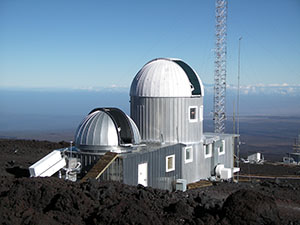
The Mauna Loa Observatory

Scientists at the Mauna Loa Observatory in Hawaii announced this past May that for the first time in human history the level of carbon dioxide in the atmosphere passed 400 ppm. The last time carbon dioxide levels were this high was probably in the Pliocene epoch, over three million years ago. To top it off, a paper just published in Nature predicts that by mid-century over half the planet will be experiencing average temperatures equivalent to the hottest days recorded since 1860.[ii]

As bad as this news is, and it is bad, there is some really good news on the clean energy front. According to a recent flurry of studies, we have the ability with existing technology to get 80-100 percent of our power from wind, sun, water, tides, and other renewable sources, and prevent runaway climate change, far worse than what is already locked in, from taking place. A 2011 report from the United Nations’ Intergovernmental Panel on Climate Change (IPCC), for example, concluded that already existing technologies could, in combination, make up almost 80 percent of our energy supply by 2050 and cut greenhouse gas emissions by a third from business-as-usual projections.[iii] Earlier this year, Stanford and Cornell researchers issued a detailed analysis explaining how wind, water, and solar power could replace all fossil fuels in New York State in an economically viable way if the external health and environmental costs are taken into account.[iv] In both cases, the message is the same: the critical missing components are the policies necessary to drive change in this direction and the political will to implement them.

At another, deeper level, of course, climate destabilization is more than a physical problem to be solved by technology or a policy problem to be solved by politics. It is, in Malcolm Bull’s words, “an ethical problem that necessarily requires moral solutions.”[v] The real question is not so much whether we have the technical ability or the political will to slow down the rate of global warming but whether we have the capacity to expand our moral imagination so that we can grasp the importance of doing so.

Transforming our exploitation of Earth into a relationship that is mutually beneficial must be at the core of this enlarged moral imagination. We need to move from what Otto Scharmer calls “egosystem awareness to ecosystem awareness.” In Scharmer’s words, “we have to open up, let go of the past, and tune in to what we feel is a field of future possibility, something that might be possible, something that we could bring into reality, a future that would be very different from the past.”[vi] Unless we act now to make this shift to “ecosystem awareness,” devoting ourselves to preserve and enhance the life, beauty, and diversity of the planet for future generations, we will become, as Thomas Berry writes, “impoverished in all that makes us human.”[vii]

Notes

A longer version of this post was originally published in Second Nature’s The Implementer newsletter in November 2013.

[i] Yogi Berra, The Yogi Book: I Really Didn’t Say Everything I Said (New York: Workman Publishing, 1989), pp. 118-19.

[ii] Tia Ghose, “NASA: 2012 Was 9th Hottest Year on Record Worldwide,” Live Science, January 15, 2013. http://www.livescience.com/26277-nasa-2012-ninth-hottest-year.html.; Nafeez Ahmed, “White House Warned on Imminent Arctic Ice Death Spiral,” The Guardian, May 2, 2013. http://www.guardian.co.uk/environment/earth-insight/2013/may/02/white-house-arctic-ice-death-spiral; John Vidal, “Global Carbon Dioxide Levels Set to Pass 400 ppm Milestone,” The Guardian, April 29, 2013. http://www.guardiannews.com/environment/2013/apr/29/global-carbon-dioxide-levels; Andrew Simms, “Why Did the 400 ppm Carbon Milestone Cause Barely a Ripple?” The Guardian, May 30, 2013. http://www.guardian.co.uk/environment/blog/2013/may/30/carbon-milestone-newspapers; Justin Gillis, “By 2047, Coldest Years May Be Warmer Than Hottest in Past, Scientists Say,” New York Times, October 9, 2013. http://www.nytimes.com/2013/10/10/science/earth/by-2047-coldest-years-will-be-warmer-than-hottest-in-past.html.

[iii] IPCC, Special Report on Renewable Energy Sources and Climate Change Mitigation. Prepared by Working Group III of the Intergovernmental Panel on Climate Change (Cambridge, UK and New York: Cambridge University Press, 2011). http://srren.ipcc-wg3.de/report.

[iv] Mark Z. Jacobson, et al., “Examining the Feasibility of Converting New York State’s All-Purpose Energy Infrastructure to One Using Wind, Water, and Sunlight,” Energy Policy (2013). http://www.stanford.edu/group/efmh/jacobson/Articles/I/NewYorkWWSEnPolicy.pdf. See also Mark Z. Jacobson and Mark A. Delucchi, “A Path to Sustainable Energy by 2030,” Scientific American, 301 (November 2009): 38-65. http://www.stanford.edu/group/efmh/jacobson/Articles/I/sad1109Jaco5p.indd.pdf; Adam White and Jason Anderson, “Re-energising Europe: Putting the EU on Track for 100% Renewable Energy.” 2013 World Wildlife Fund Report. http://awsassets.panda.org/downloads/res_report_final_1.pdf.

[v] Malcolm Bull, “What is the Rational Response?” London Review of Books, vol. 34, no. 10 (May 24, 2012), pp. 3-6. http://www.lrb.co.uk/v34/n10/malcolm-bull/what-is-the-rational-response.

[vi] C. Otto Scharmer, “The Blind Spot of Institutional Leadership: How to Create Deep Innovation through Moving from Egosystem to Ecosystem Awareness,” delivered at the World Economic Forum, September 2010, Tinjan, China. http://www.ottoscharmer.com/docs/articles/2011_BMZ_Forum_Scharmer.pdf.

[vii] Thomas Berry, The Great Work: Our Way into the Future (New York: Bell Tower Books, 2007), pp. 201, 200.

Boiling the Ocean?

As you may be aware, a draft of the Intergovernmental Panel on Climate Change (IPCC)’s 2013 Summary for Policymakers report was leaked to the press last week. The findings were far from comforting.

As someone who grew up in the Sputnik Era, a time when science and technology became a central focus of national policy, I remain baffled by how such a large segment of the U.S. population could be so firmly committed to climate denialism, ignoring the overwhelming consensus of scientists that global warming is accelerating.

NYC Under Water

But, of course, logic and reason have very little to do with the refusal of many Americans to acknowledge the threat that runaway climate change poses to the health and security of people around the world.

For those who still think science is a valid way of thinking and knowing, there were some real OMG moments contained in the leaked IPCC draft, which of course is still subject to revision. Mother Jones shared what it called “five ‘holy crap’ statements”:

  • We’re headed toward transforming the planet in a way “unprecedented in hundreds to thousands of years.”
  • Ocean acidification is “virtually certain” to increase.
  • Long-term, sea level rise could be 5 to 10 meters (16 to 32 feet).
  • During the last interglacial period, the melting of Greenland alone “very likely” accounted for between 1.4 and 4.3 meters of global sea level rise.
  • Even if we were to immediately halt all greenhouse gas emissions warming would continue for “many centuries.”

Particularly alarming is the finding about ocean acidification. We may not be able to boil the ocean but we sure are changing it. The ocean absorbs over a quarter of the carbon dioxide released each year, much of it the result of human agricultural and industrial activity; after decades of rising carbon dioxide levels, the chemistry of the ocean is clearly beginning to shift.

As Mother Jones observes, ocean acidification “threatens the survival of entire ecosystems from phytoplankton to coral reefs, and from Antarctic systems reliant on sea urchins to many human food webs dependent on everything from oysters to salmon.” In other words, virtually the entire marine food chain is at risk. You don’t have to be a rocket scientist or even a post-Sputnik student to realize this could be big trouble.

A Drought in Common Sense

Thousands of people from across the U.S. marched past the White House on Sunday, February 17, calling on President Barack Obama to reject the Keystone XL oil pipeline and fracking, and take other steps to fight climate change.The record attendance at the rally in Washington, D.C. highlighted the growing movement in the U.S. among ordinary citizens who sense that the point of no return for runaway climate change is fast approaching.

Coming on the heels of President Obama’s State of the Union address, in which he challenged Congress to deal with the issue of climate change, the outpouring of people at the rally was good news indeed. As the president put it, “For the sake of our children and our future, we must do more to combat climate change.”

070712_lowriver2_lmw

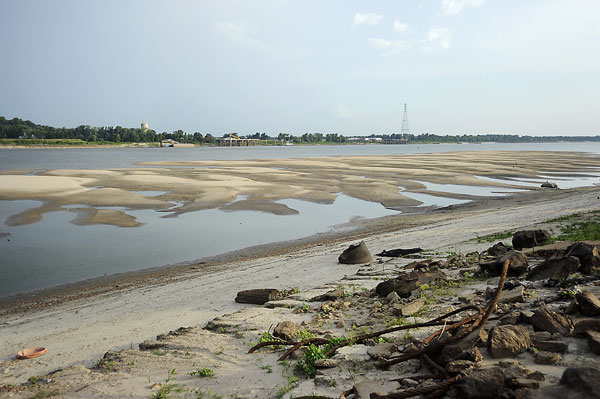
Parts of the bottom of the Mississippi River appeared during the drought last summer.

Perhaps anticipating the demands of the thousands who would flock to Washington a few days later, President Obama struck an unusually combative tone in his annual address. If Congress refused to act, the president warned. then he would exercise his executive authority “to reduce pollution, prepare our communities for the consequences of climate change, and speed the transition to more sustainable sources of energy.”

It remains to be seen, of course, whether Obama will remain true to his word. But all signs indicate that he better do so, for our sake. Just one recent example: reports of a thin snowpack in the western mountains suggest that the High Plains, West, and Southwest are likely to experience a third summer of withering drought.

The National Oceanic and Atmospheric Administration’s (NOAA) latest three-month drought projections, which the agency released February 21, promises little relief. Forecasters predict that drought will continue in the Rocky Mountain and Plains states, expand throughout northern and southern California and return to most of Texas, which has suffered a severe drought since 2011.

According to USDA’s Natural Resources Conservation Service National Water and Climate Center, the February streamflow forecast predicts a decline in nearly every state and basin in the West. The winter snow season still has two months left, but “if the remaining season turns out dry, water supply conditions could end up in the 50 to 70 percent of average range.”

Those dry conditions and poor snowpack have also increased the risk that the Mississippi River could drop to levels later this year equal to or worse than last fall’s record dip, once again seriously disrupting barge traffic on the nation’s busiest waterway. According to Time magazine, if conditions do not improve soon, “the stoppage could last for months.”

We are fortunate, thanks to the abundance of water in the Finger Lakes region, not to have this kind of severe drought looming on the horizon. But we will not be unaffected by developments west of the Mississippi. One wonders what kind of national economic disaster it will take to finally force Congress to act on climate change, but perhaps the shutdown of a river that sees $180 billion of goods travel along it each year will do the trick.

Time for an Energy Policy that Makes Sense

We all know that a clear, predictable, and fair national policy encouraging investment in energy efficiency and renewable energy is the key to any real, viable solution to avoiding runaway climate change. If this is the case, then why does the overwhelming bulk of our federal tax dollars go to subsidizing the oil, coal, and gas industries and not clean energy? Why are the tax credits that support the fossil fuel industry permanent and unchallengeable? Why are the tax credits that support renewable energy temporary and constantly up for grabs?

A Shell oil platform in the Gulf of Mexico

According to a 2010 Environmental Law Institute study, the U.S. government provided $72 billion between 2002 and 2008 to the fossil fuel industry. About $54 billion of that total took the form of permanent tax credits for oil, coal, and natural gas producers. During that same period, the renewable energy industry received only $29 billion, most of it also in the form of federal tax credits. The difference is that none of the renewable energy tax credits are permanent.

Of course, as David Roberts writes in Grist, “Comparisons of direct subsidies capture only the tip of a giant iceberg – most of fossil fuels’ big advantages are invisible, beneath the surface, and entirely taken for granted.” Even a quick glance at the indirect subsidies makes clear how uneven the playing field is. External costs such as the public health toll paid for air and water pollution and the national security price of maintaining our addiction to oil amount to trillions of dollars.

Then there are the costs of climate change as superstorms such as Sandy become more frequent and violent. Early estimates of the damage from Sandy range up to $50 billion. And let’s not forget the enormous sunk costs of an infrastructure built on the assumption of cheap fossil energy: highways, suburbs, airports, and the like.

Viewed in this light, as Roberts vividly observes, shifting “from fossil fuels to renewable energy is not like going from Coke to Pepsi; it is to build a new world.” Not even Nate Silver, as good as he is, can tell us how long this new world will take to build and whether we will get far enough along in time to stave off runaway climate change. But one thing we should all be clear about: it’s long past the time to get started, and a national energy policy geared towards this future is an essential first step.

The Planet Is Not the Same

We’ve all noticed the increase in extreme weather over the last few months. Almost two-thirds of the lower 48 states are now suffering from drought conditions, the Washington Post pointed out last week. Nearly all of Iowa, Nebraska, Kansas, Missouri, and Illinois are in extreme or exceptional drought, making this the worst dry spell since the 1950s.

It’s not only been dry; the New York Times reported that the first six months of 2012 were the hottest since record keeping began in 1895. In early July, another Times article noted, the surface of Greenland’s ice sheet melted to a greater extent than ever observed in 30 years of satellite monitoring. About half of the surface of the ice sheet usually melts, but from July 8 to July 12, the ice melt reached 97 percent.

More and more people are making the connections between the extreme weather and climate change. The percentage of Americans who now believe that climate change is occurring rose to 70 percent in July, according to a University of Texas poll, and those insisting that it was not fell to 15 percent. A 2010 survey showed, in contrast, that only 52 percent of the American public thought that the climate was changing.

The following video from July 2012 shows Earth’s land surface temperature data from 1800 to 2009, tracking deviation from the mean temperature and overall global warming since the Industrial Revolution. For more information about this study visit http://berkeleyearth.org.

The story told in this video, even though it’s statistical, couldn’t be more dramatic. All one has to do is watch the spread of yellow, orange, and red across the map to understand that the planet is not the same place it was in 1800. The real question is, what are we going to do about it? In Bill McKibben’s words, “Climate change operates on a geological scale and time frame, but it’s not an impersonal force of nature; the more carefully you do the math, the more thoroughly you realize that this is, at bottom, a moral issue.”

A Question of Moral Imagination

One hundred years ago this spring the Titanic went down in the North Atlantic, taking the lives of over 1,500 people. Leaving Southampton on April 10, it set out on its maiden voyage celebrated as one of the most technologically advanced ships built to date. Sixteen watertight compartments and remotely activated doors, among other safety features, made it unsinkable, or so the engineers said. The speed with which the Titanic met its end shocked the world, and the event became an enduring symbol of technological hubris.

This same hubris can be seen in our own time as we plunge forward heedless of the damage industrial society inflicts on the biosphere that supports our very lives. The explosive growth of fossil fuel consumption that made possible such marvels as the Titanic has placed an unprecedented burden on our global climate system, pushing it to the brink of disaster. As Peter Hess writes, both the sinking of the Titanic and the accelerating threat of runaway climate change “are the result of a collision between human over-confidence and the implacable forces of nature.”

If nothing else, the story of the Titanic should warn us that climate change is more than a physical problem to be solved by technology. It is, in Malcolm Bull’s words, “an ethical problem that necessarily requires moral solutions.” The real question is not so much whether we have the ability to slow down the rate of global warming but whether we have the capacity to expand our moral imagination so that we can grasp the importance of doing so.