Two Steps Forward, One Step Back

With the Trump administration taking office on January 20, it’s become clear that efforts to stave off runaway climate change will have to focus on state and local policy.

Trump has promised to halt federal support for clean energy technology and electric vehicles, and he has pledged to withdraw the U.S. from the Paris climate accord, reverse a key regulation aimed at reducing emissions from power plants, and roll back other rules aimed at curbing climate change and air and water pollution.

Offshore wind is a crucial component of New York’s attempt to achieve 70 percent of its electricity from renewable energy by 2030. Photo by David Dixon/Walney Offshore Windfarm licensed under CC BY-SA 2.0.

Clean Energy’s Rapid Growth Continues

One bright light, though, is the fact that Trump can slow down progress, but he can’t stop the transformation of the domestic and global economies sparked by the clean energy revolution.

More than 40 percent of all global power in 2023 came from renewable sources, and investments in renewable energy are accelerating because prices have dropped dramatically. In fact, more than 80 percent of new electricity capacity around the world comes from carbon-free sources.

NY’s Leadership Role

Nonetheless, action at the state and local levels will be imperative going forward. With Gov. Kathy Hochul’s signing of the Climate Change Superfund Act, New York has taken on a leadership role that will give the state an opportunity to defy the president-elect’s attempt to reverse climate action. This new law, as explained above, will require the biggest oil and gas companies to contribute to a fund that will be used for infrastructure projects meant to protect New York residents from increasingly dangerous climate disasters like storms and sea level rise.

Another major step in the state’s climate fight took place when Hochul, at the same time, signed into law a prohibition on using carbon dioxide for fracking, closing a loophole in New York’s existing hydraulic fracturing ban (also reported above). This legislation, introduced by Assemblymember Anna Kelles in March, signals a determination to keep the fracking industry out of the state.

These two steps forward should be applauded, while at the same time recognizing the importance of continuing the push on climate action and clean energy in Albany when the state legislature opens its new session on January 8. Efforts to ensure that New York obtains 70 percent of its electricity from renewable energy by 2030, as called for by the 2019 Climate Leadership and Community Protection Act (CLCPA) are especially critical.

Expanding offshore wind, implementing congestion pricing in New York City, eliminating subsidies for new gas hookups as well as the Public Service Commission’s obligation to provide gas service, reducing state tax breaks provided to the fossil fuel industry, putting in place a true cap-and-invest program with guardrails to keep it from devolving into cap-and-trade, increasing the kinds of containers covered by the state’s bottle law, and addressing the issue of plastic packaging are just some of the ways New York can continue to strengthen its leadership role on the climate and clean energy fronts.

At the local level, we’ve seen a disappointing step backward with the continued attempt by Cornell University to install synthetic turf fields on campus. Given the recent finding that 2024 is set to become the hottest year on record, the massive rollout of plastic undertaken by Cornell at its athletic facilities is a bad look, to say the least.

Equally dismaying is the apparently superficial investigation by the city planning board as part of the approval process. The board’s negative declaration of environmental significance, precluding the need for the kind of thorough environmental impact statement (EIS) called for by Zero Waste Ithaca, is hard to fathom in light of existing scientific research outlining the harmful public health and environmental effects of synthetic turf. We can only hope that the lawsuit launched by this activist organization will result in greater transparency regarding the risks involved.
Time for New Leadership on Climate and Energy

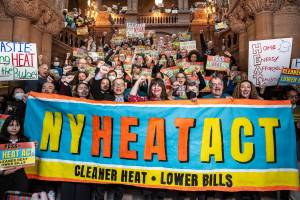
With the coming change in administration in Washington, it’s safe to say we’ll be seeing some dramatic shifts in climate and energy policy, none of which is likely to result in lower greenhouse gas emissions. Consequently, it is critical that local communities and states step in to lead the way on climate resiliency and adaptation, as well as the clean energy transition. Given the huge transformation of the political landscape at the national level, New York must move forward decisively. The biggest indication that it will do so would be if Governor Hochul signs the Climate Change Superfund Act passed at the end of the last session. This act adopts the “polluter must pay” principle. The fossil fuel industry has known for decades that its product is responsible for the climate damage we’ve experienced, and through its campaign of misinformation and outright deception it has avoided accountability. It is time for this to stop. The bill doesn’t ask Big Oil to pick up the entire tab, just a fair share of it. Taxpayers should not have to cover the entire cost of destruction caused by the fossil fuel industry. Besides the Climate Change Superfund Act, unfinished business from the last session includes the NY HEAT Act, which seeks to eliminate subsidies for new gas hookups, eliminate the “obligation to serve” gas to neighborhoods, and ensure that no low-income household would pay more than 6% of its income for energy. The NY HEAT Act passed in the Senate this year by a wide margin, but never came to a vote in the Assembly due to the controversy over congestion pricing that erupted in the final days of the session. Another big piece that needs to be put in place is the Cap and Invest Program. By applying a price to the amount of pollution, the Cap and Invest Program incentivizes consumers, businesses, and other entities to transition to lower-carbon alternatives. Assemblymember Anna Kelles (D -125th District) is the lead sponsor on a version of this program that would put in place guardrails to keep it from devolving into a vehicle for cap and trade, and would also ensure that an appropriate share of the revenue raised by the program goes to projects in frontline communities. As Kelles points out, the Climate Change Superfund Act and the Cap and Invest Program work together, with the former addressing past damage and the latter looking forward to future destruction incurred as a result of carbon pollution. Together with the NY HEAT Act, adoption of this legislation would send a strong message to Washington and the other states that progress on the climate and clean energy transition cannot be stopped.
Accountability and Climate Change in Albany

It’s that time of year in Albany when a wave of bills sweeps ashore in the New York State Legislature, among them a number of critical climate and energy transition measures.

The big question on the minds of climate and environmental activists and their legislative allies is pretty straightforward: to what extent is Governor Kathy Hochul committed to fulfilling not just the letter but the spirit of the state’s 2019 Climate Leadership and Community Protection Act (CLCPA)?

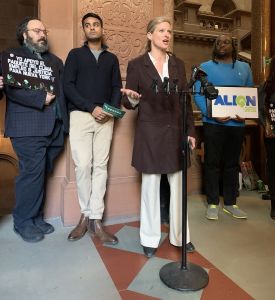
Assemblymember Anna Kelles speaking at a NY Renews rally in January. Photo courtesy of NY Renews.

Uncertainty and Anziety
Close on the heels of this question is a related issue: the State Climate Action Council has developed a substantive, thoughtful roadmap for meeting the ambitious goals of the CLCPA, but it remains unclear how energetically the governor intends to pursue it.

Feeding this sense of uncertainty are the challenges facing the rollout of utility-scale renewable energy projects in New York. As Marie French points out in a recent article, recent setbacks in developing industrial wind and solar have raised serious doubts about the state’s ability to meet the demands of the Climate Law, which requires that 70 percent of New York’s power come from renewable sources by 2030.

Finding a Solution
At the same time, extreme weather events attributable to climate change have been escalating, creating a palpable sense of urgency about the need to find a solution. As Raya Salter, a member of the Climate Action Council and founder of the Energy Justice Law and Policy Center, puts it, “The stakes are higher than ever so the governor needs to be willing to step out and make sure that we fully implement the CLCPA.”

There is certainly no shortage of suggestions about how to do this. One of the boldest set of proposals before the legislators is the Climate, Jobs, and Justice Package (CJJP) advanced by NY Renews, a coalition made up of over 370 environmental, justice, faith, labor, and community groups, including TCCPI.

The CJJP has three main components: 1) fully fund the CLCPA so that it can achieve its objectives; 2) build renewable energy for all and create green union jobs; and 3) hold polluters accountable and ensure everyone pays their fair share in taxes. Here are the details about how this would be accomplished:

  • The People’s Climate Justice Budget is a $1 billion spending plan that outlines critical climate and environmental justice programs that would constitute a downpayment on the more than $10 billion a year the state estimates is necessary to address the climate crisis. It builds on the creation of the Climate Action Fund (CAF) in 2023, seizing a historic opportunity to fund projects across the state.
  • The NY HEAT (Home Energy Affordable Transition) Act would eliminate subsidies for new gas hookups (the “100-foot rule”), enable neighborhood scale building decarbonization by eliminating the “obligation to serve” gas, and ensure that no household pays more than 6% of its income for energy. The plan would also ban the construction of any new gas plants in areas where they do not already exist after September 30, 2023.
  • The Just Energy Transition Act provides a plan to guide the replacement and redevelopment of at least 4 GW of New York State’s fossil fuel facilities by 2030. It lays out a clear direction for proceeding with the transition off fossil fuels in accordance with the CLCPA requirements. Converting these facilities to renewable energy as soon as possible will generate climate and economic benefits as well as public health benefits.
  • The Climate Change Superfund Act holds major oil companies, the state’s worst climate polluters, accountable for the harm they’ve inflicted on New York between 2000 and 2018. It would require companies that have contributed significantly to the buildup of greenhouse gases to bear a share of the costs of infrastructure investments required to adapt to the impacts of climate change in the state. The program would assess the major fossil fuel emitters $3 billion annually over the span of 25 years to offset the climate damages incurred by the state.

Not included in the CJJP, but closely aligned with it, is the Stop Climate Polluter Handouts Act. Many supporters view it, in particular, as a companion bill to the Climate Superfund Act, arguing that New York shouldn’t be providing huge subsidies to an industry that is causing so much destruction. This legislation will end the most egregious state subsidies of over $330 million each year (out of an annual total of $1.6 billion) to oil and gas companies.

These are just a few of the bills under consideration in Albany. Efforts to ensure that the Cap-and-Invest program doesn’t devolve into a cap-and-trade shell game; to make the fashion industry more transparent when it comes to supply chains, carbon emissions, and labor conditions; to reduce plastic packaging and modernize the bottle bill; and to push the governor and legislature to figure out how state facilities in downtown Albany, including the Empire State Plaza and State Capitol, could receive their electric power and heating and cooling from 100% renewable energy are all crucial ways in which New York can demonstrate its seriousness about fulfilling the vision of the CLCPA.

As Raya Salter contends, “the stakes are higher than ever.” The governor and legislature need to demonstrate the vision and leadership that act on this understanding, and it’s up to the rest of us to hold their feet to the fire. TCCPI will be right there with our allies in the climate and energy transition movement, making sure that our representatives feel the heat and act accordingly.

Time to Rein in the Cargill Salt Mine

Cayuga Lake is one of our community’s most precious natural assets. Not only does it offer a large array of recreational opportunities, but it also provides the drinking water for over 100,000 people. As global warming accelerates and fresh water sources become increasingly scarce, we are fortunate to have such a plentiful resource available. In addition, as Assemblymember Anna Kelles points out, the $3-billion-dollar local agritourism economy, which employs 60,000 people, depends on the lake. Continue reading

Cryptocurrency Mining and Climate Change

When political leaders demonstrate the courage of their convictions, it’s immediately evident. Perhaps it’s because the authenticity shines through the usual political fog so brightly. All pretense drops, the language becomes direct and straightforward, and the clear meaning of their words rings out.

The most striking example recently of such leadership, one that has been both inspiring and breathtaking, is that of President Volodymyr Zelensky. He has not shied away from acknowledging the immense military odds stacked against Ukraine or downplayed the difficulty ordinary Ukrainians face. He has invoked a deep sense of common purpose and brought his country together.

Kathy Hochul sworn in as the 57th governor of New York. Photo by NY Senate licensed under CC BY 2.0.

In a different way and at a very different level, NY Gov. Kathy Hochul has a similar opportunity to demonstrate the courage of her convictions. The Climate Leadership and Community Protection Act (CLCPA), signed into law in 2019, laid out aggressive benchmarks for New York to reduce its carbon emissions. Gov. Hochul has emphatically expressed her support for the CLCPA, proclaiming in her recent State of the State address that climate change is “a threat to our way of life, here and now.” She boldly called for a ban on the use of natural gas in new construction after 2027, the rapid development of offshore wind, and the phasing out of peaker plants—only used when excess energy is needed by the grid—as well as older fossil-fuel power plants.

Another closely related issue offers Hochul a similar chance to display bold leadership: imposing a statewide moratorium on proof-of-work bitcoin mining, a practice that poses a profound threat to the climate. Assemblymember Anna Kelles has introduced a bill that would place a three-year moratorium on proof-of-work cryptocurrency mining. The bill is currently making its way through the legislative process and has gained the support of 41 co-sponsors and 15 key committee chairs in the Assembly.

So far the governor has said very little about bitcoin mining, its environmental impact, or whether she supports a moratorium. It’s time she stepped forward.

Why is this action so critical?

Proof-of-work cryptocurrency mining consumes a tremendous amount of energy to operate the multiple, high-powered computers that validate the exchange of bitcoins as well as the cooling technology needed to keep the machines from overheating. In fact, a Cambridge University study concluded that bitcoin mining uses more electricity annually than the entire country of Argentina.

What is especially galling is that proof-of-work is only one way to mine cryptocurrency. “Proof-of-stake, another popular method, uses far less energy,” points out Yvonne Taylor, co-founder and vice president of Seneca Lake Guardian. But, she notes, proof-of-work’s energy use in the U.S. has grown 320% in just the past five years. New York, moreover, hosts nearly 20% of that.

Thanks to the work of Taylor and other environmentalists, attention in New York has focused on Greenidge Generation, a recently revived operation located on Seneca Lake. Formerly a coal-fired power station, it turned to natural gas when it reopened its doors. Originally intended to be a peaker plant, no one knew it would become a private bitcoin mining operation that ran 24 hours a day, 7 days a week.

Greenidge’s Title V air permit is currently up for renewal, as discussed in our last issue. The decision on the renewal was due Jan. 31 but has been postponed to March 31 so that the state Department of Environmental Conservation (DEC) could “complete its ongoing review” of about 4,000 public comments on the case. As Peter Mantius reports, however, the delay provides Greenidge with the ability to expand its operations.

Under the CLCPA, the state is required to reduce its greenhouse gas emissions 40% by 2030. The importance of doing so was underscored by today’s release of a report from the UN’s Intergovernmental Panel on Climate Change (IPCC) warning that the pace of global warming threatens to overcome our ability to adapt to it. Greenidge is just one of many fossil-fuel power plants retired in upstate New York that could potentially be reopened for proof-of-work cryptocurrency mining; the possibility of Cayuga Power Plant going down this road punctuates the point.

If the bitcoin mining industry is allowed to continue growing without any oversight or regulation, the ability to achieve the CLCPA goals will be put in serious jeopardy. For the governor to be true to her word that climate change is a threat to our way of life, it’s clear what her next move must be: declare a moratorium on bitcoin mining.