Time to Move Forward on Cap-and-Invest

Last year saw a string of costly extreme weather events fueled by climate change across New York, including record rainfall, flash flooding, and tornadoes in upstate communities. This past August Tropical Storm Debby’s remnants caused flash flooding and widespread damage in the Finger Lakes.

These events altogether caused over $1 billion in damages in New York in 2024. In the face of escalating costs, by implementing a good cap-and-invest system, the state has an important opportunity to bring in much-needed funds to pay for climate damage going forward, while also reducing emissions from major polluters.
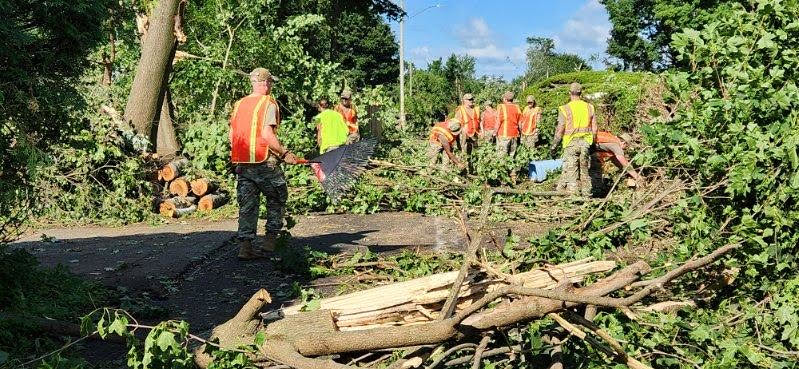
New York Air Guard Airmen help clear debris in Rome, NY following tornado in July 2024. The state National Guard activated 60 soldiers and airmen to help clear debris in the city. Courtesy photo by Major Ryan Marquette.

A Strong Cap-and Invest Program Needed

A strong cap-and-invest program will impose limits on the amount of emissions allowed by polluters and charge them to do so. With those funds, New York can more seriously invest in upgrades to homes to make them more energy efficient and run on clean, renewable energy while also boosting our local economy.

These measures will be especially important as residents absorb the costly increases in energy charged by NYSEG and other state utilities.

The Time for Delay is Over

Cap-and-invest is critical to meeting the targets of the state’s Climate Law. It also ensures New York can provide the level of investment necessary to make energy affordable while also boosting our economy.

Done the right way, Gov. Kathy Hochul, the DEC, and NYSERDA can lead New York into a new year that makes corporate polluters pay. At the same time, cap-and-invest could unlock billions of dollars for investments that drive sustainable economic development, increase energy efficiency, improve public health, and direct funds into neighborhoods to support community-led clean energy transitions.

Unfortunately, while draft regulations were originally due to be issued by now, with revenue beginning to flow by later in the year, Gov. Hochul recently announced that draft regulations won’t be issued until the end of 2025, and even then it appears these will only be partial.

Gov. Hochul’s delay in rolling out the program’s regulations ignores the urgency of the moment: the climate emergency has arrived and we must deal with it immediately. By continuing to stall, the governor increases the burden on disadvantaged communities, worsens harmful emissions, and allows polluters to go unchecked.

The governor first promised the cap-and-invest program over two years ago as the foundation of New York’s climate strategy. Now it appears that instead of promised regulations, we will see at least another year of delays. This move is part and parcel of a growing legacy of inaction and broken commitments on the most urgent crisis of our time.

We need leaders in Albany who are willing to take bold, decisive action to cut air pollution and lower greenhouse gas emissions. It is time to push for faster action from Gov. Hochul. Especially with a new administration in Washington actively hostile to climate policy, and with the state’s utility rates skyrocketing, it is critical that the cap-and-invest program be implemented as soon as possible.

In doing so, we can protect the residents of Ithaca and Tompkins County, as well as future generations, from the most harmful effects of the climate crisis.

Covid-19, Species Collapse, and the Climate Emergency

In the midst of the Covid-19 pandemic comes word that the collapse of thousands of wildlife species sparked by the climate crisis could take place as early as the next decade if greenhouse gas emissions are not dramatically reduced. Just as unsettling: this collapse wouldn’t happen in a long, slow slide, but rather would be far more abrupt than previously thought.

As Alex Pigot, a scientist at University College London and co-author, told a New York Times reporter, “For a long time things can seem OK and then suddenly they’re not. Then, it’s too late to do anything about it because you’ve already fallen over this cliff edge.”

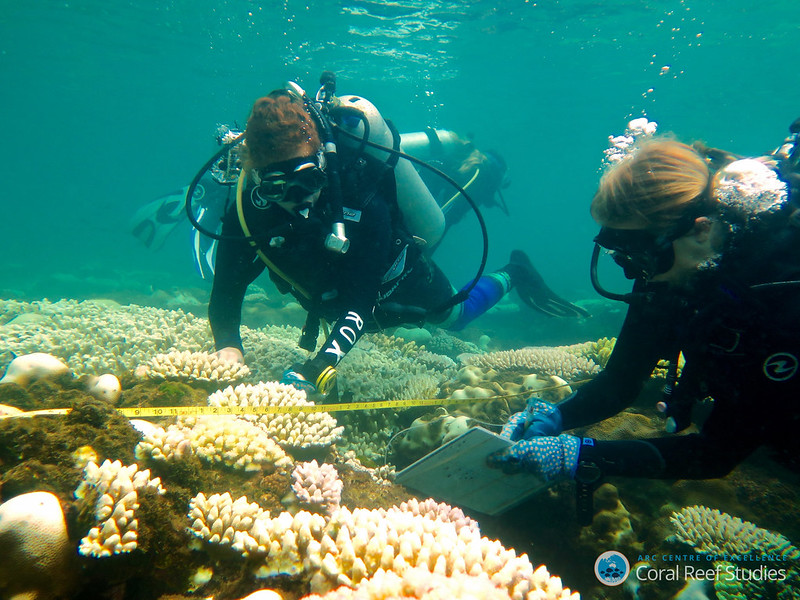
Recent coral bleaching events suggest that ecosystem collapse in tropical oceans may already be underway. Photo by ARC Centre of Excellence licensed under CC BY-ND 2.0.

The study, published in Nature earlier this month, examined more than 30,000 species on land and in water to determine when climate change would dramatically reduce population levels and what the pace of those changes would be. The scientists identified the hottest temperature that a species is known to have survived and then projected when that temperature would be reached under different emissions scenarios.

The bad news? Abrupt collapse of tropical ocean ecosystems could begin “before 2030” and “spread to tropical forests and higher latitudes by 2050” at the current rate of emissions. On the other hand, if global warming stays below 2 degrees C, the number of species endangered would decline by 60 percent and the number of ecosystems exposed to catastrophic collapse would be limited to less than 2 percent.

The benefits of what one of the researchers called “early and rapid action” on limiting greenhouse gas emissions could hardly be clearer. The extinction of vast swaths of species upon which human survival depends would be avoided, although many people and species would still be vulnerable.

If you see a parallel here to the coronavirus crisis, you’re not alone. Early and rapid action, where it has taken place, has saved thousands of lives. But in those parts of the world that waited too long, once the infections took hold and multiplied  exponentially, it was too late and disaster ensued

So what will it be? Do we take the necessary steps now and prevent the collapse of the ecosystems that keep us alive or do we continue to avoid making the hard decisions and fall off the cliff edge? It’s a stark and unavoidable choice. The one positive thing that could come from the current pandemic, an event that has taken nearly 165,000 lives so far and inflicted widespread economic suffering, would be the wisdom sufficient to make the right choice about the future of our planet.

Greenland and the Climate Emergency

One of the signature features of our times is the dramatic disconnect between the speed with which the climate emergency is unfurling, on the one hand, and our ability to integrate this reality into our day-to-day life, on the other. In an article earlier this summer, David Wallace-Wells, the author of The Uninhabitable Earth: Life After Warming (2019), reflected on what he called the “phenomenon of cascading climate impacts.”

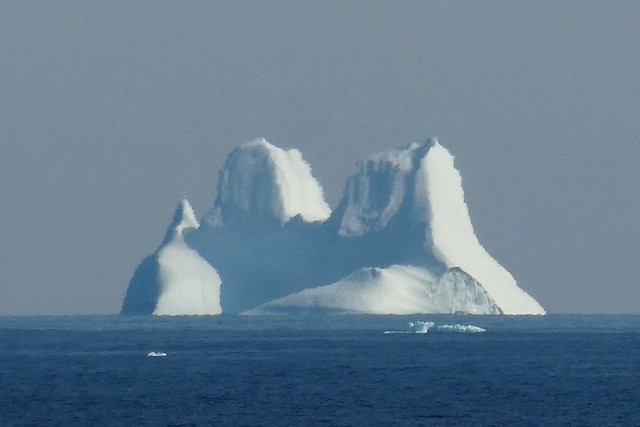
An iceberg off the Greenland coast this summer. Photo by Harry and Rowena Kennedy licensed under CC BY-NC-ND 2.0.

“How many natural disasters does it take to qualify as biblical, or apocalyptic, or at least to make us understand that we are living not through a bad week, or a bad year, but an unraveling climate system in which so much of what we take for granted as permanent features of the built environment may be turned into flotsam and jetsam by unprecedented weather?” he asked.

His haunting question came to mind this month as I read one report after another about the record ice melt in Greenland. Scientists estimate that by the end of the summer something like 440 billion tons of ice will have melted or calved off Greenland’s giant ice sheet.

In just five days from July 31 to August 3, more than 58 billion tons melted from the surface of the world’s largest island, 40 billion tons more than average for this time of year. That’s not taking into account the huge ice chunks breaking off into the ocean or warm water attacking the glaciers from below.

Just since the 1990s, Greenland’s rate of ice loss has increased from 41 gigatons per year to 286 gigatons per year during the period from 2010 to 2018. A recent study found that, if greenhouse gas emissions are not cut significantly in the next decade or two, Greenland could contribute up to two feet of global sea level rise by 2100.

How does one even begin to comprehend the enormity of this catastrophe?

Wallace-Wells suggests that our capacity for denial and compartmentalization may be such that we actually never come to grips with what we are doing and the threat that it poses to our very existence. Instead, we simply incorporate each new horrifying event into a “new normal” and move on. Even more disconcerting, Wallace-Wells thinks we may begin to find ourselves normalizing ” clear and terrifying patterns,” not just single instances of extreme weather events and climate disasters such as the India heat wave in June or the vast, ongoing fires in the Amazon.

At that point, obviously, our doom will be sealed. We must do everything possible, then, to keep reminding ourselves that nothing about what is happening to our climate and its impacts is normal. We must keep talking with each other and finding ways to act collectively that push back against any of this from becoming normal.

As Greta Thunberg, the 16-year-old activist who has called for a global climate strike on September 20, reminds us, ” Yes, we are failing, but there is still time to turn everything around. We can still fix this.”