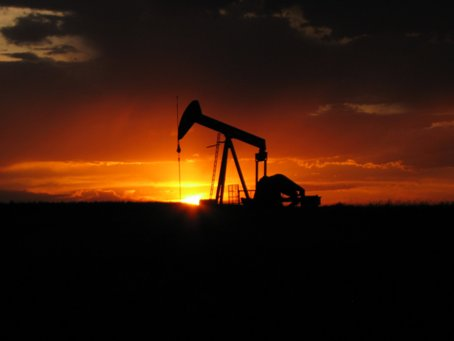
Why are NY Taxpayers Subsidizing Big Oil & Gas in this Day & Age?

New York State currently subsidizes the fossil fuel industry by exempting it from paying $1.6 billion of Sales & Use Taxes and Petroleum Business Taxes every year. When I first learned of these subsidies, I was astonished. How could New York, which established some of the most aggressive targets in the nation for reducing greenhouse emissions in its climate law of 2019, still be handing out taxpayer dollars to businesses that continue to pump more of these emissions into the atmosphere?

Besides this obvious reason for taking a good, hard look at the subsidies, there are at least two more reasons why they no longer make any sense. First, the fossil fuel industry has been making enormous profits in recent years. In 2023, the global oil and gas industry earned a record income of more than $2.7 trillion, while they invested just 4% of capital expenditure on clean energy. Clearly, big oil and gas no longer need to be supported by these tax breaks, especially when they are turning around and investing so little in clean energy.

Second, New York passed the Climate Change Superfund Act last year in an effort to hold the fossil fuel industry accountable for the damage that its reckless business practices inflicted on the state. In other words, we are handing out subsidies to the same industry that we have just decided to impose stiff penalties on for its destructive behavior.

The Stop Climate Polluter Handouts Act (S3389/A7949), currently being considered by the state legislature, seeks to pull back on the incentives that benefit the most highly polluting fuels and their most unreasonable uses, including high-emission commercial airline fuel and low-grade shipping “bunker” fuel, the operation of fracked gas infrastructure, industry research and development, and more.

The bill targets fossil fuel corporations’ most egregious actions and protects ordinary New Yorkers by preserving some tax breaks that benefit the public such as the home heating credit for low and middle-income households and an agricultural exemption that helps small- to mid-sized farmers. In total, the legislation would end over $330 million in fossil fuel subsidies. At a time when Washington is taking steps to make huge cuts in the federal budget, cuts that would be extremely damaging to New York, the bill would also help to close the state’s budget deficit.

In short, the Stop Climate Polluter Handouts Act is a commonsense bill, raising revenue for the state while aligning state spending with New York’s 2018 climate law targets and holding fossil fuel companies accountable to pay the taxes from which they have been exempted for decades. There are only a few days left in this year’s legislative session, so time is running out. The legislature needs to move quickly to approve this measure and send it on to Gov. Hochul for her signature.

NYS Moves Closer to Banning Gas in New Buildings

To say the least, there’s not a lot of good news these days regarding efforts in the U.S. to reduce greenhouse gas emissions. So we should make a point of highlighting what positive news there is to avoid falling into despair.

On Feb. 28, New York state took an important step to ban fossil fuels in new buildings when the State Fire Prevention and Building Code Council voted to recommend major updates to the state’s building code, including rules requiring most new buildings to be all electric starting in 2026, as mandated by a law passed two years ago.The law bans fossil fuel combustion in most new buildings under seven stories starting in 2026, with larger buildings covered starting in 2029.
Environmentalists and climate activists breathed a sign of relief following the state council’s approval given that the state council had cancelled meetings twice in recent months, leaving some supporters concerned that the state might be backing away from the gas ban. With the rules now released for public comment, New York looks to be the first state to implement such a ban.

Buildings are New York’s largest source of emissions, amounting to nearly one-third of all climate pollution. In fact, according to the national clean energy nonprofit RMI, New York’s buildings burn more fossil fuels for heat and hot water than any other state, contributing not only to global warming but also to local air pollution that poses serious public health problems.

Although the proposed new codes do not delay the ban on fossil fuels, they fail to include mandates to require EV charging infrastructure, energy storage, and solar at new buildings. The state’s 2022 climate plan listed these three provisions as “key strategies” to achieve New York’s legally binding emissions targets.

Not surprisingly, the fossil fuel industry fought at every level against these changes in the buildings codes. Industry trade groups, in particular, led a major campaign to keep provisions such as the EV-charging requirement out of the national building code that provides a model for states, including New York.

Despite these shortcomings, the key development is that the NYS Building Council has backed the ban on fossil fuels in new construction. That’s a victory worth celebrating.

A Failure of Leadership at the Capitol

When the state’s final budget was released earlier this month, not a single major climate bill was included. No Climate Change Superfund Act, no NY HEAT Act, no Stop Climate Polluter Handouts Act.

It was a shocking development in light of the state’s supposed commitment to achieving an 85% reduction in greenhouse gas emissions by 2050. That’s what New York State’s 2019 Climate Leadership and Community Protection Act (CLCPA) requires, but you’d never know it flipping though the pages of this year’s budget book.

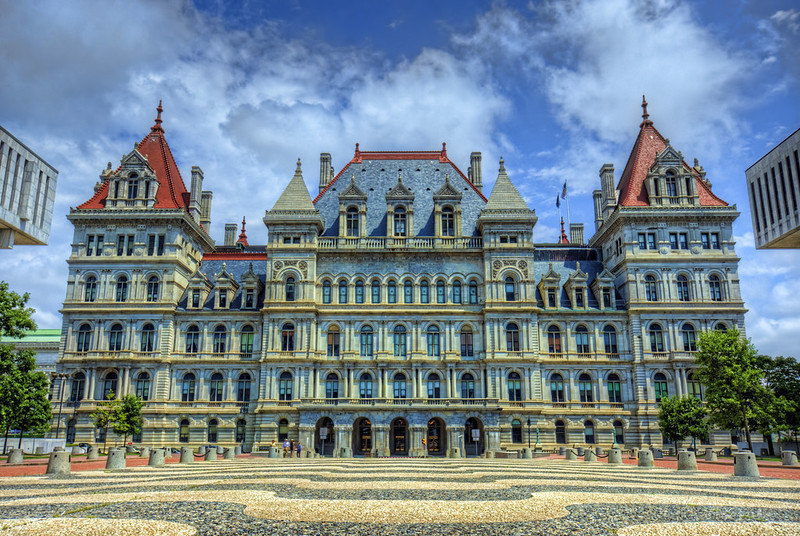
The New York State Capitol in Albany. Photo by Craig Fildes licensed under CC BY-NC-ND 2.0 DEED.

The operative word in the title of the CLCPA is “leadership.” It was hard to discern any of that, however, when it came to Gov. Hochul and the legislature, especially the General Assembly. Instead, anxiety about the upcoming elections prevailed and Democrats took the safe way out. It was a sad day in Albany and there was little to celebrate when Earth Day occurred a few days later.

The Fossil Fuel Industry Betrayal

It was bad enough when we found out this past January that the fossil fuel industry had more than enough evidence as early as 1954 to understand the impact of greenhouse gas emissions on the climate. But then word came today, with the release of internal documents, that Big Oil lobbied against climate policies that they claimed to support. The betrayal was complete.

“For decades, the fossil-fuel industry has known about the economic and climate harms of its products,” declared Sen. Sheldon Whitehouse (D-RI) “but [it] has deceived the American public to keep collecting more than $600bn each year in subsidies while raking in record-breaking profits.”

Where Do We Go From Here?

In the context of these larger national events, the fact that oil and gas companies were a major factor in pressuring state legislators to forego climate legislation in this year’s budget is especially galling. All three major bills directly confront the oil and gas firms. The NY HEAT Act seeks to eliminate subsidies for new gas hookups, eliminate the “obligation to serve” gas to neighborhoods, and ensure that no low-income household would pay more than 6% of its income for energy.

The Climate Change Superfund Act holds major oil companies accountable for the harm they inflicted on New York between 2000 and 2018. It would require these companies to bear a share of the costs of infrastructure investments required to adapt to the impacts of climate change in the state. The program would assess the major fossil fuel emitters $3 billion annually over the span of 25 years to offset the climate damages incurred by the state.

The Stop Climate Polluter Handouts Act aims at paring back the $1.6 billion taxpayers hand out each year to the oil and gas companies in tax subsidies and other breaks. It defies logic that the state continues to provide huge subsidies to an industry that is causing so much destruction. This bill would end the most egregious state subsidies, amounting to $265 million annually.

The fight to secure the passage of these three bills is far from over. Even though the budget has been set, the legislature still has until June 1 to gain their approval. This is clearly the tougher road but climate movement activists across the state, including TCCPI, are gearing up to push even harder over the next four weeks for this legislation to become law. It’s time to roll up our sleeves and get to work!


Success and Failure at COP28

The expectations for COP28, given the track record of recent U.N. climate conferences, were low. Held in Dubai earlier this month, it appeared from the outset to be a captive of the global fossil fuel industry. About 2,400 people connected to the coal, oil and gas industries, an all-time high, registered for COP28. As the dust settled following the talks, however, a mixed picture emerged, one with a few important achievements alongside some notable failures.

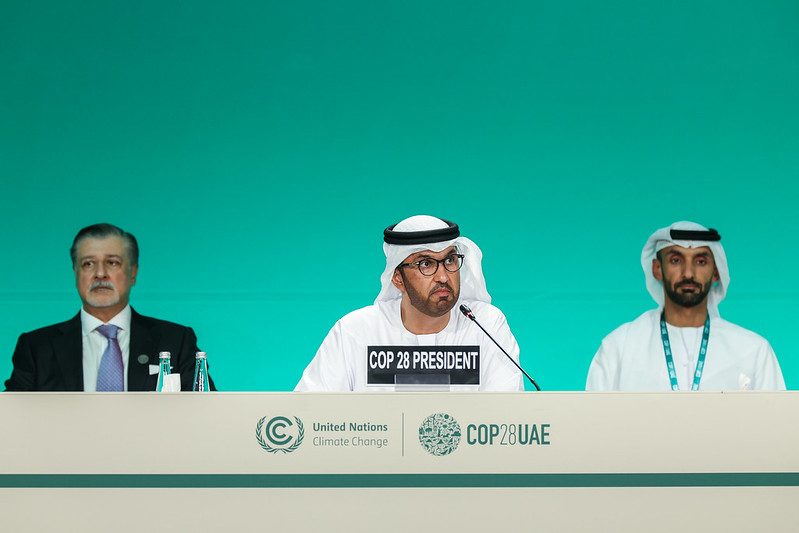
The president of the summit, Sultan Ahmed al-Jaber (center), is chief executive of the state-owned Abu Dhabi National Oil Company. Photo by UNclimatechange licensed under CC BY NC-SA 2.0 DEED.

Significant Achievements

  • Loss and Damage Fund: The Loss and Damage Fund, dedicated to aiding vulnerable nations already grappling with the devastating consequences of climate change, marked an historic breakthrough. It acknowledges the responsibility of developed nations and their obligation to support those on the frontline of the crisis.
  • Fossil Fuel: For the first time, a COP agreement explicitly called for “transitioning away from fossil fuels.” The pact represented a compromise and is not legally binding, but it should signal to investors and policymakers that a turning point has been reached.
  • Methane Mitigation: Recognizing methane’s potent warming effect, COP28 implemented several measures to buttress COP26’s Global Methane Pledge, aimed at reducing anthropogenic methane emissions by 30% by 2030. The U.S. and European Union put in place new regulations and oil and gas producers announced new pledges to curb methane emissions. The latter commitments, though, were strictly voluntary.
  • Adaptation: Adaptation received increased attention, with targets established on water security, ecosystem restoration, and health. By 2025, all countries must have in place a detailed plan to adapt to the current and future impacts of climate change in their countries, and must demonstrate progress in implementing such a plan by 2030.
  • Financial Commitments: Data published in the run up to COP28 indicated that developed countries finally fulfilled their long overdue promise to provide $100 billion in 2022 to help poorer countries deal with climate change. In addition, initial contributions of $429 million to the Loss and Damage Fund reinforced this acknowledgement of financial responsibility.

Critical Failures

Despite these achievements, COP28 fell short in several critical areas:

  • Ambition Gap: The agreed-upon measures are insufficient to limit warming to 1.5°C. The “carbon budget” for 1.5°C will be exhausted in around five years at current levels of emissions. Developed nations need to significantly ramp up their ambition and action.
  • Fossil Fuel Loophole: The language about the need to transition away from fossil fuels stopped short of calling for a “phase out,” leaving room for interpretation and potential loopholes. Fossil fuel interests will continue to exert undue influence, hindering a definitive shift towards clean energy.
  • Finance Shortfall: While the $100 billion target for 2022 was finally met, it barely scratches the surface of the actual need. Adaptation finance remains “woefully inadequate,” leaving developing nations struggling to cope with climate impacts.
  • Equity and Justice: The voices of developing nations and marginalized communities were largely ignored at COP28. The principle of “common but differentiated responsibilities” remains unrealized, with historical polluters failing to take commensurate action.
  • Human Rights Concerns: Hosting COP28 in Dubai, with its record of widespread human rights violations, raised concerns about silencing dissent and hindering meaningful participation.

The Road Ahead

COP28’s mixed bag leaves the world at a crossroads. While the achievements offer a glimmer of hope, the failures highlight the urgency of the moment. Here are some key takeaways for the road ahead:

  • Increased Ambition: Developed nations must significantly ratchet up their emissions reduction targets and concretely implement their commitments.
  • Just Transition: A just and equitable transition away from fossil fuels is crucial. Investments must prioritize vulnerable communities and support workers in high-carbon industries towards alternative livelihoods.
  • Enhanced Finance: Developed nations must scale up adaptation funding and fulfill their responsibility to support the most vulnerable.
  • Amplifying Marginalized Voices: The voices of developing nations, Indigenous communities, and other marginalized groups must be heard and acted upon. Inclusive decision-making is essential for effective climate action.
  • Holding Polluters Accountable: Developed nations, historically responsible for most emissions, must take ownership of their role and provide adequate financial and technological support to developing nations.

Clearly, COP28 did not deliver the transformational change needed, but it did offer some signs of progress as well as stepping stones for future action. The time for incremental steps, though, is over. The window of opportunity is closing and we must move quickly if we hope to avoid the onset of runaway climate change. Finally, if nothing else, the climate talks underscored the importance of local climate action for generating tangible results.

Climate Action & the NY Fossil Fuel Industry

The 2023 session of the New York state legislature is well underway at this point, and a flurry of important climate and clean energy bills have been introduced in the General Assembly and State Senate. Following the recent release of the state plan approved by the Climate Action Council, as required by the 2019 Climate Leadership and Community Protection Act (CLCPA), lawmakers are seeking ways to buttress its recommendations.

State legislators welcome Gov. Hochul for her 2023 State of the State address. Photo courtesy of NYS Senate Media Services licensed under CC By 2.0.

Given the potential of the various proposals to accelerate an equitable energy transition, it’s not surprising they have stirred up opposition and anxieties. In particular, the fossil fuel industry has mounted an aggressive lobbying campaign to undermine these far-reaching efforts and hamper the ability of the state to meet its climate targets.

A recent report issued by the nonprofit Public Accountability Initiative lays out in great detail the attempts of the industry to obstruct climate action in New York. It points out that millions of dollars have been spent by the industry and its supporters “to delay, water down and otherwise frustrate the implementation of the CLCPA and other key climate legislation.”

“Legislators, communities and other stakeholders invested in a cleaner, greener, decarbonized future for New York must stay vigilant around efforts by the fossil fuel industry to muzzle and erode” the state’s climate actions, the report warns.

Not only are the oil and gas industry representatives engaging in aggressive inside lobbying of legislators in Albany, they are working hand in hand with gas utilities to disseminate misinformation among the general public, muddying the waters and generating unwarranted fears. Deploying online ads and robocalls, they are raising the prospect of “power outages and cost increases.” “We need all energy options to keep the lights on and heat flowing,” they misleadingly claim.

The fossil fuel companies have been mobilizing their customers to contact state lawmakers and express their opposition to building electrification. What’s especially galling is that New York State hands out about $1.5 billion each year in tax subsidies to these companies, which are then turning around and spending a significant portion of the dollars to fund their misinformation and lobbying machine.

There is hope, however, that this time the industry will not be as effective as it has been in the past at stopping crucial climate action. Rich Schrader, New York State policy director at the Natural Resources Defense Council, notes that the oil and gas groups engaged in these tactics last year and have now lost the element of surprise. In addition, the advantages of new technologies such as cold-weather heat pumps have come into sharper focus.

“The politics have changed, information has changed, and the [federal] incentives are much clearer now,” he observes. “All that weighs against their propaganda.”

Time for an Energy Policy that Makes Sense

We all know that a clear, predictable, and fair national policy encouraging investment in energy efficiency and renewable energy is the key to any real, viable solution to avoiding runaway climate change. If this is the case, then why does the overwhelming bulk of our federal tax dollars go to subsidizing the oil, coal, and gas industries and not clean energy? Why are the tax credits that support the fossil fuel industry permanent and unchallengeable? Why are the tax credits that support renewable energy temporary and constantly up for grabs?

A Shell oil platform in the Gulf of Mexico

According to a 2010 Environmental Law Institute study, the U.S. government provided $72 billion between 2002 and 2008 to the fossil fuel industry. About $54 billion of that total took the form of permanent tax credits for oil, coal, and natural gas producers. During that same period, the renewable energy industry received only $29 billion, most of it also in the form of federal tax credits. The difference is that none of the renewable energy tax credits are permanent.

Of course, as David Roberts writes in Grist, “Comparisons of direct subsidies capture only the tip of a giant iceberg – most of fossil fuels’ big advantages are invisible, beneath the surface, and entirely taken for granted.” Even a quick glance at the indirect subsidies makes clear how uneven the playing field is. External costs such as the public health toll paid for air and water pollution and the national security price of maintaining our addiction to oil amount to trillions of dollars.

Then there are the costs of climate change as superstorms such as Sandy become more frequent and violent. Early estimates of the damage from Sandy range up to $50 billion. And let’s not forget the enormous sunk costs of an infrastructure built on the assumption of cheap fossil energy: highways, suburbs, airports, and the like.

Viewed in this light, as Roberts vividly observes, shifting “from fossil fuels to renewable energy is not like going from Coke to Pepsi; it is to build a new world.” Not even Nate Silver, as good as he is, can tell us how long this new world will take to build and whether we will get far enough along in time to stave off runaway climate change. But one thing we should all be clear about: it’s long past the time to get started, and a national energy policy geared towards this future is an essential first step.