A Victory (for now) on the NYS Climate Action Front

There is so little good news in the world these days, especially regarding the climate crisis, that it’s worth paying attention when some comes along. Not just happy, greeting card talk, but substantive, positive developments.

Well, there was good news last Friday (October 24) and it’s worth focusing on. A state supreme court judge ruled that New York is violating its own 2019 climate law, the Climate Leadership and Community Protection Act (CLCPA).

CLCPA Mandates

How can this possibly be good news?

Here’s why: it’s been clear for months now that Governor Hochul and her administration have been working hard at slow-walking the effort to to implement the CLCPA. This law mandated – not suggested, recommended, or advised, but legally stipulated – the following climate and clean energy targets: a 40% reduction in greenhouse gases by 2030; an 85% reduction in greenhouse gases by 2050; and 70% renewable electricity by 2030; and 100% carbon-free electricity by 2040.

Cap and Trade Rules

Under the law, the State Department of Environmental Conservation (DEC) had until the start of 2024 to issue regulations that would “ensure” New York met its binding greenhouse gas emissions targets. A year and a half later, no such regulations had been issued.

Behind the scenes, the DEC and NYSERDA had apparently completed draft rules at the beginning of this year for cap and invest, the emissions program that is critical to theimplementation of the climate law. But the governor, instead of releasing these rules for public comment, pulled the plug on them.

In response, Citizen Action of New York, PUSH Buffalo, Sierra Club, and WE ACT for Environmental Justice filed suit in March. In his decision Judge Julian Schreibman gave the DEC until February 6 to issue the cap and trade regulations. “While DEC notes that it has taken other, commendable regulatory steps to reduce greenhouse gas emissions,” the judge said, “it candidly concedes that the impact of those regulations would fall far short” of the targets set out in the climate law.

Echoing Governor Hochul’s concerns about cap and trade, the DEC argued in court that issuing the regulations was “infeasible” because it “would require imposing extraordinary and damaging costs upon New Yorkers.”Judge Schreibman, to his credit, dismissed that argument. “It is undoubtedly true that the task placed before the DEC is very complicated indeed,” he observed. “But as a legal argument, this is unavailing.”

Two Paths

The judge said there were two paths ahead: the DEC can release regulations to meet the requirements of the law or the legislature can change the law. Of course, the DEC could also appeal the decision, which would lead the case to drag on for months longer, if not more. The DEC would only say that it was reviewing the decision.

Governor Hochul took a less ambiguous position on the decision, indicating that she was considering the possibility of pushing the state legislature to change the CLCPA.

NY Renews, a statewide climate justice coalition, spoke out in strong opposition to this possibility. In its words, “changing the climate law would be a massive step in the wrong direction, allowing polluters across New York to proceed with business as usual, unfettered and unchecked, and condemning us to an ever-worsening climate crisis.”

As if on cue, Hurricane Melissa roared through the Caribbean, leaving a trail of death and massive destruction in its wake. One of the strongest hurricanes on record, Melissa slammed into Jamaica on October 28 with winds of 185 mph. Closer to home, New York City suffered extensive flooding and at least two deaths on October 30 as rainfall broke 100-year records and submerged streets and subways.

The message couldn’t be clearer: the climate crisis isn’t going away and, in fact, will only get worse. Those of us who recognize this likelihood must hold the governor and state legislators accountable during the next session beginning in January, making sure that any efforts to weaken the climate law are defeated.

The New York Draft Energy Plan Falls Woefully Short

It wasn’t that long ago New York achieved national prominence for its ambitious renewable energy push. But with NYSERDA’s recent release of its draft energy plan state officials are openly acknowledging that New York will fail to meet the clean energy targets mandated by the Climate Leadership and Community Protection Act of 2018. The state climate law stipulates that 70% of the energy produced in New York should be zero-emissions by 2030.

The plan recognizes the need for more renewable energy and greenhouse gas emissions reductions. To say the least, however, it sends a disappointing message by calling for continued reliance on fossil fuels as well as new investments in new natural gas pipelines and the repowering of fossil fuel plants.

The plan also concludes that New York’s goal of reaching a 40% reduction in emissions from 1990s levels by 2030 is probably not achievable. So far the state has only reduced its emissions by 10% with just five years to go.

Not surprisingly, the plan blames some of the state’s failures on the increasingly aggressive opposition to renewable energy by the Trump administration, but as environmental activists point out, the state was already behind before these attacks.

To its credit, the plan calls for accelerating the deployment of energy efficiency measures such as home weatherization and power-saving appliances. According to its projections, up to 25% of homes by 2040 will have heat pumps and over half the cars could be zero-emission vehicles.

The plan also seeks to increase solar power and battery storage, and notes that New York could increase its renewable electricity generation by 80% over the next 10 years. Of course, the Trump administration’s irrational effort to pull the plug on offshore wind casts a shadow over this possibility.

With the right kind of strong, visionary leadership, New York could accelerate its adoption of solar energy, battery storage, and geothermal energy while retiring its fossil fuel system and electrifying transportation and buildings. The key problem clearly lies with Gov. Kathy Hochul’s reluctance to meet the moment and provide such leadership.

Thousands of comments have been submitted by the public focusing on the flaws in the draft energy plan and its lack of commitment to the CLCPA. Later this year, the state will publish a final plan. Let’s hope it responds to these comments, keeping New York on the path to a renewable energy future.

Time to Move Forward on Cap-and-Invest

Last year saw a string of costly extreme weather events fueled by climate change across New York, including record rainfall, flash flooding, and tornadoes in upstate communities. This past August Tropical Storm Debby’s remnants caused flash flooding and widespread damage in the Finger Lakes.

These events altogether caused over $1 billion in damages in New York in 2024. In the face of escalating costs, by implementing a good cap-and-invest system, the state has an important opportunity to bring in much-needed funds to pay for climate damage going forward, while also reducing emissions from major polluters.

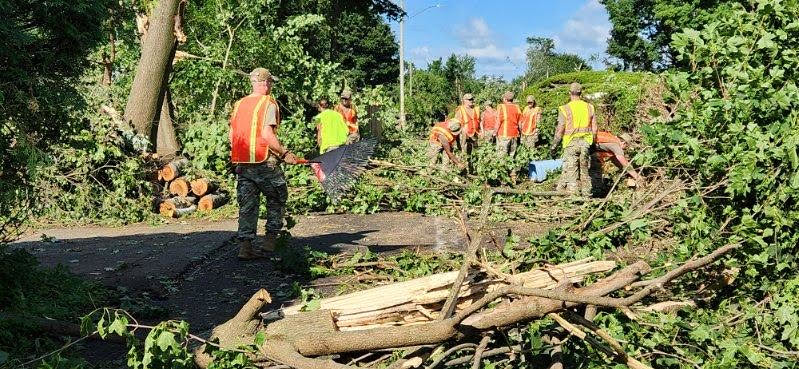
New York Air Guard Airmen help clear debris in Rome, NY following tornado in July 2024. The state National Guard activated 60 soldiers and airmen to help clear debris in the city. Courtesy photo by Major Ryan Marquette.

A Strong Cap-and Invest Program Needed

A strong cap-and-invest program will impose limits on the amount of emissions allowed by polluters and charge them to do so. With those funds, New York can more seriously invest in upgrades to homes to make them more energy efficient and run on clean, renewable energy while also boosting our local economy.

These measures will be especially important as residents absorb the costly increases in energy charged by NYSEG and other state utilities.

The Time for Delay is Over

Cap-and-invest is critical to meeting the targets of the state’s Climate Law. It also ensures New York can provide the level of investment necessary to make energy affordable while also boosting our economy.

Done the right way, Gov. Kathy Hochul, the DEC, and NYSERDA can lead New York into a new year that makes corporate polluters pay. At the same time, cap-and-invest could unlock billions of dollars for investments that drive sustainable economic development, increase energy efficiency, improve public health, and direct funds into neighborhoods to support community-led clean energy transitions.

Unfortunately, while draft regulations were originally due to be issued by now, with revenue beginning to flow by later in the year, Gov. Hochul recently announced that draft regulations won’t be issued until the end of 2025, and even then it appears these will only be partial.

Gov. Hochul’s delay in rolling out the program’s regulations ignores the urgency of the moment: the climate emergency has arrived and we must deal with it immediately. By continuing to stall, the governor increases the burden on disadvantaged communities, worsens harmful emissions, and allows polluters to go unchecked.

The governor first promised the cap-and-invest program over two years ago as the foundation of New York’s climate strategy. Now it appears that instead of promised regulations, we will see at least another year of delays. This move is part and parcel of a growing legacy of inaction and broken commitments on the most urgent crisis of our time.

We need leaders in Albany who are willing to take bold, decisive action to cut air pollution and lower greenhouse gas emissions. It is time to push for faster action from Gov. Hochul. Especially with a new administration in Washington actively hostile to climate policy, and with the state’s utility rates skyrocketing, it is critical that the cap-and-invest program be implemented as soon as possible.

In doing so, we can protect the residents of Ithaca and Tompkins County, as well as future generations, from the most harmful effects of the climate crisis.

Two Steps Forward, One Step Back

With the Trump administration taking office on January 20, it’s become clear that efforts to stave off runaway climate change will have to focus on state and local policy.

Trump has promised to halt federal support for clean energy technology and electric vehicles, and he has pledged to withdraw the U.S. from the Paris climate accord, reverse a key regulation aimed at reducing emissions from power plants, and roll back other rules aimed at curbing climate change and air and water pollution.

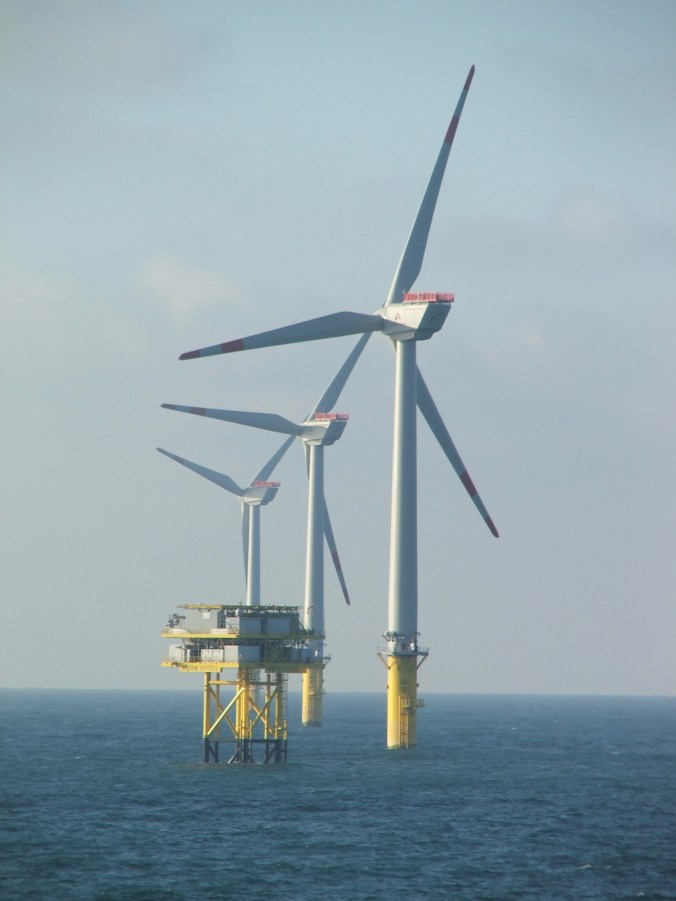
Offshore wind is a crucial component of New York’s attempt to achieve 70 percent of its electricity from renewable energy by 2030. Photo by David Dixon/Walney Offshore Windfarm licensed under CC BY-SA 2.0.

Clean Energy’s Rapid Growth Continues

One bright light, though, is the fact that Trump can slow down progress, but he can’t stop the transformation of the domestic and global economies sparked by the clean energy revolution.

More than 40 percent of all global power in 2023 came from renewable sources, and investments in renewable energy are accelerating because prices have dropped dramatically. In fact, more than 80 percent of new electricity capacity around the world comes from carbon-free sources.

NY’s Leadership Role

Nonetheless, action at the state and local levels will be imperative going forward. With Gov. Kathy Hochul’s signing of the Climate Change Superfund Act, New York has taken on a leadership role that will give the state an opportunity to defy the president-elect’s attempt to reverse climate action. This new law, as explained above, will require the biggest oil and gas companies to contribute to a fund that will be used for infrastructure projects meant to protect New York residents from increasingly dangerous climate disasters like storms and sea level rise.

Another major step in the state’s climate fight took place when Hochul, at the same time, signed into law a prohibition on using carbon dioxide for fracking, closing a loophole in New York’s existing hydraulic fracturing ban (also reported above). This legislation, introduced by Assemblymember Anna Kelles in March, signals a determination to keep the fracking industry out of the state.

These two steps forward should be applauded, while at the same time recognizing the importance of continuing the push on climate action and clean energy in Albany when the state legislature opens its new session on January 8. Efforts to ensure that New York obtains 70 percent of its electricity from renewable energy by 2030, as called for by the 2019 Climate Leadership and Community Protection Act (CLCPA) are especially critical.

Expanding offshore wind, implementing congestion pricing in New York City, eliminating subsidies for new gas hookups as well as the Public Service Commission’s obligation to provide gas service, reducing state tax breaks provided to the fossil fuel industry, putting in place a true cap-and-invest program with guardrails to keep it from devolving into cap-and-trade, increasing the kinds of containers covered by the state’s bottle law, and addressing the issue of plastic packaging are just some of the ways New York can continue to strengthen its leadership role on the climate and clean energy fronts.

At the local level, we’ve seen a disappointing step backward with the continued attempt by Cornell University to install synthetic turf fields on campus. Given the recent finding that 2024 is set to become the hottest year on record, the massive rollout of plastic undertaken by Cornell at its athletic facilities is a bad look, to say the least.

Equally dismaying is the apparently superficial investigation by the city planning board as part of the approval process. The board’s negative declaration of environmental significance, precluding the need for the kind of thorough environmental impact statement (EIS) called for by Zero Waste Ithaca, is hard to fathom in light of existing scientific research outlining the harmful public health and environmental effects of synthetic turf. We can only hope that the lawsuit launched by this activist organization will result in greater transparency regarding the risks involved.

Hurricane Beryl, the Supreme Court & Our Troubled Political Landscape

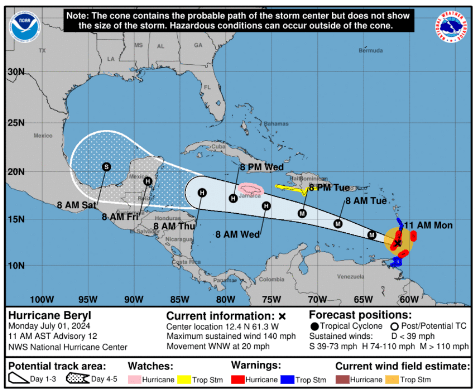
Hurricane Beryl has now become the earliest Category 5 Atlantic hurricane on record as it marches across the Caribbean, wreaking havoc to the Windward Islands. Beryl’s maximum sustained winds have reached close to 160 mph, with higher gusts, according to the National Hurricane Center.

There is strong agreement among scientists that climate breakdown has increased the occurrence of the most intense and destructive tropical storms. Warming oceans, thanks to human-caused climate change, provide more energy to fuel these storms.

Political Will Needed

Ralph Gonsalves, prime minister of St. Vincent and the Grenadines, assailed the lack of political will in the U.S. and Europe to tackle the climate breakdown as Beryl hammered his nation.

“For the major emitters of greenhouse gases, those who contribute most to global warming,” he said, “you are getting a lot of talking, but you are not seeing a lot of action—as in making money available to small-island developing states and other vulnerable countries.

“I am hopeful that what is happening—and we are quite early in the hurricane season—will alert them to our vulnerabilities, our weaknesses and encourage them to honour the commitments they have made on a range of issues, from the Paris accord to the current time.”

The Supreme Court Weighs In

Right on cue, at a time when strong climate action is clearly called for, the U.S. Supreme Court last Friday sharply reined in the power of federal agencies, overturning a forty-year legal precedent known as the Chevron doctrine, which led courts to defer to the expertise of these agencies. As a result, hundreds of environmental and climate regulations promulgated by the Environmental Protection Agency, among others in the executive branch, will be open to legal challenges.

“Rules on water quality, smokestack and tailpipe emissions, biodiversity and the effects of climate change will now be relitigated and reinterpreted by the courts,” noted Richard Martin at GreenBiz.

Closer to home, as this year’s legislative session came to a close last month, Gov. Hochul made the controversial decision to pause congestion pricing in New York City after months of preparation to put it in place. In the ensuing chaos, other bills such as the NY HEAT Act and the Packaging Reduction Act failed to get a proper hearing in the General Assembly.

It was a disheartening display of the fossil fuel industry’s ability to bend state political leaders to its will, in part due to the flood of dollars it’s been handing out this election year.

The one bright light in Albany was the last-minute passage of the Climate Change Superfund Act. As reported above, the bill would charge Big Oil companies a total of $3 billion a year for 25 years to pay for costs associated with the destruction caused by climate change.

The legislation now awaits the governor’s signature. If enacted, New York will join Vermont as the second U.S. state with a law requiring fossil-fuel companies to pick up at least a portion of the tab for the huge damage they’ve knowingly inflicted.

In the face of so much demoralizing news, climate justice and environmental groups across the state will push hard this summer to make sure the governor signs this historic bill. If she does, it will mark a significant step towards holding climate polluters accountable. But don’t count on it; only intense, sustained grassroots pressure can make it happen. So, for the sake of future generations, don’t sit on the sidelines. It’s time to turn up the heat.

NYS Drops the Ball on Climate Legislation

In a breathtaking display of political malpractice, the NYS General Assembly just adjourned the 2023-2024 legislative session in Albany without taking a vote on several crucial pieces of climate legislation.

The final days of the session turned into a brawl to rescue congestion pricing after Gov. Kathy Hochul paused the program just weeks before it was set to begin. As a result, key bills were left by the wayside.

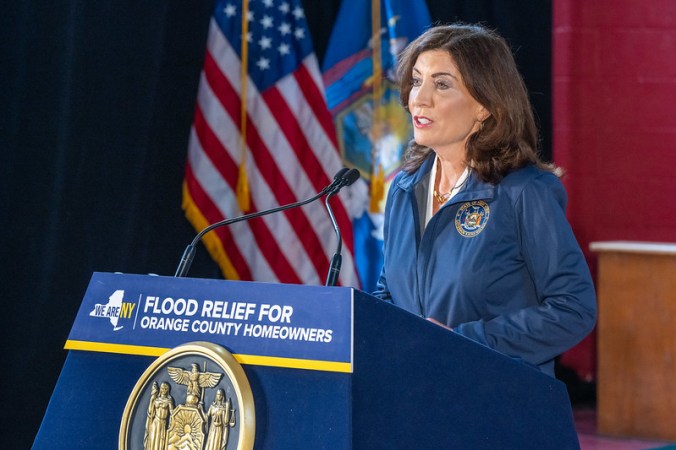
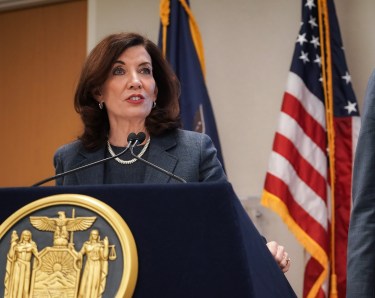
Governor Kathy Hochul. Photo credit: Darren McGee, Office of Governor.

They included the NY HEAT Act, which would stop utilities from automatically charging ratepayers for new gas lines, a measure to reduce plastic packaging, and an expanded bottle deposit law. Both the NY HEAT Act and the Packaging Reduction Act had already passed in the Senate by wide margins, and they had the backing of a majority of co-sponsors in the Assembly, but they never came to a vote.

“This is taking us backwards where we need to be to meet our climate law mandates and to protect people and save them money,” said Liz Moran, a state policy advocate at Earthjustice.

Moran pointed out that NYS lawmakers approved the Climate Leadership and Community Protection Act in 2019, with a goal to reduce greenhouse gas emissions by 85% by 2050. But since then, she said, Democratic leaders in Albany have been unwilling to take the steps needed to actually achieve that goal.

“We will not forget this failure as we struggle with utility shutoffs, high temperatures, and bad air this summer,” said AGREE executive director Jessica Azulay, joining the call for a special session to take up the NY HEAT Act.

The governor’s decision to pause congestion pricing, combined with the failure of the other bills to get a proper hearing in the Assembly, is disconcerting, to say the least. These actions displayed the power of the fossil fuel industry to get its way in Albany, thanks to the flood of dollars it’s handing out in what is an election year.

There was one place where Big Oil failed to get its way, though. In the final hours of the Assembly session—at 3:22 am, to be exact—the Climate Change Superfund Act secured passage.

The bill would charge fossil-fuel companies a total of $3 billion a year for 25 years to pay for costs associated with the destruction caused by climate change.

The Climate Change Superfund Act now lands on Gov. Hochul’s desk, awaiting her signature. If enacted, New York will join Vermont as the second U.S. state with a law requiring fossil-fuel companies to pick up at least a portion of the tab for the huge damage they’ve knowingly inflicted.

There will be tremendous pressure brought to bear, as there should be, by climate justice and environmental groups across the state to make sure the governor signs this historic bill. If she does, it will mark a significant step towards holding climate polluters accountable.

A Failure of Leadership at the Capitol

When the state’s final budget was released earlier this month, not a single major climate bill was included. No Climate Change Superfund Act, no NY HEAT Act, no Stop Climate Polluter Handouts Act.

It was a shocking development in light of the state’s supposed commitment to achieving an 85% reduction in greenhouse gas emissions by 2050. That’s what New York State’s 2019 Climate Leadership and Community Protection Act (CLCPA) requires, but you’d never know it flipping though the pages of this year’s budget book.

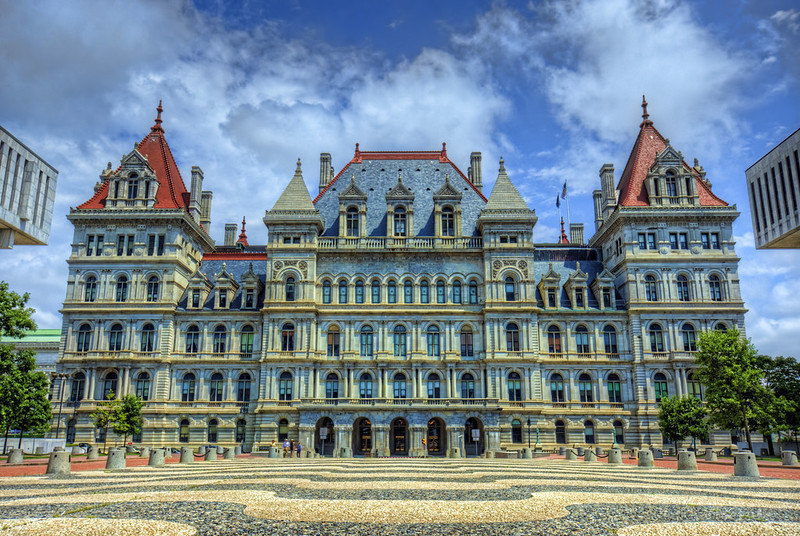
The New York State Capitol in Albany. Photo by Craig Fildes licensed under CC BY-NC-ND 2.0 DEED.

The operative word in the title of the CLCPA is “leadership.” It was hard to discern any of that, however, when it came to Gov. Hochul and the legislature, especially the General Assembly. Instead, anxiety about the upcoming elections prevailed and Democrats took the safe way out. It was a sad day in Albany and there was little to celebrate when Earth Day occurred a few days later.

The Fossil Fuel Industry Betrayal

It was bad enough when we found out this past January that the fossil fuel industry had more than enough evidence as early as 1954 to understand the impact of greenhouse gas emissions on the climate. But then word came today, with the release of internal documents, that Big Oil lobbied against climate policies that they claimed to support. The betrayal was complete.

“For decades, the fossil-fuel industry has known about the economic and climate harms of its products,” declared Sen. Sheldon Whitehouse (D-RI) “but [it] has deceived the American public to keep collecting more than $600bn each year in subsidies while raking in record-breaking profits.”

Where Do We Go From Here?

In the context of these larger national events, the fact that oil and gas companies were a major factor in pressuring state legislators to forego climate legislation in this year’s budget is especially galling. All three major bills directly confront the oil and gas firms. The NY HEAT Act seeks to eliminate subsidies for new gas hookups, eliminate the “obligation to serve” gas to neighborhoods, and ensure that no low-income household would pay more than 6% of its income for energy.

The Climate Change Superfund Act holds major oil companies accountable for the harm they inflicted on New York between 2000 and 2018. It would require these companies to bear a share of the costs of infrastructure investments required to adapt to the impacts of climate change in the state. The program would assess the major fossil fuel emitters $3 billion annually over the span of 25 years to offset the climate damages incurred by the state.

The Stop Climate Polluter Handouts Act aims at paring back the $1.6 billion taxpayers hand out each year to the oil and gas companies in tax subsidies and other breaks. It defies logic that the state continues to provide huge subsidies to an industry that is causing so much destruction. This bill would end the most egregious state subsidies, amounting to $265 million annually.

The fight to secure the passage of these three bills is far from over. Even though the budget has been set, the legislature still has until June 1 to gain their approval. This is clearly the tougher road but climate movement activists across the state, including TCCPI, are gearing up to push even harder over the next four weeks for this legislation to become law. It’s time to roll up our sleeves and get to work!


No Watering Down the NYS Climate Law

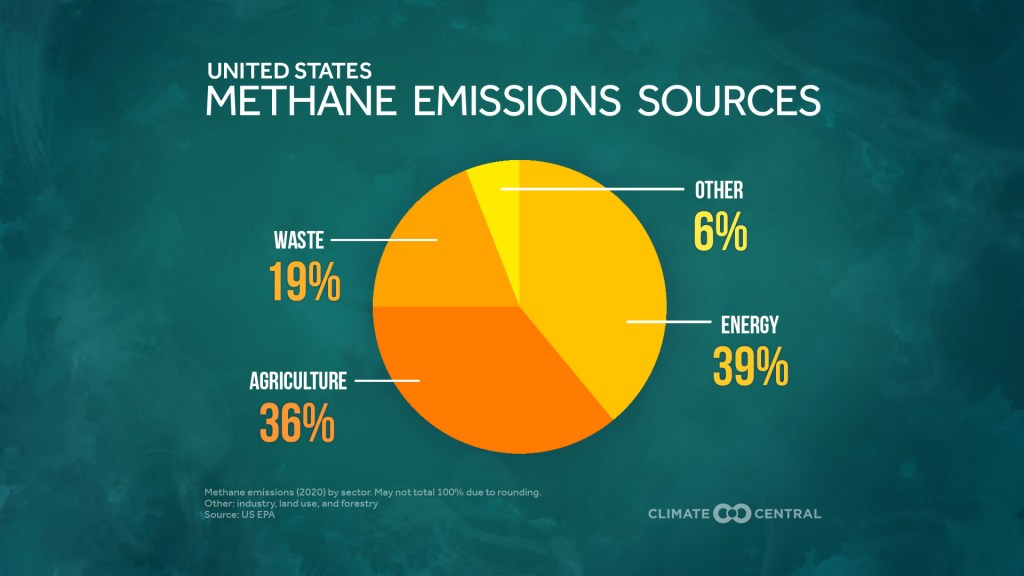
We know from the work of Cornell University Professor Robert Howarth and other scientists that two properties of methane make it a critical greenhouse gas: on the one hand, it has roughly 80 times the warming power of carbon dioxide over a 20-year period, and on the other, it begins to dissipate in the atmosphere after a decade, as opposed to many centuries for carbon dioxide. Together these characteristics mean that rapidly cutting methane can have a major impact in the near future on heading off runaway climate change.

For this reason Howarth, a member of the NY Climate Action Council (CAC), sought to secure a new approach to methane emissions as part of the 2019 Climate Protection and Community Leadership Act (CLCPA), measuring them over a 20-year time frame rather than the 100-year time frame previously used in the state. Doing so, in his words, provided NY policymakers with a tool that “more heavily weighs the role of methane as an agent of warming over the next few decades.”


Dropping a Bomb

Most officials in Albany and the climate and environmental justice movements assumed this change was a settled matter following the release of the CAC’s final scoping plan last December.

But in early April Gov. Kathy Hochul indicated her support for bills sponsored by Democratic chairs of the State Senate and General Assembly energy committees to abandon the new method of methane accounting embedded in the climate law and the CAC report, reverting to the 100-year time frame.

Highlighting the Hochul administration’s support for this initiative, the co-chairs of the CAC published an opinion article arguing that the change was necessary to protect “the competitiveness of our businesses” and retain jobs. “As it stands today, the climate act’s emissions accounting method is certain to be a major driver of future costs for New York families,” wrote Basil Seggos, commissioner of the NYS Department of Environmental Conservation, and Doreen Harris, president and CEO of the New York State Energy Research and Development Authority.

Besides the proposed alteration in measuring methane emissions, the bills introduced by Sen. Kevin Parker (D-Brooklyn) and Didi Barrett (D-Hudson) would exclude emissions generated by the combustion of biomass and biofuels from statewide totals of GHG emissions and include anaerobic digestion and forest biopower in the state’s definition of “renewable energy systems,” contrary to the CLCPA and CAC.

A Fierce Reaction

Coming in the midst of budget negotiations, these moves set off a firestorm. Opponents in the climate and environmental movements rallied immediately, asserting that the bills would deliver a “a body blow” to the nation-leading climate law and constituted “an accounting trick” designed to placate the oil and gas lobby. “Governor Hochul would side with the fossil fuel industry to torpedo New York’s landmark climate law, along with her own budget proposals to address the climate crisis, should she move forward with a proposal to weaken the state’s accounting for methane emissions,” said Liz Moran, the NY policy advocate for Earthjustice. TCCPI joined dozens of other groups in sending a memo of opposition within 24 hours of the breaking news.

The ability of so many organizations to mount a powerful campaign of phone calls, emails, and social media messages on such short notice was both impressive and inspiring. The depth and breadth of the backlash clearly came as a surprise to the Hochul administration. Two days after the Seggos and Harris op-ed, Gov. Hochul backed off the drive to weaken the climate law as part of the budget negotiations. It was not a coincidence that this took place the same day that Howarth and two dozen other scientists from Cornell University, Stanford University, and the Massachusetts Institute of Technology sent a letter of protest.

In the end, at least for now, science won and the fossil fuel industry lost. There is a distinct possibility, however, that the attempt to water down the climate law will raise its head again following the approval of the state budget. As it is, the proposal to redefine renewable energy to include biofuels is still on the table. Both this and the effort to change the methane accounting rule must be kept from becoming law.

It is one thing to stop these kinds of ill-considered and ill-timed moves and another to achieve victory for the crucial climate justice and clean energy legislation still under consideration in Albany. The so-called “conceptual agreement” on the budget reached  on April 27th includes a ban on the use of fossil fuels in new construction, and the proposal for a cap-and-invest program is still in the mix. The details of both, however, as well as the fate of other important climate and energy bills, remain uncertain.

Time grows short to implement the measures necessary to ensure the success of the CLCPA and bolster the CAC’s plan to avoid even worse climate chaos. The lesson to be learned from the latest developments is clear: the only real possibility of success in the face of the relentless pressure brought to bear by the oil and gas lobby is unstinting collective action by well-organized citizens fighting for their communities. We must remain vigilant and make sure our elected representatives hear us.

Turning Up the Heat on Climate Action in Albany

The Climate Action Council has delivered a sound and comprehensive plan for meeting the crucial targets of the 2019 Climate Leadership and Community Protection Act, which established the Council and charged it with putting together the plan. The question now is whether Gov. Hochul and the state legislature will step up and provide the necessary backing to ensure the plan’s success.

This year’s legislative session has been underway for too little time to reach any conclusions about the work of the General Assembly and State Senate, but the governor has laid out her priorities in the January 10th State of the State address, as well as in the proposed executive budget issued on February 1st. It’s a mixed record so far.

Renewable Heat Now rally at the state capitol on January 24. Photo credit: Sane Energy Project.

Hochul underscored once again her support for phasing out fossil fuel heating and appliances in new construction, a position she announced in last year’s executive budget. In addition, she backed the Climate Action Council’s call for a cap-and-invest program, a vehicle for funding climate action, and proposed modest programs to improve energy affordability.

But the governor’s actions fell short on several key fronts. Most important, she wants to push back the date for a phase-out of fossil fuels in newly-constructed small buildings to 2026 and to 2029 for high rise buildings.

These dates are one year longer than proposed in the final scoping plan and two years more than initially laid out in the draft plan. It’s a disappointing move, and flies in the face of mounting evidence that we need to speed up, not slow down, meaningful efforts to reduce greenhouse gas emissions. 

Fortunately, the state legislature has the opportunity to rectify the matter and restore the dates originally called for the in the draft scoping plan. The All-Electric Building Act excludes fossil fuel from new buildings, starting in 2024 with buildings under 7 stories and then 2027 for larger buildings. 

The Renewable Heat Now campaign, which has brought together over 220 organizations (including TCCPI), strongly backs this approach, urging legislators to stick with the earlier dates. It also proposes the following:

  • A funding package that includes a Green Affordable Pre-Electrification (GAP) fund, low interest financing, and additional funding for the NYSERDA’s Regional Clean Energy Hubs. Many homes in New York State have crucial health and safety issues, including mold, lead, gas, and/or carbon monoxide leaks. These issues must be remedied before an energy audit can be done to determine how to weatherize the home, save money, and make it electrification-ready. Families need financial and technical help to afford these critical retrofits addressing health and safety issues in existing buildings. This funding is necessary to ensure a just energy transition for all New Yorkers.
  • The NY Home Energy Equitable Transition (HEAT) Act eliminates over $200 million per year in subsidies for new gas hookups, enables neighborhood-scale building decarbonization, and improves energy affordability by eliminating the costly “obligation to serve” gas regulation, and ensuring no household pays more than 6% of their income for energy.
  • The Energy Efficiency, Equity, and Jobs Act deploys funding for cost-saving energy efficiency retrofits where they are most needed, removes health hazards from homes so they can undergo energy efficiency retrofits, and ensures that the workers hired for energy efficiency upgrades come from disadvantaged communities.

Another important bill, part of NY Renews’ Climate, Jobs, and Justice campaign (and also supported by TCCPI), would eliminate over $330 million of the most egregious state subsidies handed out each year to the fossil fuel industry. The Stop Climate Polluter Handouts Act preserves tax exemptions that help low- to moderate-income households, including a home-heating credit and an agricultural exemption for small- to mid-sized farmers.

Together these proposals will significantly strengthen the state’s climate action plan and correct some of the serious flaws in Gov. Hochul’s climate agenda. The next few weeks in Albany will be telling, so now is the time to make our voices heard. 

Building Electrification in the Empire State

New York burns more fossil fuels in its residential and commercial buildings than any other state in the country, a fact that underscores the importance of dramatically reducing the carbon footprint of our built environment to avert runaway climate change. As the New York legislature entered the final days of the 2022 session last week, however, prospects for passage of the All-Electric Building Act (AEBA) appeared dim.

Commercial building heat pumpsThe AEBA would have required all new buildings starting in 2024 to be constructed using only electric appliances for heating, cooking, hot water, and drying clothes; in 2027, the standard would have applied to taller buildings as well.

Although other significant environmental and climate legislation did make it through, including the two-year moratorium on cryptocurrency mining produced by fossil fuel power plants, it was lights out for the AEBA when the session ended. The bill had strong support in both houses, but the leadership blocked it from going to the floor for a vote. It was a bitter disappointment for climate activists, especially in light of the Democratic majority in the state legislature.

Similar proposals have fared better elsewhere in the U.S. Washington became the first state in the country in April to effectively ban the use of natural gas in most newly constructed buildings, mandating the installation of all-electric heating and hot water systems. California adopted a new building code in August 2021 that established a strong preference for electric heating in new construction, although it did not impose an explicit ban on natural gas.

Closer to home, the Ithaca Common Council in May 2021 voted unanimously in support of an energy code supplement that required all new construction beginning in 2026 to be net-zero buildings that do not use fossil fuels except for cooking. New York City passed a law in December 2021 prohibiting the use of natural gas and oil burning systems in new construction starting in 2024, when developers would have to design buildings with all-electric heating, hot water, and cooking appliances.

The AEBA would have implemented a key recommendation of the Climate Action Council, which has been charged with developing a plan to achieve the goals established under the state’s 2019 Climate Leadership and Protection Act (CLCPA). The Draft Scoping Plan, released at the end of December 2021 for public comment, calls for the adoption of all-electric state codes that prohibit the use of fossil fuel for heating, cooling, hot water, cooking, and appliances by 2024 for new construction of single-family and low-rise residential buildings and by 2027 for multifamily buildings over four stories and commercial buildings (see pp. 125-28).Gov. Kathy Hochul’s State of the State address in January seemed to signal a green light for building decarbonization, and she included support for a ban on natural gas in new construction after 2027 in her executive budget, a move backed by the State Senate. The General Assembly, however, left it out of its one-house budget.

The failure of the state legislature to take action on the AEBA makes it very difficult for New York to meet the legal climate targets stipulated in the CLCPA. All the more reason, then, that concerned citizens should make their voices heard in support of the Draft Scoping Plan recommendations. Fortunately, there is still time to do so now that the public comment period has been extended to July 1. Comments may be submitted via the online public comment form, via email at scopingplan@nyserda.ny.gov, and via U.S. mail to Attention: Draft Scoping Plan Comments, NYSERDA, 17 Columbia Circle, Albany, NY 12203-6399. The Climate Action Council will issue a final draft of the climate plan by the end of the year.