As climate change has accelerated in the United States, it’s become clear that its consequences are not experienced equally in the U.S. The specifics of these disproportionate impacts are the focus of a groundbreaking federal report issued last month by some of the nation’s leading climate scientists, public health experts, and economists.
The release marks the first time a National Climate Assessment, mandated by Congress under the Global Change Research Act of 1990, has treated environmental justice as an important consideration in its findings. Why the new attention? As the Fifth National Climate Assessment puts it, “An equitable and sustainable U.S. response to climate change has the potential to reduce climate impacts while improving well-being, strengthening resilience, benefiting the economy, and, in part, redressing legacies of racism and injustice.”

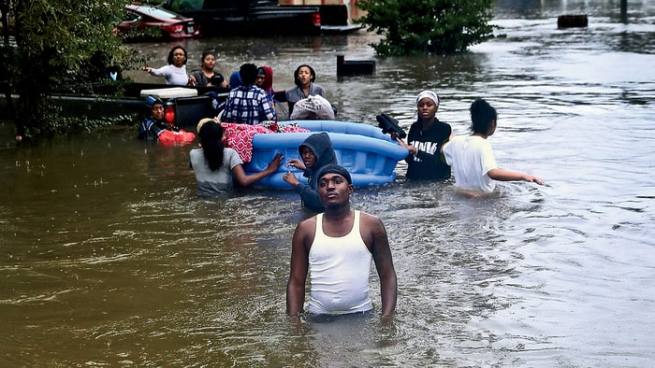
Hurricane Harvey in 2017 had a disproportinate impact on poor African American neighborhoods in Houston.
The report outlines in detail how lower-income families and communities of color have historically experienced the worst environmental damage while benefiting the least from regulation, adaptation efforts, and recovery funding. It examines how marginalized groups, among other things, have a greater likelihood of living in a flood zone, lacking access to parks and other green spaces, and having fewer resources to recover from extreme weather events such as hurricanes, flash floods, and wildfires.
“Climate change affects us all, but it doesn’t affect us all equally,” observes Katharine Hayhoe, chief scientist of The Nature Conservancy and one of the report’s authors. “This new assessment provides a more comprehensive understanding of how climate impacts disproportionately affect those who have done the least to cause the problem. These impacts exacerbate social inequities, including racial and gender-based disparities; and they emphasize how climate solutions must also be solutions for justice and equity.”
According to Inside Climate News, previous assessments “approached the inequitable outcomes of the climate crisis as an afterthought,” making scattered references to “social justice,” “climate justice” or “environmental justice.” In contrast, the Fifth National Climate Assessment threads discussions of social, economic, and health inequities throughout the entire report.
In a key chapter on “Social Systems and Justice,” the study argues that the necessary elements of a just transition are: 1) recognizing lower-income families and communities of color have borne disparate burdens and social injustices and thus may have different needs; 2) ensuring people affected by the outcomes of decision-making are included in those processes; and 3) distributing resources and opportunities so that no single group or set of individuals receives disproportionate benefits or burdens.
The report, which comes out roughly every four years, compiles the latest peer-reviewed studies and other relevant research on climate change and weaves them into a comprehensive document for U.S. policymakers. The National Climate Assessment is widely considered to be the nation’s most authoritative document on how global warming is affecting the country, so the new attention to environmental justice, while overdue, is welcome and deserves broad public attention.
 Rebooting the Future