The Days of Reckoning Are Just Ahead

There’s no need at this stage to press the point that the coming U.S. election will be pivotal, not just in terms of whether our constitutional republic will survive, but also whether we can manage to avoid catastrophic, runaway climate change. Regular readers of this column readily grasp what’s at stake with both of these issues.

A report just released by World Weather Attribution (WWA), an international research group, closely examines how the 10 deadliest weather disasters since 2004, including three tropical cyclones, four heatwaves, two floods and a drought, killed an estimated half million people, and probably many more. It makes for sobering reading and, on the eve of Tuesday’s election, is a reminder that our choices at the ballot box will affect not just this nation but the entire planet.
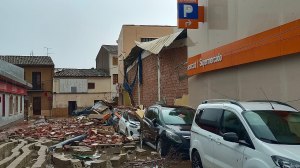
Flooding in Valencia, Spain. Photo by Eidursson – Own Work licensed under CC BY 4.0.

Role of Fossil Fuels
The WWA study investigates how all of these events were intensified by global warming, which was, in turn, caused by the burning of fossil fuels and deforestation. The main finding is simply put: “with every ton of coal, oil and gas burned, all heatwaves get hotter, and the overwhelming majority of heavy rainfall events, droughts, and tropical cyclones get more intense.” In other words, there is no such thing as a “natural” disaster anymore.

Polluters Must Pay
As if to underscore the truth of this observation, horrific flooding in Spain that claimed at least 158 deaths took place just as the WWA analysis was issued. According to Spain’s national weather service, it rained more in eight hours in Valencia, the hardest hit region, than it had in the preceding 20 months. Imperial College climate scientist Friederike Otto, who helps run the WWA, said it was “very clear that climate change did play a role.”

The flooding in Europe and across the U.S. Southeast this fall also underscores why the effort to hold the fossil fuel industry responsible for the havoc that it has caused is so critical, especially in light of the overwhelming evidence that Big Oil was aware of the potential consequences.

At the federal level, Sen. Chris Van Hollen (D-MD), Rep. Jerry Nadler (D-NY), and Rep. Judy Chu (D-CA) have recently introduced bills in Congress to do so. The Polluters Pay Climate Fund Act would assess companies based on their global carbon dioxide emissions, and it authorizes the U.S. Treasury Department to charge the largest polluters in proportion to their past carbon emissions, in excess of 1 billion metric tons, an estimated $100 billion each for ten years.

Closer to home, the New York Climate Change Superfund Act, still sits on Gov. Kathy Hochul’s desk, awaiting her signature to become state law. Both the General Assembly and State Senate passed the legislation during the last session. Public pressure has mounted on the governor to act, and it’s a certainty that this pressure will increase exponentially after the election.

Under the bill passed by lawmakers, New York would seek to collect about $3 billion a year for the next 25 years, for a total of $75 billion. The state Department of Environmental Conservation would be tasked with identifying the oil and gas companies that should be held responsible for greenhouse gas emissions and it would investigate how much they should each pay the state.

Regardless of the outcome of these events, one thing is for sure: the days of reckoning are upon us, and we each have the obligation as democratic citizens to make our voices heard. If there ever was a time to make sure that we become subjects in history and are not just objects of history, it is now.

How Serious is NY about Its Climate Goals?

There’s something seriously unnerving about the casual way in which Gov. Hochul has acknowledged that New York will probably not meet its 2030 climate targets. The pathbreaking Climate Leadership and Community Protection Act (CLCPA) calls for the state to obtain 70 percent of its electricity from renewable energy by 2030.

joint draft report issued in July by the New York State Energy Research and Development Authority (NYSERDA) and the Public Service Commission (PSC) indicated that the 70 percent renewables target will not be achieved before 2033.

State State Comptroller Thomas DiNapoli and Senate Majority Leader Andrea Stewart-Cousins. NY Senate Photo licensed under CC BY 2.0.

Audit Reveals Flaws
A few weeks after this report, State Comptroller Thomas DiNapoli released a detailed audit criticizing the PSC and NYSERDA for inadequate planning and the use of outdated data. In particular, it said that the PSC had failed to address “all current and emerging issues that could significantly increase electricity demand and lower projected generation.”

Perhaps most disturbing was the audit’s finding that the PSC had overlooked the need to calculate the costs of the transition to renewables or to identify how to cover those costs beyond the tried and true method of dumping them on ratepayers. 

How Committed is the State?
Together these two reports raise major questions about the actual commitment of the state to implementing the 2019 CLCPA. The governor’s reaction to these findings? Oh well, it won’t hurt if we let things slide for a few years. Not surprisingly, state Republican leaders and the business community have taken advantage of the leadership vacuum to attack the climate law and press Hochul to abandon it.

How is it possible for this failure of leadership to take hold during the same summer that global temperatures have been setting new records month after month? In fact, not only was this past July the warmest on record, but it was also the 14th consecutive month of record-high global temperatures. Does anyone see a pattern here?

Cornell professor Robert Howarth, a member of the state’s Climate Action Council, certainly does. The council passed a plan to implement the CLCPA in December 2022, and Howarth is on the front line defending it. “I am appalled at this pushback against the CLCPA by business interests pushing their short-sighted agenda,” Howarth said in an interview with WaterFront. “Climate change is very real. The consequences of climate disruption (floods, droughts, fires, crop failures) are becoming increasing obvious to all.”

Eddie Bautista, executive director of the New York City Environmental Justice Alliance, strongly agrees that stronger leadership is necessary. “In just five short years, we’ve gone from being visionary leaders to not being able to implement our own laws. It’s just insane,” he said recently.

The governor’s reversal on congestion pricing in New York City has environmentalists wondering whether this is part of a larger plan to back away from other elements of the state climate action agenda such as the cap-and-invest plan that would price greenhouse gas emissions. At the very least, it looks likely that the administration will blow past its self-imposed deadline to launch the program in early 2025.

A Simple Step
One step that Hochul could take to restore some degree of confidence in her commitment to climate action would be to sign the Climate Change Superfund Act that is currently sitting on her desk after being passed in June by both the General Assembly and State Senate. This legislation would require oil and gas companies to pay a total of $3 billion a year for 25 years to cover the cost of the climate damage they have inflicted on the state.

The governor has not yet signaled her intention, which leaves a lot of climate activists worried, although some think she might just be waiting until after the election to do so. The pressure on her has been growing throughout the summer and will only continue to increase this fall.

Fossil Free Media, together with the Sunrise Movement, has launched a national billboard campaign in California, New York, Arizona, and Philadelphia, with plans to expand to Florida and Louisiana in September. as part of the effort to build support for the principle that polluters should pay for the mess they have made.

The Make Polluters Pay campaign seeks to hold the fossil fuel industry accountable through legislation, lawsuits, and public pressure. This is exactly the kind of national attention that Hochul wants to avoid, but she better get used to it. Sen. Chris Van Hollen (D-MD) and Rep. Jerry Nadler (D-NY) just announced their intention to introduce federal Polluter Pays bills in Congress. Things are definitely heating up – stay tuned.

Cryptocurrency Mining and Climate Change

When political leaders demonstrate the courage of their convictions, it’s immediately evident. Perhaps it’s because the authenticity shines through the usual political fog so brightly. All pretense drops, the language becomes direct and straightforward, and the clear meaning of their words rings out.

The most striking example recently of such leadership, one that has been both inspiring and breathtaking, is that of President Volodymyr Zelensky. He has not shied away from acknowledging the immense military odds stacked against Ukraine or downplayed the difficulty ordinary Ukrainians face. He has invoked a deep sense of common purpose and brought his country together.

Kathy Hochul sworn in as the 57th governor of New York. Photo by NY Senate licensed under CC BY 2.0.

In a different way and at a very different level, NY Gov. Kathy Hochul has a similar opportunity to demonstrate the courage of her convictions. The Climate Leadership and Community Protection Act (CLCPA), signed into law in 2019, laid out aggressive benchmarks for New York to reduce its carbon emissions. Gov. Hochul has emphatically expressed her support for the CLCPA, proclaiming in her recent State of the State address that climate change is “a threat to our way of life, here and now.” She boldly called for a ban on the use of natural gas in new construction after 2027, the rapid development of offshore wind, and the phasing out of peaker plants—only used when excess energy is needed by the grid—as well as older fossil-fuel power plants.

Another closely related issue offers Hochul a similar chance to display bold leadership: imposing a statewide moratorium on proof-of-work bitcoin mining, a practice that poses a profound threat to the climate. Assemblymember Anna Kelles has introduced a bill that would place a three-year moratorium on proof-of-work cryptocurrency mining. The bill is currently making its way through the legislative process and has gained the support of 41 co-sponsors and 15 key committee chairs in the Assembly.

So far the governor has said very little about bitcoin mining, its environmental impact, or whether she supports a moratorium. It’s time she stepped forward.

Why is this action so critical?

Proof-of-work cryptocurrency mining consumes a tremendous amount of energy to operate the multiple, high-powered computers that validate the exchange of bitcoins as well as the cooling technology needed to keep the machines from overheating. In fact, a Cambridge University study concluded that bitcoin mining uses more electricity annually than the entire country of Argentina.

What is especially galling is that proof-of-work is only one way to mine cryptocurrency. “Proof-of-stake, another popular method, uses far less energy,” points out Yvonne Taylor, co-founder and vice president of Seneca Lake Guardian. But, she notes, proof-of-work’s energy use in the U.S. has grown 320% in just the past five years. New York, moreover, hosts nearly 20% of that.

Thanks to the work of Taylor and other environmentalists, attention in New York has focused on Greenidge Generation, a recently revived operation located on Seneca Lake. Formerly a coal-fired power station, it turned to natural gas when it reopened its doors. Originally intended to be a peaker plant, no one knew it would become a private bitcoin mining operation that ran 24 hours a day, 7 days a week.

Greenidge’s Title V air permit is currently up for renewal, as discussed in our last issue. The decision on the renewal was due Jan. 31 but has been postponed to March 31 so that the state Department of Environmental Conservation (DEC) could “complete its ongoing review” of about 4,000 public comments on the case. As Peter Mantius reports, however, the delay provides Greenidge with the ability to expand its operations.

Under the CLCPA, the state is required to reduce its greenhouse gas emissions 40% by 2030. The importance of doing so was underscored by today’s release of a report from the UN’s Intergovernmental Panel on Climate Change (IPCC) warning that the pace of global warming threatens to overcome our ability to adapt to it. Greenidge is just one of many fossil-fuel power plants retired in upstate New York that could potentially be reopened for proof-of-work cryptocurrency mining; the possibility of Cayuga Power Plant going down this road punctuates the point.

If the bitcoin mining industry is allowed to continue growing without any oversight or regulation, the ability to achieve the CLCPA goals will be put in serious jeopardy. For the governor to be true to her word that climate change is a threat to our way of life, it’s clear what her next move must be: declare a moratorium on bitcoin mining.

Next Steps for the NYS Draft Climate Plan

The Climate Action Council, headed up by Department of Environmental Conservation (DEC) Commissioner Basil Seggos and New York State Energy Research and Development Authority (NYSERDA) President and CEO Doreen M. Harris, has just issued its draft scoping plan. Now it’s our job to review it carefully and respond. Beginning on Jan. 1, the public will have 120 days to offer comments and make sure their voices are heard.

The Climate Leadership and Community Protection Act (CLCPA), signed into law in 2019, calls for New York to achieve a 40 percent reduction in greenhouse gas emissions and 70 percent renewable energy generation by 2030, establish a zero-emission electricity sector by 2040, and create a carbon-neutral economy by 2050. The CLCPA established the Climate Action Council, a 22-member committee charged with determining how to meet these statutory goals. The Council also consulted with a wide range of advisory panels and working groups over the past two years to address issues in areas such as transportation, solid waste, energy generation, workforce development, and climate justice.

A December 30 wildfire destroyed hundreds of homes in suburban Denver, the latest dramatic sign of climate change. Photo by Tristantech licensed under CC BY-SA 4.0.

The release of the draft scoping plan is the crucial first step in reaching the ambitious but necessary climate goals laid out in the CLCPA. There is certainly plenty of material for New Yorkers to wade through. The body of the report itself is 330 pages, followed by 520 pages of appendices. The Climate Action Council’s seven advisory panels – Transportation, Agriculture and Forestry, Land Use and Local Government, Power Generation, Energy Efficiency and Housing, Energy Intensive and Trade Exposed Industries, and Waste – submitted recommendations for the Climate Action Council to consider in the draft scoping plan, all of which can be found in the appendices.

In addition, the Climate Justice Working Group and Just Transition Working Group played key roles in the development of the draft scoping plan. The Disadvantaged Communities Barriers and Opportunities Report examines why some communities are disproportionately impacted by climate change and air pollution and have unequal access to clean energy, and recommends ways to rectify these problems using a climate justice lens. The Just Transition Working Group Jobs Study explores the consequences of climate change mitigation for the job market as well as actions required to provide adequate training, education, and workforce development.

The release of the draft scoping plan takes place against an increasingly dire climate crisis. The latest manifestation of this crisis is the Colorado wildfire that raced through suburbs between Denver and Boulder on Dec. 30, destroying at least 500 homes and forcing the evacuation of thousands of residents. Needless to say, December wildfires are not a common occurrence in Colorado, but a severe drought combined with high winds to fuel the most destructive blaze in the state’s history. Elsewhere, a new report has found unsettling evidence that the so-called “Doomsday Glacier” in Antarctica could collapse in as little as five years, raising the world’s sea level by several feet. The Thwaites glacier already loses 50 billion tons of ice each year and makes up about four percent of the planet’s annual sea rise.

The need to take dramatic and immediate climate action, then, is obvious. Although one of the most sweeping plans issued by any state or country, the NYS draft report leaves many specifics to be worked out. The broad outlines of any effective climate plan must include, as this one does, calls for the electrification of buildings, a shift to electric vehicles, the expansion of renewables such as solar and wind power, the development of feasible energy storage strategies, the decommissioning of natural gas, and the implementation of a carbon tax. But still unclear are the details and timing involved with setting these steps in motion, and how to do so in a way that takes into account historic inequities and brings about a just transition.

The draft scoping plan is now in the hands of Gov. Kathy Hochul and the state legislature. It remains to be seen to what extent public input will influence the final shape of the plan, but it’s critical that New Yorkers weigh in. The final report will be issued on Jan. 1, 2023 and the DEC will then announce legally binding regulations by Jan. 1, 2024 to ensure that the state achieves the CLCPA’s required targets.

Information about how to participate in the public hearings on the draft scoping plan will be disclosed in early 2022, according to the press release issued by the Climate Action Council. There will be at least six hearings held across the state. In addition, comments can be submitted via the online public comment form, by email at scopingplan@nyserda.ny.gov, and by U.S. mail to Attention: Draft Scoping Plan Comments, NYSERDA, 17 Columbia Circle, Albany, NY 12203-6399. Stay tuned!