Utilities Need to Step Up Their Climate Efforts

This past July was the warmest July in the 175 years that the National Oceanic and Atmospheric Agency (NOAA) has been keeping records. It was also the 14th consecutive month of record-high global temperatures, which itself is a record.

Commercial heat pumps in NYC.

We’ve jumped from 11 billion tons of carbon dioxide per year in 1960s to 36.6 billion tons in 2023. The world is now in territory not seen for more than 3 million years. At that time the global surface temperature was 4.5-7.2°F warmer than during pre-industrial era. Human civilization simply cannot survive in a climate like this.

We’re clearly walking along a knife’s edge. That’s what makes the complacency — some might say willful opposition — of the utilities so infuriating.

This is not to say utility efforts to help customers make energy-saving improvements haven’t made a difference, because they have. But it clearly hasn’t been enough. Utilities could do far more to help homes and businesses decarbonize.

We recently saw a good example in the NYS commercial building sector of what can happen when a utility makes a serious effort to facilitate electrification. NYSEG launched an economic development heat pump incentive for gas-constrained areas in April 2023 as part of a larger statewide effort rolled out by the NYS Public Service Commission. The pilot program provided up to $200,000 per project to transition off gas-powered technologies. Together with federal incentives, it suddenly made sense financially to install heat pumps in nonresidential buildings in Ithaca.

In short order, ten major weatherization and electrification projects involving commercial buildings got underway. Retail stores, restaurants, offices, and houses of worship, as well as cultural and performance spaces, took advantage of the decarbonization program, amounting to a total clean energy investment of over $1.9 million, with $1.4 million from state and federal incentives. The energy upgrades represent nearly 680 metric tons of annual avoided greenhouse gas emissions based on EPA estimates. Five of the ten buildings were members of the Ithaca 2030 District.

The program expired after only several months and once again the effort to electrify commercial buildings didn’t pencil out. Not surprisingly, the stream of projects slowed to a trickle.

A new report from the American Council for an Energy Efficient Economy (ACEEE) takes a close look at utility energy-saving initiatives, arguing that utilities need to step up their efforts. The report provides recommendations for state legislators and utility regulators aimed at expanding the scale and scope of utility energy efficiency programs to better address the growing climate crisis.

In particular, the study makes the crucial point that “climate goals, not just energy savings, should drive utilities’ efficiency efforts.” It notes that the majority of current energy efficiency programs focus too narrowly on energy savings and, as a result, often miss important decarbonization opportunities. Without a doubt, state regulators and utitlity executives should rethink their approach to energy efficiency; this report offers a new path forward.
From Climate Crisis to Climate Chaos

It’s been a record-shattering summer, and from the looks of it, we’re well on our way from climate crisis to climate chaos. Historic heat waves, wildfires, and floods have struck the U.S., Canada, Europe, China, and India, among other places. No doubt the return of El Niño has temporarily exacerbated the frequency and intensity of recent extreme weather events, but climate scientists are clear that the major factor at work is the continued burning of fossil fuels.

The world has not yet passed a tipping point into runaway climate change, say these scientists, but we’re getting closer. They warn that, as unnerving as this summer has been, even worse impacts are sure to come if we don’t move fast to reduce greenhouse gas emissions. “Climate science’s projections [have been] pretty robust over the last decades,” notes Professor Malte Meinshausen of the University of Melbourne in Australia in a Guardian interview from earlier this week. “Unfortunately, humanity’s stubbornness to spew out ever-higher amounts of greenhouse gases has also been pretty robust.


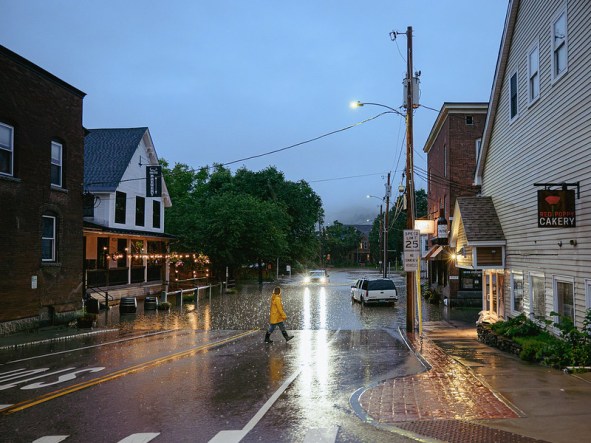
Flooding in Vermont, July 2023. Photo by Nicolas Erwin licensed under CC BY-NC-ND 2.0.

Hottest July Ever

The National Oceanic and Atmospheric Administration (NOAA) announced this month that July 2023 was the warmest July in its 174 years of recordkeeping, and the global surface temperature of the January-July period ranked as the third warmest ever. For the fourth consecutive month, global ocean surface temperatures hit a record high.

“The era of global warming has ended; the era of global boiling has arrived,” UN Secretary-General António Guterres declared last month. “Leaders must lead. No more hesitancy. No more excuses. No more waiting for others to move first. There is simply no more time for that.”

Climate Inequality

The disproportionate impact of climate destabilization has never been more evident. A report on climate inequality released by the World Inequality Lab (WIL) earlier this year found that the top 10% of the world’s carbon emitters were responsible for almost 50% of global greenhouse gas emissions, and the top 1% of global emitters generate more emissions than the entire bottom half. Agricultural productivity has declined by 30% in many low-income regions due to climate change, thus making poverty and food insecurity even worse.

The IPCC Sixth Assessment synthesis report issued in March concluded that climate change impacts are already more far-reaching and extreme than anticipated. Global warming of 1.1°C (1.98°F) has already set off unprecedented changes to Earth’s climate, and 3.3 billion to 3.6 billion people currently live in countries highly vulnerable to climate impacts. According to the report, the death toll from extreme weather disasters is 15 times as high in vulnerable nations as it is elsewhere.

A window still exists to avoid the worst impacts of climate change, the report points out, but it is a narrow one. To limit global warming to 1.5°C (2.7°F), greenhouse gas emissions need to peak before 2025 at the very latest, get cut in half by 2030, and reach net zero by 2050. The global consumption of coal must fall 95% by 2050, oil use must decline by 60%, and gas by about 45%. The annual investment in clean energy investment worldwide needs to increase between 3 and 6 times by 2030.

Fossil Fuel Subsidies

It’s in the context of these findings from NOAA, WIL, and the IPCC that an analysis of global fossil fuel subsidies from the International Monetary Fund (IMF) strikes with special force. Total subsidies for oil, gas, and coal in 2022 surged to a record $7 trillion (a rise of $2 trillion over two years), costing the equivalent of 7.1% of global gross domestic product.

As the IMF observes, that’s more than governments spend annually on education (4.3% of global income) and about two thirds of what they spend on healthcare (10.9%). Another way of putting these hard-to-swallow facts is that fossil fuels were subsidized in 2022 at the rate of $13 million a minute. The biggest subsidizers of fossil fuels were China, the U.S., Russia, the European Union, and India. The G20 nations cause 80% of global carbon emissions, yet they spent a record $1.4 trillion on fossil fuel subsidies in 2022.

The cognitive dissonance generated by the juxtaposition of recent extreme weather events, on the one hand, and the enormous undercharging of fossil fuel costs and their environmental impacts, on the other, could hardly be more head splitting. In the words of the IMF, scrapping fossil fuel subsidies “would prevent 1.6 million premature deaths annually, raise government revenues by $4.4 trillion, and put emissions on track toward reaching global warming targets.” To put it bluntly, ending these subsidies must be at the center of any effective climate solution.

The Arctic Gets a New Ecosystem

As the Rolling Stones song goes, “You can’t always get want you want.” Fair enough. But sometimes, unfortunately, you get exactly the opposite of what you need. That’s certainly true of the Arctic this past winter. The last thing it needed was to break another warm weather record, yet that’s exactly what happened.

The extent of the warming has even caught scientists off guard. The record jump in temperatures “is probably the all-time surprise we’ve seen in the Arctic,” according to Jim Overland, a research oceanographer at the National Oceanic and Atmospheric Administration.]

Needless to say, when you manage to surprise the folks who’ve spent their careers studying you, you’ve accomplished something. Not necessarily something good, but something. What does this mean for the Arctic?

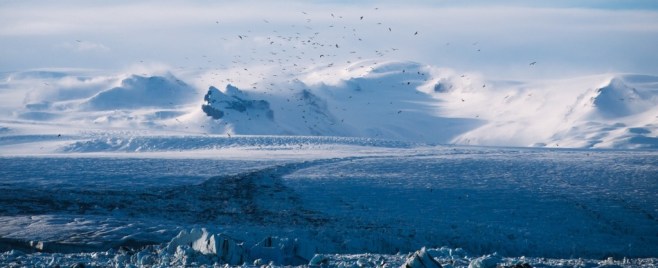
Alaska Glacier2

What it means is that the Arctic gets a complete makeover. Yes, that’s right. A new ecosystem is emerging in the Arctic and it’s wreaking havoc with life in the region: thinner ice, shorter winters, new animals, new vegetation. In short, everything is changing. Everything.

“For the elders in the community, they’ve seen the entire ecosystem change,” said Fort Yukon local Ed Alexander in a Washington Post report last month. “A lot of it is a dramatic change. We have a whole other ecosystem here.”

Oops. We did that. The salmon are smaller, the caribou have changed their migration routes, new plant life is overgrowing usually clear dog sled trails, more forest fires are occurring, and even cardinals are showing up in Fort Yukon.

Think about that last news flash. It’s the rough equivalent of pink flamingos making an appearance on the shores of Cayuga Lake. Imagine the shock if that happened while you were walking along the Waterfront Trail. In the words of Mr. Alexander, “When you see a red bird for the first time in your life, you take note.”

And in case you think it’s only Alaska that has caught climate scientists by surprise, think again. Here’s what Mike MacFerrin, a University of Colorado climate scientist, had to say earlier this month about another well-known region in the Arctic: “melt in Greenland, over this wide an area, this early in the season, is not supposed to happen.”

In fact, the melt was taking place so early and so fast in Greenland that scientists thought something must be wrong with their data so they went back and checked. Get this: thermometers on and around the ice showed temperatures as high as 64 degrees Fahrenheit on April 11. That’s more than 35 degrees warmer than normal for this time of year, which for that part of the world is more like a warm day in the summer.

Oops. We did that, too. To paraphrase the Pottery Barn rule, “we broke it, we own it.” But now that we own it will we ever own up to it? That’s the really big question, isn’t it?

Will Alaska Be the New Florida?

The current debate over the proposed construction of the West Dryden Road natural gas pipeline raises a fundamental question: at what point will we acknowledge that we can no longer conduct “business as usual”?

Implicit in this question is another one: what does it actually mean to put this understanding into operation? Are we willing to move in a radically different direction, as uncomfortable and anxiety-producing as that may be? When will we stop saying, “yes, but …” and recognize that the time to act is now?

The County target of an 80 percent reduction in greenhouse gas emissions by 2050 is not just a nice idea; it’s the minimum necessary to avoid runaway climate disruption. If we can’t accomplish this task in Tompkins County, then where in the U.S. will that target be met?

Oroville Lake, California, in 2011 (top) and the same lake in 2014 (bottom).

A New York Times article in late September examined the issue of climate refugees, not in Bangladesh or the South Pacific, but in the United States. At current rates of global warming, one of the climate researchers observed, “Alaska is going to be the next Florida by the end of the century.”

Matthew E. Kahn, an environmental economist at the University of California, Los Angeles, predicts that “millions of people” will be moving inland to cities such as Minneapolis, Milwaukee, and Detroit to escape coastal flooding in the East and Gulf Coast. By the middle of this century, California and the Southwest will be experiencing catastrophic water shortages and extreme heat.

Aside from the upper Midwest, the Pacific Northwest and Alaska will be among the few refuges left. Even in these places the weather will be dramatically altered. “Summer in Minnesota is projected to be like the climate is in northern Oklahoma – the trees and the forests there, the crops that farmers plant,” according to Thomas C. Peterson, principal scientist for the National Oceanic and Atmospheric Administration (NOAA)’s National Climatic Data Center.

We still have time to avoid the worst effects of climate change, but only if we recognize that the decisions we make now will determine whether we do so or not.

A Drought in Common Sense

Thousands of people from across the U.S. marched past the White House on Sunday, February 17, calling on President Barack Obama to reject the Keystone XL oil pipeline and fracking, and take other steps to fight climate change.The record attendance at the rally in Washington, D.C. highlighted the growing movement in the U.S. among ordinary citizens who sense that the point of no return for runaway climate change is fast approaching.

Coming on the heels of President Obama’s State of the Union address, in which he challenged Congress to deal with the issue of climate change, the outpouring of people at the rally was good news indeed. As the president put it, “For the sake of our children and our future, we must do more to combat climate change.”

070712_lowriver2_lmw

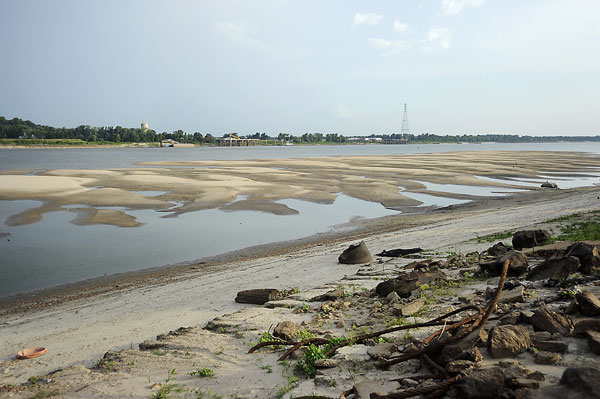
Parts of the bottom of the Mississippi River appeared during the drought last summer.

Perhaps anticipating the demands of the thousands who would flock to Washington a few days later, President Obama struck an unusually combative tone in his annual address. If Congress refused to act, the president warned. then he would exercise his executive authority “to reduce pollution, prepare our communities for the consequences of climate change, and speed the transition to more sustainable sources of energy.”

It remains to be seen, of course, whether Obama will remain true to his word. But all signs indicate that he better do so, for our sake. Just one recent example: reports of a thin snowpack in the western mountains suggest that the High Plains, West, and Southwest are likely to experience a third summer of withering drought.

The National Oceanic and Atmospheric Administration’s (NOAA) latest three-month drought projections, which the agency released February 21, promises little relief. Forecasters predict that drought will continue in the Rocky Mountain and Plains states, expand throughout northern and southern California and return to most of Texas, which has suffered a severe drought since 2011.

According to USDA’s Natural Resources Conservation Service National Water and Climate Center, the February streamflow forecast predicts a decline in nearly every state and basin in the West. The winter snow season still has two months left, but “if the remaining season turns out dry, water supply conditions could end up in the 50 to 70 percent of average range.”

Those dry conditions and poor snowpack have also increased the risk that the Mississippi River could drop to levels later this year equal to or worse than last fall’s record dip, once again seriously disrupting barge traffic on the nation’s busiest waterway. According to Time magazine, if conditions do not improve soon, “the stoppage could last for months.”

We are fortunate, thanks to the abundance of water in the Finger Lakes region, not to have this kind of severe drought looming on the horizon. But we will not be unaffected by developments west of the Mississippi. One wonders what kind of national economic disaster it will take to finally force Congress to act on climate change, but perhaps the shutdown of a river that sees $180 billion of goods travel along it each year will do the trick.