Accountability and Climate Change in Albany

It’s that time of year in Albany when a wave of bills sweeps ashore in the New York State Legislature, among them a number of critical climate and energy transition measures.

The big question on the minds of climate and environmental activists and their legislative allies is pretty straightforward: to what extent is Governor Kathy Hochul committed to fulfilling not just the letter but the spirit of the state’s 2019 Climate Leadership and Community Protection Act (CLCPA)?
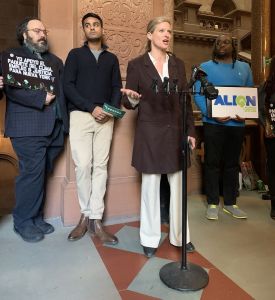
Assemblymember Anna Kelles speaking at a NY Renews rally in January. Photo courtesy of NY Renews.

Uncertainty and Anziety
Close on the heels of this question is a related issue: the State Climate Action Council has developed a substantive, thoughtful roadmap for meeting the ambitious goals of the CLCPA, but it remains unclear how energetically the governor intends to pursue it.

Feeding this sense of uncertainty are the challenges facing the rollout of utility-scale renewable energy projects in New York. As Marie French points out in a recent article, recent setbacks in developing industrial wind and solar have raised serious doubts about the state’s ability to meet the demands of the Climate Law, which requires that 70 percent of New York’s power come from renewable sources by 2030.

Finding a Solution
At the same time, extreme weather events attributable to climate change have been escalating, creating a palpable sense of urgency about the need to find a solution. As Raya Salter, a member of the Climate Action Council and founder of the Energy Justice Law and Policy Center, puts it, “The stakes are higher than ever so the governor needs to be willing to step out and make sure that we fully implement the CLCPA.”

There is certainly no shortage of suggestions about how to do this. One of the boldest set of proposals before the legislators is the Climate, Jobs, and Justice Package (CJJP) advanced by NY Renews, a coalition made up of over 370 environmental, justice, faith, labor, and community groups, including TCCPI.

The CJJP has three main components: 1) fully fund the CLCPA so that it can achieve its objectives; 2) build renewable energy for all and create green union jobs; and 3) hold polluters accountable and ensure everyone pays their fair share in taxes. Here are the details about how this would be accomplished:

  • The People’s Climate Justice Budget is a $1 billion spending plan that outlines critical climate and environmental justice programs that would constitute a downpayment on the more than $10 billion a year the state estimates is necessary to address the climate crisis. It builds on the creation of the Climate Action Fund (CAF) in 2023, seizing a historic opportunity to fund projects across the state.
  • The NY HEAT (Home Energy Affordable Transition) Act would eliminate subsidies for new gas hookups (the “100-foot rule”), enable neighborhood scale building decarbonization by eliminating the “obligation to serve” gas, and ensure that no household pays more than 6% of its income for energy. The plan would also ban the construction of any new gas plants in areas where they do not already exist after September 30, 2023.
  • The Just Energy Transition Act provides a plan to guide the replacement and redevelopment of at least 4 GW of New York State’s fossil fuel facilities by 2030. It lays out a clear direction for proceeding with the transition off fossil fuels in accordance with the CLCPA requirements. Converting these facilities to renewable energy as soon as possible will generate climate and economic benefits as well as public health benefits.
  • The Climate Change Superfund Act holds major oil companies, the state’s worst climate polluters, accountable for the harm they’ve inflicted on New York between 2000 and 2018. It would require companies that have contributed significantly to the buildup of greenhouse gases to bear a share of the costs of infrastructure investments required to adapt to the impacts of climate change in the state. The program would assess the major fossil fuel emitters $3 billion annually over the span of 25 years to offset the climate damages incurred by the state.

Not included in the CJJP, but closely aligned with it, is the Stop Climate Polluter Handouts Act. Many supporters view it, in particular, as a companion bill to the Climate Superfund Act, arguing that New York shouldn’t be providing huge subsidies to an industry that is causing so much destruction. This legislation will end the most egregious state subsidies of over $330 million each year (out of an annual total of $1.6 billion) to oil and gas companies.

These are just a few of the bills under consideration in Albany. Efforts to ensure that the Cap-and-Invest program doesn’t devolve into a cap-and-trade shell game; to make the fashion industry more transparent when it comes to supply chains, carbon emissions, and labor conditions; to reduce plastic packaging and modernize the bottle bill; and to push the governor and legislature to figure out how state facilities in downtown Albany, including the Empire State Plaza and State Capitol, could receive their electric power and heating and cooling from 100% renewable energy are all crucial ways in which New York can demonstrate its seriousness about fulfilling the vision of the CLCPA.

As Raya Salter contends, “the stakes are higher than ever.” The governor and legislature need to demonstrate the vision and leadership that act on this understanding, and it’s up to the rest of us to hold their feet to the fire. TCCPI will be right there with our allies in the climate and energy transition movement, making sure that our representatives feel the heat and act accordingly.

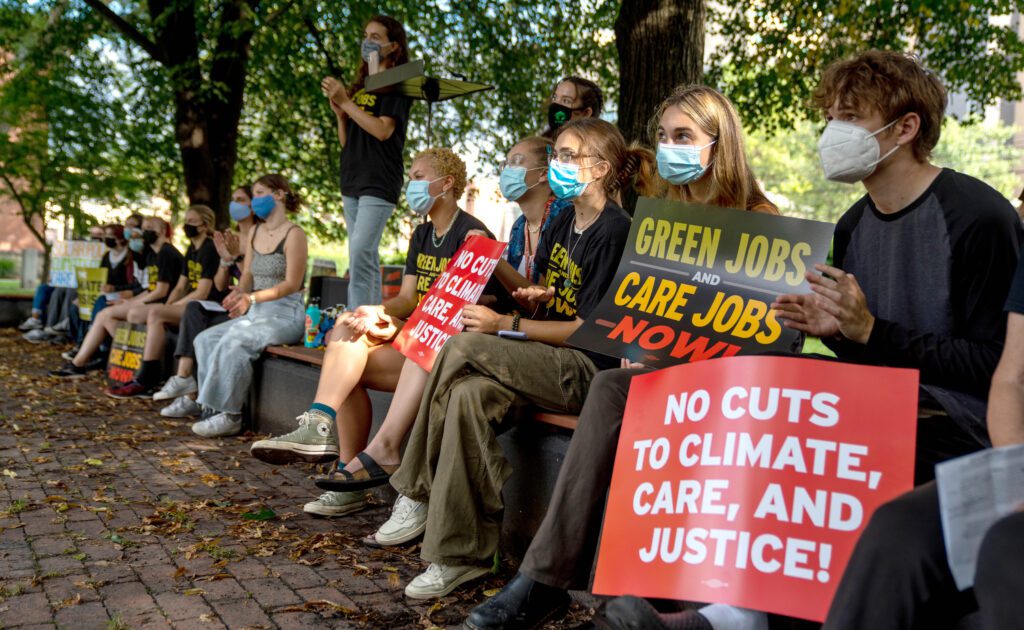
Turning Up the Heat on Climate Action in Albany

The Climate Action Council has delivered a sound and comprehensive plan for meeting the crucial targets of the 2019 Climate Leadership and Community Protection Act, which established the Council and charged it with putting together the plan. The question now is whether Gov. Hochul and the state legislature will step up and provide the necessary backing to ensure the plan’s success.

This year’s legislative session has been underway for too little time to reach any conclusions about the work of the General Assembly and State Senate, but the governor has laid out her priorities in the January 10th State of the State address, as well as in the proposed executive budget issued on February 1st. It’s a mixed record so far.

Renewable Heat Now rally at the state capitol on January 24. Photo credit: Sane Energy Project.

Hochul underscored once again her support for phasing out fossil fuel heating and appliances in new construction, a position she announced in last year’s executive budget. In addition, she backed the Climate Action Council’s call for a cap-and-invest program, a vehicle for funding climate action, and proposed modest programs to improve energy affordability.

But the governor’s actions fell short on several key fronts. Most important, she wants to push back the date for a phase-out of fossil fuels in newly-constructed small buildings to 2026 and to 2029 for high rise buildings.

These dates are one year longer than proposed in the final scoping plan and two years more than initially laid out in the draft plan. It’s a disappointing move, and flies in the face of mounting evidence that we need to speed up, not slow down, meaningful efforts to reduce greenhouse gas emissions. 

Fortunately, the state legislature has the opportunity to rectify the matter and restore the dates originally called for the in the draft scoping plan. The All-Electric Building Act excludes fossil fuel from new buildings, starting in 2024 with buildings under 7 stories and then 2027 for larger buildings. 

The Renewable Heat Now campaign, which has brought together over 220 organizations (including TCCPI), strongly backs this approach, urging legislators to stick with the earlier dates. It also proposes the following:

  • A funding package that includes a Green Affordable Pre-Electrification (GAP) fund, low interest financing, and additional funding for the NYSERDA’s Regional Clean Energy Hubs. Many homes in New York State have crucial health and safety issues, including mold, lead, gas, and/or carbon monoxide leaks. These issues must be remedied before an energy audit can be done to determine how to weatherize the home, save money, and make it electrification-ready. Families need financial and technical help to afford these critical retrofits addressing health and safety issues in existing buildings. This funding is necessary to ensure a just energy transition for all New Yorkers.
  • The NY Home Energy Equitable Transition (HEAT) Act eliminates over $200 million per year in subsidies for new gas hookups, enables neighborhood-scale building decarbonization, and improves energy affordability by eliminating the costly “obligation to serve” gas regulation, and ensuring no household pays more than 6% of their income for energy.
  • The Energy Efficiency, Equity, and Jobs Act deploys funding for cost-saving energy efficiency retrofits where they are most needed, removes health hazards from homes so they can undergo energy efficiency retrofits, and ensures that the workers hired for energy efficiency upgrades come from disadvantaged communities.

Another important bill, part of NY Renews’ Climate, Jobs, and Justice campaign (and also supported by TCCPI), would eliminate over $330 million of the most egregious state subsidies handed out each year to the fossil fuel industry. The Stop Climate Polluter Handouts Act preserves tax exemptions that help low- to moderate-income households, including a home-heating credit and an agricultural exemption for small- to mid-sized farmers.

Together these proposals will significantly strengthen the state’s climate action plan and correct some of the serious flaws in Gov. Hochul’s climate agenda. The next few weeks in Albany will be telling, so now is the time to make our voices heard. 

NY Renews Seeks to Implement State Climate Law

​The following piece appeared in the November 9th issue of the Tompkins Weekly.

Luis Aguirre-Torres’s recent decision to step down as the Ithaca city sustainability director came as a deep disappointment to many in Tompkins County. His plan to make the city carbon neutral by 2030 while making sure climate justice was central to this endeavor was ambitious and inspiring and embodied the spirit and vision of the Ithaca Green New Deal (IGND).

Fortunately, Rebecca Evans remains in place as the city sustainability planner. Her expertise, experience and talent, as well as a longstanding commitment to a just and equitable society, will help ensure that the IGND maintains its momentum. But the community also needs to stay engaged and support her work if the IGND is to meet its goals and continue serving as a national model.

Attendees at a recent climate rally in Ithaca.

Besides joining in local activism to promote the IGND, it is important that Tompkins County residents advocate at the state level for effective climate and clean energy policies. The passage in 2019 of the Climate Leadership and Community Protection Act (CLCPA), the nation’s most progressive climate law, carved out the path for moving forward.

This landmark legislation calls for 70% renewable energy in the state by 2030, 100% zero emission electricity in the state by 2040 and an 85% reduction in greenhouse gas emissions by 2050.

NY Renews, a coalition of more than 320 environmental justice, community, faith, labor and multi-issue organizations, played a key role in getting the CLCPA on the books three years ago. Local organizations in the statewide coalition include Climate Justice Cornell, Sunrise Ithaca, Sustainable Finger Lakes and the Tompkins County Climate Protection Initiative.

With the CLCPA signed into law, the fight has shifted to the enactment of legislation needed to achieve its critical goals. As part of this effort, NY Renews recently announced the public campaign launch for its Climate, Jobs, and Justice Package. The campaign seeks to build public support for this crucial set of bills ahead of the legislative session that kicks off in January 2023.

The Climate, Jobs, and Justice Package, if approved by the State Legislature, will rapidly decarbonize New York, make the state healthier and more equitable, ensure a just transition for workers and help create an accessible green economy for all. Overall, the bills individually and collectively advance the goals of the CLCPA.

Beginning Nov. 16, communities across the state will be rolling out the Climate, Jobs, and Justice Package, looking to make the promises of the CLCPA a reality. The Ithaca event, sponsored by Climate Justice Cornell and others, will be Nov. 18 at 5 p.m. at Thompson Park, across from Gimme! Coffee on North Cayuga Street. People planning to attend can RSVP here.

“Ithacans have fought hard to ensure that equity is at the center of the IGND, and the Climate, Jobs, and Justice Package would extend that commitment to the state level,” said Siobhan Hull, coordinator of Sunrise Ithaca and member of Climate Justice Cornell. “As vulnerable New Yorkers continue to be hardest hit by pollution, economic recessions and the COVID-19 pandemic, it is more important than ever to invest in our frontline communities and secure a just transition for all.”

The Climate, Jobs, and Justice Package has three main components: 1) fully fund the CLCPA so that it can achieve its objectives; 2) build renewable energy for all and create green union jobs; and 3) hold polluters accountable and ensure everyone pays their fair share in taxes. The details for each of these include:

1. Fully fund and implement New York’s Climate Act

Climate and Community Protection Fund creates a pool of money to ensure sufficient investment to fund the CLCPA. The act’s core investments would include broad labor, procurement, community benefits and responsible contracting standards.

2. Build renewable energy for all and create good, green union jobs

Build Public Renewables Act would allow the New York Power Authority to build new large-scale renewables more quickly, effectively and democratically than private developers.

Climate Accountability Act provides state agencies with the authority and guidance required to implement the Climate Act and ensure that our energy system is accountable and transparent to the public.

Gas Transition and Affordable Energy Act will give the Public Service Commission the power and direction to align gas utilities with the Climate Act’s emission reduction and climate justice mandates.

Blueprint Bill provides a plan to direct the replacement and redevelopment of New York state’s fossil fuel facilities and sites by 2030.

3. Make polluters and the wealthiest New Yorkers pay what they owe

Climate Change Superfund Act makes the state’s worst polluters, major oil companies, pay for the harm they’ve caused.

Fossil Fuel Subsidy Elimination Act will end the most egregious state subsidies of $330 million each year to the fossil fuel industry, a major contributor to the climate crisis.

Invest in Our New York’s Plan to Fund Our Future is a revenue and spending package from the Invest in Our New York (IONY) coalition that will ensure the state eliminates wasteful handouts to businesses and the wealthiest New Yorkers pay their fair share to fund our climate law.

Make no mistake, securing the passage of the Climate, Jobs, and Justice Package will not be easy. Implementing these kinds of transformative policies will always generate opposition. In this case, the fossil fuel industry has mounted an aggressive lobbying campaign to undermine the state’s climate targets.

new report just released by the nonprofit Public Accountability Initiative describes in devastating detail the attempts of various players in the fossil fuel industry to obstruct climate action in the state. According to the report, millions of dollars have been spent by the industry and its supporters “to delay, water down and otherwise frustrate the implementation of the CLCPA and other key climate legislation.”

The study points to the presence of fossil fuel executives on the Climate Action Council, the body appointed to create a roadmap for meeting the climate and energy goals of the CLCPA, and questions their support of the state’s clean energy initiatives.

“Legislators, communities and other stakeholders invested in a cleaner, greener, decarbonized future for New York must stay vigilant around efforts by the fossil fuel industry to muzzle and erode the state’s most far-reaching climate legislation ever passed,” cautions the report.

So, keeping these words in mind, be sure to attend the unveiling of NY Renews’ Climate, Jobs, and Justice Package at Thompson Park on Nov. 18, and demonstrate your support for real climate action that will bring about a greener, healthier and more equitable future for all New Yorkers.