A Victory (for now) on the NYS Climate Action Front

There is so little good news in the world these days, especially regarding the climate crisis, that it’s worth paying attention when some comes along. Not just happy, greeting card talk, but substantive, positive developments.

Well, there was good news last Friday (October 24) and it’s worth focusing on. A state supreme court judge ruled that New York is violating its own 2019 climate law, the Climate Leadership and Community Protection Act (CLCPA).

CLCPA Mandates

How can this possibly be good news?

Here’s why: it’s been clear for months now that Governor Hochul and her administration have been working hard at slow-walking the effort to to implement the CLCPA. This law mandated – not suggested, recommended, or advised, but legally stipulated – the following climate and clean energy targets: a 40% reduction in greenhouse gases by 2030; an 85% reduction in greenhouse gases by 2050; and 70% renewable electricity by 2030; and 100% carbon-free electricity by 2040.

Cap and Trade Rules

Under the law, the State Department of Environmental Conservation (DEC) had until the start of 2024 to issue regulations that would “ensure” New York met its binding greenhouse gas emissions targets. A year and a half later, no such regulations had been issued.

Behind the scenes, the DEC and NYSERDA had apparently completed draft rules at the beginning of this year for cap and invest, the emissions program that is critical to theimplementation of the climate law. But the governor, instead of releasing these rules for public comment, pulled the plug on them.

In response, Citizen Action of New York, PUSH Buffalo, Sierra Club, and WE ACT for Environmental Justice filed suit in March. In his decision Judge Julian Schreibman gave the DEC until February 6 to issue the cap and trade regulations. “While DEC notes that it has taken other, commendable regulatory steps to reduce greenhouse gas emissions,” the judge said, “it candidly concedes that the impact of those regulations would fall far short” of the targets set out in the climate law.

Echoing Governor Hochul’s concerns about cap and trade, the DEC argued in court that issuing the regulations was “infeasible” because it “would require imposing extraordinary and damaging costs upon New Yorkers.”Judge Schreibman, to his credit, dismissed that argument. “It is undoubtedly true that the task placed before the DEC is very complicated indeed,” he observed. “But as a legal argument, this is unavailing.”

Two Paths

The judge said there were two paths ahead: the DEC can release regulations to meet the requirements of the law or the legislature can change the law. Of course, the DEC could also appeal the decision, which would lead the case to drag on for months longer, if not more. The DEC would only say that it was reviewing the decision.

Governor Hochul took a less ambiguous position on the decision, indicating that she was considering the possibility of pushing the state legislature to change the CLCPA.

NY Renews, a statewide climate justice coalition, spoke out in strong opposition to this possibility. In its words, “changing the climate law would be a massive step in the wrong direction, allowing polluters across New York to proceed with business as usual, unfettered and unchecked, and condemning us to an ever-worsening climate crisis.”

As if on cue, Hurricane Melissa roared through the Caribbean, leaving a trail of death and massive destruction in its wake. One of the strongest hurricanes on record, Melissa slammed into Jamaica on October 28 with winds of 185 mph. Closer to home, New York City suffered extensive flooding and at least two deaths on October 30 as rainfall broke 100-year records and submerged streets and subways.

The message couldn’t be clearer: the climate crisis isn’t going away and, in fact, will only get worse. Those of us who recognize this likelihood must hold the governor and state legislators accountable during the next session beginning in January, making sure that any efforts to weaken the climate law are defeated.

Time to Tackle Methane Emissions from Landfills

The following is an expanded and revised version of a piece published in the Ithaca Times in June.

When it comes to fighting climate change, it’s hardly news that time is growing short. What is news, however, is the fact that methane is our best way to buy more time.

A groundbreaking new study using aircraft-based emissions monitoring equipment just confirmed that landfills are the largest source of methane in New York State. Researchers flew over more than 100 waste sites, power plants, and farms, measuring real-time emissions. What they found was staggering: landfills were emitting methane at levels dramatically higher than state and federal estimates.

Methane Emissions Need to be Cut

A garbage scow at Fresh Kills Land Fill on Staten Island. Photo by R36 Coach licensed under CC BY 2.0.

In fact, Seneca Meadows, the biggest emitter of any landfill in the state, was more than four times higher than previously reported.

So what’s the big deal? It’s this: methane is over 80 times more potent than carbon dioxide over a 20-year period. So cutting it is one of the fastest ways to slow global warming.

Makes sense, right? But, frustratingly enough, New York is dragging its heels, continuing to delay action on this vital issue.

Time to Put Rules in Place

Despite passing the Climate Leadership and Community Protection Act in 2019, our state still lacks enforceable methane rules for landfills. That’s unacceptable; more than enough time has occurred to put such rules in place.

The Department of Environmental Conservation (DEC) itself identified this problem in the 2023 Solid Waste Management Plan, which committed to minimizing landfill greenhouse gas emissions through updating regulations and deploying effective monitoring technology. Yet more than two years later, no rulemaking has begun. Further delay hampers New York State’s ability to meet the goals set out in the state’s Climate Law and is a missed opportunity to protect overburdened communities.

Methane by itself is bad enough, but we know methane doesn’t travel alone. It comes with toxic co-pollutants like benzene and other volatile organic compounds (VOCs) that contribute to poor air quality and respiratory illness, especially for the low-income and Black and brown communities disproportionately living near landfills.

States like California and Colorado are already implementing strong landfill methane regulations. This spring, California launched a first-in-the-nation satellite program to track large methane leaks, and Colorado just released what could become the country’s most effective landfill methane standard. The proposed rule, if enacted, would require Colorado landfills to manage their emissions by installing a gas collection and control system. In addition, they would also have to phase out open flares (systems that burn methane gas into the open air) and instead use enclosed systems that more effectively control pollution.

The benefits of taking action are too great to be ignored. Strong rules would deliver significant public health, climate, and economic gains. By contrast, the price of inaction is steep—rising health care costs and worsening climate impacts that New Yorkers cannot afford. New York must get on board with these critical efforts to fight for climate and environmental justice. The Department of Environmental Conservation must initiate rulemaking now. The need for action has never been clearer.

Time to Move Forward on Cap-and-Invest

Last year saw a string of costly extreme weather events fueled by climate change across New York, including record rainfall, flash flooding, and tornadoes in upstate communities. This past August Tropical Storm Debby’s remnants caused flash flooding and widespread damage in the Finger Lakes.

These events altogether caused over $1 billion in damages in New York in 2024. In the face of escalating costs, by implementing a good cap-and-invest system, the state has an important opportunity to bring in much-needed funds to pay for climate damage going forward, while also reducing emissions from major polluters.

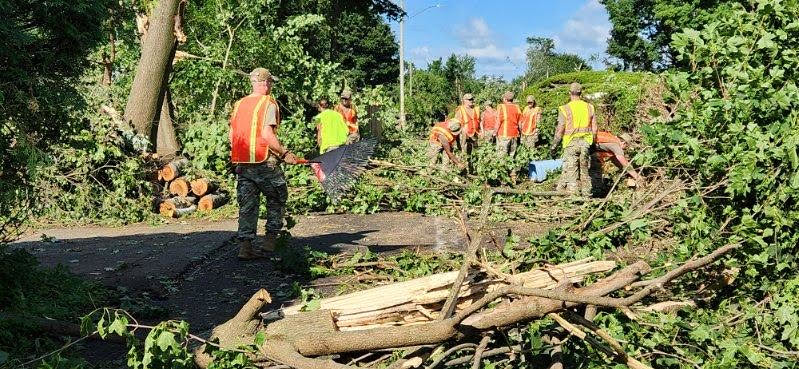
New York Air Guard Airmen help clear debris in Rome, NY following tornado in July 2024. The state National Guard activated 60 soldiers and airmen to help clear debris in the city. Courtesy photo by Major Ryan Marquette.

A Strong Cap-and Invest Program Needed

A strong cap-and-invest program will impose limits on the amount of emissions allowed by polluters and charge them to do so. With those funds, New York can more seriously invest in upgrades to homes to make them more energy efficient and run on clean, renewable energy while also boosting our local economy.

These measures will be especially important as residents absorb the costly increases in energy charged by NYSEG and other state utilities.

The Time for Delay is Over

Cap-and-invest is critical to meeting the targets of the state’s Climate Law. It also ensures New York can provide the level of investment necessary to make energy affordable while also boosting our economy.

Done the right way, Gov. Kathy Hochul, the DEC, and NYSERDA can lead New York into a new year that makes corporate polluters pay. At the same time, cap-and-invest could unlock billions of dollars for investments that drive sustainable economic development, increase energy efficiency, improve public health, and direct funds into neighborhoods to support community-led clean energy transitions.

Unfortunately, while draft regulations were originally due to be issued by now, with revenue beginning to flow by later in the year, Gov. Hochul recently announced that draft regulations won’t be issued until the end of 2025, and even then it appears these will only be partial.

Gov. Hochul’s delay in rolling out the program’s regulations ignores the urgency of the moment: the climate emergency has arrived and we must deal with it immediately. By continuing to stall, the governor increases the burden on disadvantaged communities, worsens harmful emissions, and allows polluters to go unchecked.

The governor first promised the cap-and-invest program over two years ago as the foundation of New York’s climate strategy. Now it appears that instead of promised regulations, we will see at least another year of delays. This move is part and parcel of a growing legacy of inaction and broken commitments on the most urgent crisis of our time.

We need leaders in Albany who are willing to take bold, decisive action to cut air pollution and lower greenhouse gas emissions. It is time to push for faster action from Gov. Hochul. Especially with a new administration in Washington actively hostile to climate policy, and with the state’s utility rates skyrocketing, it is critical that the cap-and-invest program be implemented as soon as possible.

In doing so, we can protect the residents of Ithaca and Tompkins County, as well as future generations, from the most harmful effects of the climate crisis.

Cryptocurrency Mining and Climate Change

When political leaders demonstrate the courage of their convictions, it’s immediately evident. Perhaps it’s because the authenticity shines through the usual political fog so brightly. All pretense drops, the language becomes direct and straightforward, and the clear meaning of their words rings out.

The most striking example recently of such leadership, one that has been both inspiring and breathtaking, is that of President Volodymyr Zelensky. He has not shied away from acknowledging the immense military odds stacked against Ukraine or downplayed the difficulty ordinary Ukrainians face. He has invoked a deep sense of common purpose and brought his country together.

Kathy Hochul sworn in as the 57th governor of New York. Photo by NY Senate licensed under CC BY 2.0.

In a different way and at a very different level, NY Gov. Kathy Hochul has a similar opportunity to demonstrate the courage of her convictions. The Climate Leadership and Community Protection Act (CLCPA), signed into law in 2019, laid out aggressive benchmarks for New York to reduce its carbon emissions. Gov. Hochul has emphatically expressed her support for the CLCPA, proclaiming in her recent State of the State address that climate change is “a threat to our way of life, here and now.” She boldly called for a ban on the use of natural gas in new construction after 2027, the rapid development of offshore wind, and the phasing out of peaker plants—only used when excess energy is needed by the grid—as well as older fossil-fuel power plants.

Another closely related issue offers Hochul a similar chance to display bold leadership: imposing a statewide moratorium on proof-of-work bitcoin mining, a practice that poses a profound threat to the climate. Assemblymember Anna Kelles has introduced a bill that would place a three-year moratorium on proof-of-work cryptocurrency mining. The bill is currently making its way through the legislative process and has gained the support of 41 co-sponsors and 15 key committee chairs in the Assembly.

So far the governor has said very little about bitcoin mining, its environmental impact, or whether she supports a moratorium. It’s time she stepped forward.

Why is this action so critical?

Proof-of-work cryptocurrency mining consumes a tremendous amount of energy to operate the multiple, high-powered computers that validate the exchange of bitcoins as well as the cooling technology needed to keep the machines from overheating. In fact, a Cambridge University study concluded that bitcoin mining uses more electricity annually than the entire country of Argentina.

What is especially galling is that proof-of-work is only one way to mine cryptocurrency. “Proof-of-stake, another popular method, uses far less energy,” points out Yvonne Taylor, co-founder and vice president of Seneca Lake Guardian. But, she notes, proof-of-work’s energy use in the U.S. has grown 320% in just the past five years. New York, moreover, hosts nearly 20% of that.

Thanks to the work of Taylor and other environmentalists, attention in New York has focused on Greenidge Generation, a recently revived operation located on Seneca Lake. Formerly a coal-fired power station, it turned to natural gas when it reopened its doors. Originally intended to be a peaker plant, no one knew it would become a private bitcoin mining operation that ran 24 hours a day, 7 days a week.

Greenidge’s Title V air permit is currently up for renewal, as discussed in our last issue. The decision on the renewal was due Jan. 31 but has been postponed to March 31 so that the state Department of Environmental Conservation (DEC) could “complete its ongoing review” of about 4,000 public comments on the case. As Peter Mantius reports, however, the delay provides Greenidge with the ability to expand its operations.

Under the CLCPA, the state is required to reduce its greenhouse gas emissions 40% by 2030. The importance of doing so was underscored by today’s release of a report from the UN’s Intergovernmental Panel on Climate Change (IPCC) warning that the pace of global warming threatens to overcome our ability to adapt to it. Greenidge is just one of many fossil-fuel power plants retired in upstate New York that could potentially be reopened for proof-of-work cryptocurrency mining; the possibility of Cayuga Power Plant going down this road punctuates the point.

If the bitcoin mining industry is allowed to continue growing without any oversight or regulation, the ability to achieve the CLCPA goals will be put in serious jeopardy. For the governor to be true to her word that climate change is a threat to our way of life, it’s clear what her next move must be: declare a moratorium on bitcoin mining.