A Victory (for now) on the NYS Climate Action Front

There is so little good news in the world these days, especially regarding the climate crisis, that it’s worth paying attention when some comes along. Not just happy, greeting card talk, but substantive, positive developments.

Well, there was good news last Friday (October 24) and it’s worth focusing on. A state supreme court judge ruled that New York is violating its own 2019 climate law, the Climate Leadership and Community Protection Act (CLCPA).

CLCPA Mandates

How can this possibly be good news?

Here’s why: it’s been clear for months now that Governor Hochul and her administration have been working hard at slow-walking the effort to to implement the CLCPA. This law mandated – not suggested, recommended, or advised, but legally stipulated – the following climate and clean energy targets: a 40% reduction in greenhouse gases by 2030; an 85% reduction in greenhouse gases by 2050; and 70% renewable electricity by 2030; and 100% carbon-free electricity by 2040.

Cap and Trade Rules

Under the law, the State Department of Environmental Conservation (DEC) had until the start of 2024 to issue regulations that would “ensure” New York met its binding greenhouse gas emissions targets. A year and a half later, no such regulations had been issued.

Behind the scenes, the DEC and NYSERDA had apparently completed draft rules at the beginning of this year for cap and invest, the emissions program that is critical to theimplementation of the climate law. But the governor, instead of releasing these rules for public comment, pulled the plug on them.

In response, Citizen Action of New York, PUSH Buffalo, Sierra Club, and WE ACT for Environmental Justice filed suit in March. In his decision Judge Julian Schreibman gave the DEC until February 6 to issue the cap and trade regulations. “While DEC notes that it has taken other, commendable regulatory steps to reduce greenhouse gas emissions,” the judge said, “it candidly concedes that the impact of those regulations would fall far short” of the targets set out in the climate law.

Echoing Governor Hochul’s concerns about cap and trade, the DEC argued in court that issuing the regulations was “infeasible” because it “would require imposing extraordinary and damaging costs upon New Yorkers.”Judge Schreibman, to his credit, dismissed that argument. “It is undoubtedly true that the task placed before the DEC is very complicated indeed,” he observed. “But as a legal argument, this is unavailing.”

Two Paths

The judge said there were two paths ahead: the DEC can release regulations to meet the requirements of the law or the legislature can change the law. Of course, the DEC could also appeal the decision, which would lead the case to drag on for months longer, if not more. The DEC would only say that it was reviewing the decision.

Governor Hochul took a less ambiguous position on the decision, indicating that she was considering the possibility of pushing the state legislature to change the CLCPA.

NY Renews, a statewide climate justice coalition, spoke out in strong opposition to this possibility. In its words, “changing the climate law would be a massive step in the wrong direction, allowing polluters across New York to proceed with business as usual, unfettered and unchecked, and condemning us to an ever-worsening climate crisis.”

As if on cue, Hurricane Melissa roared through the Caribbean, leaving a trail of death and massive destruction in its wake. One of the strongest hurricanes on record, Melissa slammed into Jamaica on October 28 with winds of 185 mph. Closer to home, New York City suffered extensive flooding and at least two deaths on October 30 as rainfall broke 100-year records and submerged streets and subways.

The message couldn’t be clearer: the climate crisis isn’t going away and, in fact, will only get worse. Those of us who recognize this likelihood must hold the governor and state legislators accountable during the next session beginning in January, making sure that any efforts to weaken the climate law are defeated.
The New York Draft Energy Plan Falls Woefully Short

It wasn’t that long ago New York achieved national prominence for its ambitious renewable energy push. But with NYSERDA’s recent release of its draft energy plan state officials are openly acknowledging that New York will fail to meet the clean energy targets mandated by the Climate Leadership and Community Protection Act of 2018. The state climate law stipulates that 70% of the energy produced in New York should be zero-emissions by 2030.

The plan recognizes the need for more renewable energy and greenhouse gas emissions reductions. To say the least, however, it sends a disappointing message by calling for continued reliance on fossil fuels as well as new investments in new natural gas pipelines and the repowering of fossil fuel plants.

The plan also concludes that New York’s goal of reaching a 40% reduction in emissions from 1990s levels by 2030 is probably not achievable. So far the state has only reduced its emissions by 10% with just five years to go.

Not surprisingly, the plan blames some of the state’s failures on the increasingly aggressive opposition to renewable energy by the Trump administration, but as environmental activists point out, the state was already behind before these attacks.

To its credit, the plan calls for accelerating the deployment of energy efficiency measures such as home weatherization and power-saving appliances. According to its projections, up to 25% of homes by 2040 will have heat pumps and over half the cars could be zero-emission vehicles.

The plan also seeks to increase solar power and battery storage, and notes that New York could increase its renewable electricity generation by 80% over the next 10 years. Of course, the Trump administration’s irrational effort to pull the plug on offshore wind casts a shadow over this possibility.

With the right kind of strong, visionary leadership, New York could accelerate its adoption of solar energy, battery storage, and geothermal energy while retiring its fossil fuel system and electrifying transportation and buildings. The key problem clearly lies with Gov. Kathy Hochul’s reluctance to meet the moment and provide such leadership.

Thousands of comments have been submitted by the public focusing on the flaws in the draft energy plan and its lack of commitment to the CLCPA. Later this year, the state will publish a final plan. Let’s hope it responds to these comments, keeping New York on the path to a renewable energy future.

Time to Move Forward on Cap-and-Invest

Last year saw a string of costly extreme weather events fueled by climate change across New York, including record rainfall, flash flooding, and tornadoes in upstate communities. This past August Tropical Storm Debby’s remnants caused flash flooding and widespread damage in the Finger Lakes.

These events altogether caused over $1 billion in damages in New York in 2024. In the face of escalating costs, by implementing a good cap-and-invest system, the state has an important opportunity to bring in much-needed funds to pay for climate damage going forward, while also reducing emissions from major polluters.

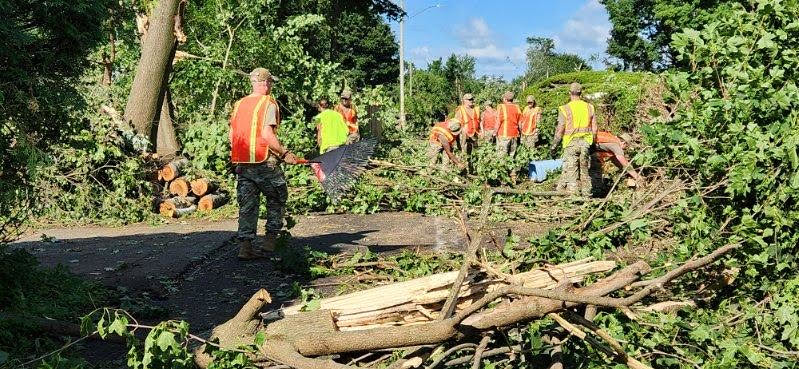
New York Air Guard Airmen help clear debris in Rome, NY following tornado in July 2024. The state National Guard activated 60 soldiers and airmen to help clear debris in the city. Courtesy photo by Major Ryan Marquette.

A Strong Cap-and Invest Program Needed

A strong cap-and-invest program will impose limits on the amount of emissions allowed by polluters and charge them to do so. With those funds, New York can more seriously invest in upgrades to homes to make them more energy efficient and run on clean, renewable energy while also boosting our local economy.

These measures will be especially important as residents absorb the costly increases in energy charged by NYSEG and other state utilities.

The Time for Delay is Over

Cap-and-invest is critical to meeting the targets of the state’s Climate Law. It also ensures New York can provide the level of investment necessary to make energy affordable while also boosting our economy.

Done the right way, Gov. Kathy Hochul, the DEC, and NYSERDA can lead New York into a new year that makes corporate polluters pay. At the same time, cap-and-invest could unlock billions of dollars for investments that drive sustainable economic development, increase energy efficiency, improve public health, and direct funds into neighborhoods to support community-led clean energy transitions.

Unfortunately, while draft regulations were originally due to be issued by now, with revenue beginning to flow by later in the year, Gov. Hochul recently announced that draft regulations won’t be issued until the end of 2025, and even then it appears these will only be partial.

Gov. Hochul’s delay in rolling out the program’s regulations ignores the urgency of the moment: the climate emergency has arrived and we must deal with it immediately. By continuing to stall, the governor increases the burden on disadvantaged communities, worsens harmful emissions, and allows polluters to go unchecked.

The governor first promised the cap-and-invest program over two years ago as the foundation of New York’s climate strategy. Now it appears that instead of promised regulations, we will see at least another year of delays. This move is part and parcel of a growing legacy of inaction and broken commitments on the most urgent crisis of our time.

We need leaders in Albany who are willing to take bold, decisive action to cut air pollution and lower greenhouse gas emissions. It is time to push for faster action from Gov. Hochul. Especially with a new administration in Washington actively hostile to climate policy, and with the state’s utility rates skyrocketing, it is critical that the cap-and-invest program be implemented as soon as possible.

In doing so, we can protect the residents of Ithaca and Tompkins County, as well as future generations, from the most harmful effects of the climate crisis.

How Serious is NY about Its Climate Goals?

There’s something seriously unnerving about the casual way in which Gov. Hochul has acknowledged that New York will probably not meet its 2030 climate targets. The pathbreaking Climate Leadership and Community Protection Act (CLCPA) calls for the state to obtain 70 percent of its electricity from renewable energy by 2030.

joint draft report issued in July by the New York State Energy Research and Development Authority (NYSERDA) and the Public Service Commission (PSC) indicated that the 70 percent renewables target will not be achieved before 2033.

State State Comptroller Thomas DiNapoli and Senate Majority Leader Andrea Stewart-Cousins. NY Senate Photo licensed under CC BY 2.0.

Audit Reveals Flaws
A few weeks after this report, State Comptroller Thomas DiNapoli released a detailed audit criticizing the PSC and NYSERDA for inadequate planning and the use of outdated data. In particular, it said that the PSC had failed to address “all current and emerging issues that could significantly increase electricity demand and lower projected generation.”

Perhaps most disturbing was the audit’s finding that the PSC had overlooked the need to calculate the costs of the transition to renewables or to identify how to cover those costs beyond the tried and true method of dumping them on ratepayers. 

How Committed is the State?
Together these two reports raise major questions about the actual commitment of the state to implementing the 2019 CLCPA. The governor’s reaction to these findings? Oh well, it won’t hurt if we let things slide for a few years. Not surprisingly, state Republican leaders and the business community have taken advantage of the leadership vacuum to attack the climate law and press Hochul to abandon it.

How is it possible for this failure of leadership to take hold during the same summer that global temperatures have been setting new records month after month? In fact, not only was this past July the warmest on record, but it was also the 14th consecutive month of record-high global temperatures. Does anyone see a pattern here?

Cornell professor Robert Howarth, a member of the state’s Climate Action Council, certainly does. The council passed a plan to implement the CLCPA in December 2022, and Howarth is on the front line defending it. “I am appalled at this pushback against the CLCPA by business interests pushing their short-sighted agenda,” Howarth said in an interview with WaterFront. “Climate change is very real. The consequences of climate disruption (floods, droughts, fires, crop failures) are becoming increasing obvious to all.”

Eddie Bautista, executive director of the New York City Environmental Justice Alliance, strongly agrees that stronger leadership is necessary. “In just five short years, we’ve gone from being visionary leaders to not being able to implement our own laws. It’s just insane,” he said recently.

The governor’s reversal on congestion pricing in New York City has environmentalists wondering whether this is part of a larger plan to back away from other elements of the state climate action agenda such as the cap-and-invest plan that would price greenhouse gas emissions. At the very least, it looks likely that the administration will blow past its self-imposed deadline to launch the program in early 2025.

A Simple Step
One step that Hochul could take to restore some degree of confidence in her commitment to climate action would be to sign the Climate Change Superfund Act that is currently sitting on her desk after being passed in June by both the General Assembly and State Senate. This legislation would require oil and gas companies to pay a total of $3 billion a year for 25 years to cover the cost of the climate damage they have inflicted on the state.

The governor has not yet signaled her intention, which leaves a lot of climate activists worried, although some think she might just be waiting until after the election to do so. The pressure on her has been growing throughout the summer and will only continue to increase this fall.

Fossil Free Media, together with the Sunrise Movement, has launched a national billboard campaign in California, New York, Arizona, and Philadelphia, with plans to expand to Florida and Louisiana in September. as part of the effort to build support for the principle that polluters should pay for the mess they have made.

The Make Polluters Pay campaign seeks to hold the fossil fuel industry accountable through legislation, lawsuits, and public pressure. This is exactly the kind of national attention that Hochul wants to avoid, but she better get used to it. Sen. Chris Van Hollen (D-MD) and Rep. Jerry Nadler (D-NY) just announced their intention to introduce federal Polluter Pays bills in Congress. Things are definitely heating up – stay tuned.

Next Steps for the NYS Draft Climate Plan

The Climate Action Council, headed up by Department of Environmental Conservation (DEC) Commissioner Basil Seggos and New York State Energy Research and Development Authority (NYSERDA) President and CEO Doreen M. Harris, has just issued its draft scoping plan. Now it’s our job to review it carefully and respond. Beginning on Jan. 1, the public will have 120 days to offer comments and make sure their voices are heard.

The Climate Leadership and Community Protection Act (CLCPA), signed into law in 2019, calls for New York to achieve a 40 percent reduction in greenhouse gas emissions and 70 percent renewable energy generation by 2030, establish a zero-emission electricity sector by 2040, and create a carbon-neutral economy by 2050. The CLCPA established the Climate Action Council, a 22-member committee charged with determining how to meet these statutory goals. The Council also consulted with a wide range of advisory panels and working groups over the past two years to address issues in areas such as transportation, solid waste, energy generation, workforce development, and climate justice.

A December 30 wildfire destroyed hundreds of homes in suburban Denver, the latest dramatic sign of climate change. Photo by Tristantech licensed under CC BY-SA 4.0.

The release of the draft scoping plan is the crucial first step in reaching the ambitious but necessary climate goals laid out in the CLCPA. There is certainly plenty of material for New Yorkers to wade through. The body of the report itself is 330 pages, followed by 520 pages of appendices. The Climate Action Council’s seven advisory panels – Transportation, Agriculture and Forestry, Land Use and Local Government, Power Generation, Energy Efficiency and Housing, Energy Intensive and Trade Exposed Industries, and Waste – submitted recommendations for the Climate Action Council to consider in the draft scoping plan, all of which can be found in the appendices.

In addition, the Climate Justice Working Group and Just Transition Working Group played key roles in the development of the draft scoping plan. The Disadvantaged Communities Barriers and Opportunities Report examines why some communities are disproportionately impacted by climate change and air pollution and have unequal access to clean energy, and recommends ways to rectify these problems using a climate justice lens. The Just Transition Working Group Jobs Study explores the consequences of climate change mitigation for the job market as well as actions required to provide adequate training, education, and workforce development.

The release of the draft scoping plan takes place against an increasingly dire climate crisis. The latest manifestation of this crisis is the Colorado wildfire that raced through suburbs between Denver and Boulder on Dec. 30, destroying at least 500 homes and forcing the evacuation of thousands of residents. Needless to say, December wildfires are not a common occurrence in Colorado, but a severe drought combined with high winds to fuel the most destructive blaze in the state’s history. Elsewhere, a new report has found unsettling evidence that the so-called “Doomsday Glacier” in Antarctica could collapse in as little as five years, raising the world’s sea level by several feet. The Thwaites glacier already loses 50 billion tons of ice each year and makes up about four percent of the planet’s annual sea rise.

The need to take dramatic and immediate climate action, then, is obvious. Although one of the most sweeping plans issued by any state or country, the NYS draft report leaves many specifics to be worked out. The broad outlines of any effective climate plan must include, as this one does, calls for the electrification of buildings, a shift to electric vehicles, the expansion of renewables such as solar and wind power, the development of feasible energy storage strategies, the decommissioning of natural gas, and the implementation of a carbon tax. But still unclear are the details and timing involved with setting these steps in motion, and how to do so in a way that takes into account historic inequities and brings about a just transition.

The draft scoping plan is now in the hands of Gov. Kathy Hochul and the state legislature. It remains to be seen to what extent public input will influence the final shape of the plan, but it’s critical that New Yorkers weigh in. The final report will be issued on Jan. 1, 2023 and the DEC will then announce legally binding regulations by Jan. 1, 2024 to ensure that the state achieves the CLCPA’s required targets.

Information about how to participate in the public hearings on the draft scoping plan will be disclosed in early 2022, according to the press release issued by the Climate Action Council. There will be at least six hearings held across the state. In addition, comments can be submitted via the online public comment form, by email at scopingplan@nyserda.ny.gov, and by U.S. mail to Attention: Draft Scoping Plan Comments, NYSERDA, 17 Columbia Circle, Albany, NY 12203-6399. Stay tuned!

The Art of Creative Problem Solving

There are few problems more intractable and complicated than climate destabilization. The interaction between the myriad parts of the climate regime, the various feedback loops and the uncertainties that make it so difficult to predict what lies ahead, can seem overwhelming.

But, fortunately, there has been a tremendous unleashing of creative energy aimed at tackling this existential threat. It is this creativity — the seemingly unlimited capacity of humans to take on the most complex challenges — that is the source of our greatest hope.

One of the toughest areas to address lies at the intersection of environmental stewardship and social equity, especially at a time when the degree of inequality in American society has reached levels not seen since the early twentieth century. It was a special honor, in this context, to hear about a new NYSERDA initiative at last month’s TCCPI meeting to develop affordable, net-zero modular homes targeted to provide low-income families with a way to dramatically reduce their carbon footprint.

An example of an affordable net zero modular home. Photo courtesy of VEIC.

Working with the Vermont Energy Investment Corporation (VEIC), NYSERDA will be spending $230 million over the next three years as it rolls out this new campaign. VEIC is a thirty-year-old nonprofit based in Burlington that is the first of the public-service ESCOs in the U.S. It has, in particular, focused on ways to provide low and moderate income families with ways to increase the energy efficiency of their homes and, in the process, provide significant cost savings for these families.

Currently, 8 million individuals live in manufactured homes in the U.S. These homes typically consume twice the energy of site-built homes. Following Tropical Storm Irene, which destroyed hundreds of mobile homes in Vermont and New York in August 2011, the call went out to replace mobile homes with modular construction.

The new net zero modular homes are equipped with solar PV systems and super efficient technology, including LED lighting, EnergyStar appliances, cold climate heat pump, heat pump water heater, and energy recovery ventilator that also monitors indoor air quality. The result is a manufactured home that not only saves the homeowner money but also reduces energy consumption and greenhouse gas emissions and provides higher quality, healthier homes.

It would be hard to come up with a better example of how human ingenuity and technical prowess can combine to address in one package two of our most serious problems, climate change and inequality. With the right priorities and focus, there is little doubt that more such solutions are on their way.

Why a 2030 District in Ithaca?

The drought in the Finger Lakes this summer has been a stark reminder that climate change is already under way not just in some distant land but in our own backyard, That doesn’t mean we should throw the towel in and concede defeat, however. On the contrary, we need to redouble our efforts to reduce our community’s greenhouse gas emissions and stave off the worst that could happen.

One of the most effective ways to do fight climate change is to improve the energy and water performance of our buildings. The built environment — commercial and municipal office buildings as well as multi-family housing — is a large consumer of natural resources and generator of emissions. In fact, 75 percent of all the electricity produced in the United States is used just to operate buildings, and the building sector is responsible for 45 percent of the nation’s carbon dioxide emissions.

2a2f3392-06b9-4a75-8b24-997349fd1ea7

HOLT Architect’s new office — the site of a former auto parts store — is near net zero energy.

The Ithaca 2030 District got its initial impetus from a 2013 visit by Ed Mazria, the founder and CEO of Architecture 2030, which issued the 2030 Challenge. Mr. Mazria was the keynote speaker at HOLT Architects‘ 50th anniversary celebration and he met with the members of the Tompkins County Climate Protection Initiative (TCCPI) while he was in town. TCCPI and HOLT began soon after to explore the potential of a 2030 District in Ithaca. With the support of its coalition members, establishing a 2030 District in Ithaca became an official project of TCCPI in 2014.

The Park Foundation and the New York State Energy Research and Development Authority (NYSERDA), through the Cleaner, Greener Communities program, have provided support to plan and begin building the Ithaca 2030 District. In addition, Cornell Cooperative Extension-Tompkins County, HOLT Architects, and Taitem Engineering have contributed significant in-kind gifts in the form of pro bono services.

Besides promoting crucial climate protection measures, the Ithaca 2030 District seeks to demonstrate that healthy and high performing buildings make good financial sense. District members will do this by bringing together diverse stakeholders, leveraging existing and developing new incentives and financing mechanisms, and creating and sharing joint resources. They will develop realistic, measurable, and innovative strategies to assist district property owners, managers, and tenants in meeting aggressive goals that keep properties and businesses competitive while operating buildings more efficiently, reducing costs, and reducing the environmental impacts of facility construction, operation, and maintenance.

The District builds on the TCCPI model to provide a non-competitive environment where building owners, community organizations, and professionals come together to share best practices and accelerate market transformation in Ithaca’s built environment. These collaborative efforts will establish the Ithaca 2030 District as an example of a financially viable, sustainability focused, multi-sector driven effort that maximizes profitability and prosperity for all involved.

The Ithaca 2030 District Emerges

As part of the City’s economic development program and effort to reduce greenhouse gas emissions, Seneca Strategic Consulting and the Tompkins County Climate Protection Initiative (TCCPI), together with Cornell Cooperative Extension Tompkins County, HOLT Architects, Taitem Engineering, and the Building Performance Contractors Association of New York State, are collaborating to create a 2030 District that will showcase ways to significantly reduce the environmental impacts of building construction and operations, while ensuring Ithaca’s economic viability and profitability for building owners, managers, and developers.

These districts seek to meet the energy, water and vehicle emissions reduction targets for existing buildings and new construction called for by Architecture 2030 in the 2030 Challenge for Planning. So far, 2030 Districts have been established in many cities all over the country, including Seattle, San Francisco, and Los Angeles, but Ithaca will be the first to create a 2030 District in New York.

The Ithaca 2030 District will build on the work of the TCCPI, an award-winning coalition of community leaders from the education, business, local government, youth, and nonprofit sectors that provides a place to network around climate and energy issues. Leveraging the climate action commitments made by Cornell University, Ithaca College, Tompkins Cortland Community College, Tompkins County, the City of Ithaca, and the Towns of Caroline, Dryden, and Ithaca, TCCPI seeks to foster a more climate resilient community and accelerate the transition to a clean energy economy.

The district will demonstrate how property owners and managers can work together to undertake energy efficiency projects in nonresidential buildings in an economically sound way. This project will create jobs in the energy efficiency sector, encouraging more investment in downtown areas, and helping to foster community revitalization. Building owners and managers will share energy, water, transportation data and case studies that will spur additional efforts to make more effective use of limited resources, improving the sustainability and resiliency of the community.

The Ithaca 2030 District is currently in the planning stage. There is a steering committee that is meeting monthly and beginning outreach to property owners and managers in the City of Ithaca. NYSERDA, through its Cleaner, Greener Communities Program, has awarded the Ithaca 2030 Districts team $90,380 against a match of $108,000 provided by the team members. Contract negotiations have been completed and the agreement with NYSERDA should be executed soon, allowing the project to get fully underway. It is anticipated the launch of the District will take place in the late spring of 2016.

Note: This article appeared originally in the Winter 2015 issue of the Commercial Energy Now newsletter.o

TCCPI Receives Cornell Sustainability Award

In honor of Sustainability Month, the Cornell University President’s Sustainable Campus Committee presented the second annual Partners in Sustainability Award to the Tompkins County Climate Protection Initiative (TCCPI) on Friday, April 29, 2011.

The award recognizes TCCPI for its ongoing partnership in regional carbon reduction strategies. Cornell cited TCCPI as an effective partner in the regional effort to conserve energy and reduce carbon emissions. “By recognizing groups that partner with higher education institutions to advance sustainability, we build on the successes of research and teaching, and acknowledge that we must also bring together practitioners and leaders throughout the world in support new policies and practices,” Daniel Roth, Cornell University sustainability manager, said.

Cornell’s Partners in Sustainability Award is given each year to one or more recipients who have made significant contributions to the sustainable development of New York State and the Cornell campus through collaboration with Cornell University. The 2010 recipient was the New York State Energy and Research Development Authority (NYSERDA) for its leadership in statewide energy conservation and renewable energy initiatives.

Gary Stewart, director of community relations at Cornell University, wrote in an Ithaca Journal op-ed earlier this week about how collaboration among the varied members of the TCCPI coalition is at the heart of its organizational culture. As he observes, “TCCPI represents the spirit of new-era democracy, with bigger-business advocates sitting next to Snug Planet, with large-scale power generators conferring with EcoVillage, or with Tompkins County Solid Waste having the opportunity to compare notes with Museum of the Earth. TCCPI sessions are about partnerships and progress in Tompkins County.”

Partnerships are the key to building a more sustainable future. Only if we harness the power of the network will we effectively address such issues as climate destabilization and clean energy. Especially in the context of the current national and international stalemate on climate policy, it is clear that communities must take up a collaborative effort to reduce greenhouse gas emissions, increase energy efficiency, and adopt renewable energy technologies. TCCPI is honored to receive the 2011 Partners in Sustainability Award from Cornell University.