TCCPI at Fifteen

It’s hard to believe, but this summer marks the 15th anniversary of the Tompkins County Climate Protection Initiative. At the time of TCCPI’s launch in June 2008 I was working on a book with a colleague at Second Nature, a nonprofit think tank in Boston dedicated to promoting the higher education sustainability movement. One of the key themes in the book, Boldly Sustainable: Hope and Opportunity for Higher Education in the Age of Climate Change (2009) was the need for greater collaboration between colleges and universities and the communities in which they operated.

I was drafting a chapter for the book in early 2008 on sustainability, economic development, and community partnerships, exploring several case studies across the U.S., including Ithaca. I had stepped down the previous year from the provost’s office at Ithaca College, where I had helped lead what became a nationally recognized sustainability initiative, to join Second Nature as a senior fellow. Having left the academic world following a quarter century as a faculty member and administrator, I became much more aware of the disconnect between campuses and communities in the emerging sustainability movement. 

Time for Collaboration

Looking over the Ithaca landscape, it seemed to me that the time was right for an effort that would bring together higher education institutions, local governments, nonprofits, and businesses around the need for climate action and the energy transition. I brought the idea to the Park Foundation and submitted a grant proposal for what became TCCPI; the foundation generously funded the proposal and has continued to do so with unstinting support.

In that time, TCCPI has held about 165 monthly meetings, published 76 newsletters, and issued 14 annual reports of member accomplishments regarding climate action, clean energy, and sustainability. In 2016, as part of an effort to strengthen our engagement with the private sector, we established (with the assistance of a grant from NYSERDA) the Ithaca 2030 District, part of what is now a network of 24 urban districts in the U.S. and Canada dedicated to improving the energy and water performance of commercial buildings in downtown areas. 

From an initial base of 15 buildings, the Ithaca 2030 District has grown to 44 buildings with 584,381 square feet of committed space. Besides our quarterly meetings and newsletters, we provide each property member with an interactive, online dashboard that measures the energy and water performance of their individual buildings. These dashboards are regularly updated so that owners, managers, and tenants can monitor their progress. You can find our latest annual district-level report here.

Policy Advocacy

Apart from the founding of the Ithaca 2030 District, perhaps the most significant change in TCCPI since its beginning is the extent to which we have become involved over the last few years in policy advocacy. Our activities in this area are primarily focused on the state level, and we are members of three statewide activist coalitions: NY Renews, Renewable Heat Now, and Climate Can’t Wait. The passage of the Climate Leadership and Community Protection Act in 2019 and the subsequent establishment of the Climate Action Council, which released its recommendations for a state climate plan this past December, as well as the flurry of bills sparked by these recommendations, have constituted the main catalyst for this evolution in TCCPI’s work. At the local level, we have been a strong and active supporter of the Ithaca Green New Deal.

Underlying this new attention on policy advocacy is a mounting sense of urgency as the climate crisis becomes an undeniable reality of our present, one that has had a disproportionate impact on marginalized groups and which demands that we place equity and justice at the center of our efforts. In the face of this growing awareness and public support for action, however, the fossil fuel industry and its allies have responded with misinformation, fear mongering, and a deep-seated commitment to maintaining the status quo.

In the process, it’s become clear that the most effective way to push back and secure a safe, just, and healthy future is collective action by well-organized citizens fighting for our communities and making sure no one is left behind. Animated by this spirit, TCCPI will keep moving forward in the years to come. As Thomas Berry writes in The Great Work: Our Way into the Future, unless we devote ourselves to preserve and enhance the life, beauty, and diversity of the planet for the generations to come, we will become “impoverished in all that makes us human.”
Embracing the Commons in the Age of Trumpism

“As we enter the twenty-first century,” Thomas Berry observed in The Great Work: Our Way into the Future (2000), “we are experiencing a moment of grace.” “You’ve got to be kidding!” is the understandable response. Certainly, anyone paying attention to the news these days has good reason to challenge this seemingly naive claim.

What Berry means, however, has less to do with a positive assessment of our current circumstances than with the narrow window of opportunity we have to turn back from the disastrous road we are on. We have an all too brief moment to transform our exploitation of the Earth and each other into a web of relationships that is, in Berry’s words, “mutually beneficial.” Unless we act now to preserve and enhance the life, beauty, and diversity of the planet for future generations, Berry contends, we will become “impoverished in all that makes us human.”

96775190-9c81-4986-ab2c-a8ccddfec25f

These are important words to remember as we come to grips with a level of political polarization in our nation’s history unprecedented since at least the days of racial, ethnic, and class conflict in the 1890s, when lynchings, virulent opposition to immigration, and widespread  attacks on labor dominated the U.S. landscape. In particular, the threat that Trumpism poses to democracy is all too real, and the implications of “America First” for global efforts to stabilize the climate and confront inequality in the developing nations are alarming.

How should we respond? For those of us privileged enough to have the resources, it is all too easy to fall into despair and retreat into our respective cocoons. But that is moral cowardice and, at any rate, will end up being self-defeating. As Van Jones has pointed out, ” eco-apartheid is just a speed-bump on the way to eco-apocalypse. Any successful, long-term strategy will require a full and passionate embrace of the principle of eco-equity.”

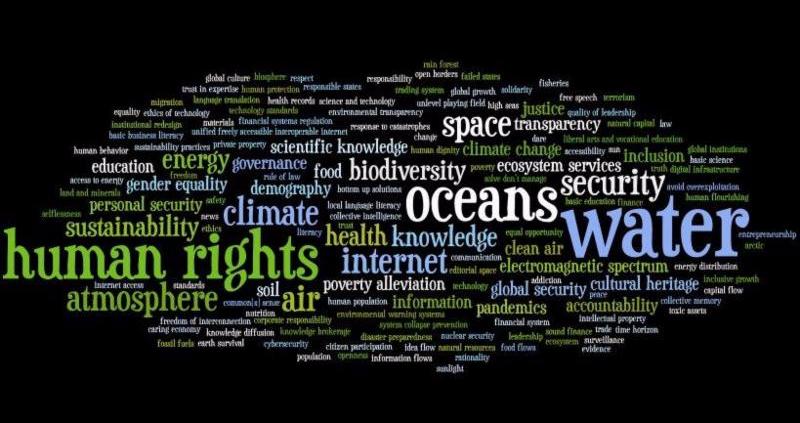
What does it mean to embrace eco-equity? Conventional politics offers two opposing points of view: conservatism, in which the unfettered market is seen as the way forward, and progressivism, in which the expanded state is considered to be the solution. But the hard truth, as George Monbiot contends, is that “the market alone cannot meet our needs; nor can the state.” In Monbiot’s words, “One element has been conspicuously absent from the dominant ideologies, something that is neither market nor state: the commons.”

What are the commons? Monbiot provides an admirably concise explanation: the commons are “an asset over which a community has shared and equal rights.” It can, at least in theory, include land, water, air, knowledge, scientific research, and culture. Historically, the commons in pre-industrial England were an integral part of the manor. They existed as part of the estate owned by the lord of the manor, but to which the tenants and others held certain rights.

By definition, then, the commons as an idea holds itself over and against the concept of private and exclusive ownership. Perhaps the most compelling current example of the commons is the Missouri River, which the Standing Rock Sioux and other Native Americans, have fought to protect against the incursion of the Dakota Access Pipeline (DAPL). Knowing the clear risk that a potential oil spill could pose to the drinking water not only of their own people but also all those living downstream, the “water protectors” have taken a stand against the argument that the rights of corporations have precedent over the rights of all those whose lives depend on the commons, including those yet to be born.

To understand the crucial place of the commons in determining the future of what it means to be human, in short, is to see that the “moment of grace” to which Berry refers insists that we resist Trumpism and the corrosive atomization of community and radical individualism that it engenders. It is the most effective and humane way that we can bring about the kind of eco-equity Van Jones rightly views as the only viable option left for avoiding an otherwise inescapable eco-apocalypse.

Not Just Renewable Energy

The day after attending the anti-fracking concert in Binghamton featuring Natalie Merchant and the Horse Flies, I ran across a new report published by the American Meteorological Society concluding that the ice covering Lake Ontario in the winter had decreased by 88 per cent over the last forty years. Eighty-eight percent. That’s a big number.

Natalie Merchant

Yes, smaller cyclical climate patterns like El Nino and El Nina were responsible for some of this decline but so, too, was the broad trend of global warming. Lake Superior was so free of ice this past winter that a local ferry north of Ashland, Wis., operated all season, something that has happened only once before.

One of the speakers at the concert called on the audience to not only oppose Marcellus drilling but also support the development of renewable energy. “Energy efficiency, too,” I thought to myself. Solar, wind, and geothermal by themselves will not be enough to manage the risk of runaway climate change. And climate adaptation and resilience must be tackled, given the amount of change already baked in. And then there are issues of local food security, alternative transportation, and waste, all being addressed in the Get Your GreenBack Tompkins (GYGB) campaign.

So much work to do; it can all seem more than a little overwhelming. But then every generation has work to do. In many ways, we are fortunate that what Thomas Berry calls “the Great Work” of our time is so well defined. We know what we must do to make sure the generations after us have clean water, clean air, healthy food to eat, and families that thrive. As Natalie Merchant sang that wonderful evening in Binghamton, “These are the days you’ll remember.”

From “Egosystem Awareness” to “Ecosystem Awareness”

“The future ain’t what it used to be,” Yogi Berra once declared.[i] He wasn’t talking about climate change, but he could’ve been. Eight out of the nine hottest years on record worldwide, including last year, have occurred since 2000. The rate of the Arctic summer melt is accelerating at an astonishing pace and the latest reports now predict that we could have ice free summers in the Arctic as early as 2015.

observatory

The Mauna Loa Observatory

Scientists at the Mauna Loa Observatory in Hawaii announced this past May that for the first time in human history the level of carbon dioxide in the atmosphere passed 400 ppm. The last time carbon dioxide levels were this high was probably in the Pliocene epoch, over three million years ago. To top it off, a paper just published in Nature predicts that by mid-century over half the planet will be experiencing average temperatures equivalent to the hottest days recorded since 1860.[ii]

As bad as this news is, and it is bad, there is some really good news on the clean energy front. According to a recent flurry of studies, we have the ability with existing technology to get 80-100 percent of our power from wind, sun, water, tides, and other renewable sources, and prevent runaway climate change, far worse than what is already locked in, from taking place. A 2011 report from the United Nations’ Intergovernmental Panel on Climate Change (IPCC), for example, concluded that already existing technologies could, in combination, make up almost 80 percent of our energy supply by 2050 and cut greenhouse gas emissions by a third from business-as-usual projections.[iii] Earlier this year, Stanford and Cornell researchers issued a detailed analysis explaining how wind, water, and solar power could replace all fossil fuels in New York State in an economically viable way if the external health and environmental costs are taken into account.[iv] In both cases, the message is the same: the critical missing components are the policies necessary to drive change in this direction and the political will to implement them.

At another, deeper level, of course, climate destabilization is more than a physical problem to be solved by technology or a policy problem to be solved by politics. It is, in Malcolm Bull’s words, “an ethical problem that necessarily requires moral solutions.”[v] The real question is not so much whether we have the technical ability or the political will to slow down the rate of global warming but whether we have the capacity to expand our moral imagination so that we can grasp the importance of doing so.

Transforming our exploitation of Earth into a relationship that is mutually beneficial must be at the core of this enlarged moral imagination. We need to move from what Otto Scharmer calls “egosystem awareness to ecosystem awareness.” In Scharmer’s words, “we have to open up, let go of the past, and tune in to what we feel is a field of future possibility, something that might be possible, something that we could bring into reality, a future that would be very different from the past.”[vi] Unless we act now to make this shift to “ecosystem awareness,” devoting ourselves to preserve and enhance the life, beauty, and diversity of the planet for future generations, we will become, as Thomas Berry writes, “impoverished in all that makes us human.”[vii]

Notes

A longer version of this post was originally published in Second Nature’s The Implementer newsletter in November 2013.

[i] Yogi Berra, The Yogi Book: I Really Didn’t Say Everything I Said (New York: Workman Publishing, 1989), pp. 118-19.

[ii] Tia Ghose, “NASA: 2012 Was 9th Hottest Year on Record Worldwide,” Live Science, January 15, 2013. http://www.livescience.com/26277-nasa-2012-ninth-hottest-year.html.; Nafeez Ahmed, “White House Warned on Imminent Arctic Ice Death Spiral,” The Guardian, May 2, 2013. http://www.guardian.co.uk/environment/earth-insight/2013/may/02/white-house-arctic-ice-death-spiral; John Vidal, “Global Carbon Dioxide Levels Set to Pass 400 ppm Milestone,” The Guardian, April 29, 2013. http://www.guardiannews.com/environment/2013/apr/29/global-carbon-dioxide-levels; Andrew Simms, “Why Did the 400 ppm Carbon Milestone Cause Barely a Ripple?” The Guardian, May 30, 2013. http://www.guardian.co.uk/environment/blog/2013/may/30/carbon-milestone-newspapers; Justin Gillis, “By 2047, Coldest Years May Be Warmer Than Hottest in Past, Scientists Say,” New York Times, October 9, 2013. http://www.nytimes.com/2013/10/10/science/earth/by-2047-coldest-years-will-be-warmer-than-hottest-in-past.html.

[iii] IPCC, Special Report on Renewable Energy Sources and Climate Change Mitigation. Prepared by Working Group III of the Intergovernmental Panel on Climate Change (Cambridge, UK and New York: Cambridge University Press, 2011). http://srren.ipcc-wg3.de/report.

[iv] Mark Z. Jacobson, et al., “Examining the Feasibility of Converting New York State’s All-Purpose Energy Infrastructure to One Using Wind, Water, and Sunlight,” Energy Policy (2013). http://www.stanford.edu/group/efmh/jacobson/Articles/I/NewYorkWWSEnPolicy.pdf. See also Mark Z. Jacobson and Mark A. Delucchi, “A Path to Sustainable Energy by 2030,” Scientific American, 301 (November 2009): 38-65. http://www.stanford.edu/group/efmh/jacobson/Articles/I/sad1109Jaco5p.indd.pdf; Adam White and Jason Anderson, “Re-energising Europe: Putting the EU on Track for 100% Renewable Energy.” 2013 World Wildlife Fund Report. http://awsassets.panda.org/downloads/res_report_final_1.pdf.

[v] Malcolm Bull, “What is the Rational Response?” London Review of Books, vol. 34, no. 10 (May 24, 2012), pp. 3-6. http://www.lrb.co.uk/v34/n10/malcolm-bull/what-is-the-rational-response.

[vi] C. Otto Scharmer, “The Blind Spot of Institutional Leadership: How to Create Deep Innovation through Moving from Egosystem to Ecosystem Awareness,” delivered at the World Economic Forum, September 2010, Tinjan, China. http://www.ottoscharmer.com/docs/articles/2011_BMZ_Forum_Scharmer.pdf.

[vii] Thomas Berry, The Great Work: Our Way into the Future (New York: Bell Tower Books, 2007), pp. 201, 200.