Endangerment at Home and Abroad

At first glance, climate policy rollbacks and a military strike on Iran may seem unrelated: one deals with environmental regulation at home, the other with foreign policy and conflict abroad. But in 2026, they share deep connections in how the current administration frames U.S. national priorities.

Repealing the Endangerment Finding

Let’s start with the rescinding of the endangerment finding by the Environmental Protection Agency (EPA).

Earlier this month the EPA under President Trump finalized the repeal of the 2009 endangerment finding, the scientific and legal determination that greenhouse gases such as carbon dioxide and methane endanger public health and welfare. The 2009 ruling gave the EPA its authority to regulate these emissions under the Clean Air Act.

The endangerment finding became the foundation of virtually all U.S. federal climate policy. It empowered the EPA to establish vehicle emissions standards, regulate powerful industrial polluters, and curtail greenhouse gas emissions from power plants and oil and gas facilities.

By rescinding that finding, the Trump EPA has unraveled that legal foundation, effectively eliminating federal greenhouse gas regulation and significantly weakening the agency’s ability to enforce climate policy. The final rule also eliminates reporting and measurement requirements for vehicle emissions.

This move represents one of the most consequential environmental policy rollbacks in U.S. history, undermining protections for air quality and climate health while rejecting a long-standing scientific consensus.

Without the authority of the 2009 finding, the EPA loses its central statutory basis for most climate regulations, opening the door to increased emissions, less federal oversight, and deeper disparities between state and federal policies. It also signals a clear ideological position against federal climate engagement and in favor of oil and gas companies.

The Attack on Iran

Both the repeal of the endangerment finding and the Iran conflict reflect a broader political agenda emphasizing the central influence of the U.S. fossil fuel industry. The EPA rollback is justified politically as removing what the Trump administration and its supporters call “overreach,” presenting less federal control as central to economic freedom and growth. On the other hand, the unprovoked military assault on Iran strengthens the power of the White House to act unilaterally in carrying out its foreign policy.

What unites the two is the unprecedented influence of big oil and gas corporations. Iran has the world’s second-largest reserves of natural gas and the third-biggest oil reserves. U.S. oil producers see Iran as a much better prospect than Venezuela and offered last month to be a “stabilizing force” in Iran if the regime there falls.

“You can imagine our industry going back there — we would get a lot more oil, a lot sooner than we will out of Venezuela,” a U.S. energy and geopolitics consultant observed, practically licking his chops. “That’s more conventional oil right near infrastructure, and gas as well.”

The Interplay of Domestic Politics and Foreign Policy

Climate policy and military strategy both shape global perceptions of U.S. leadership. The rollback of climate regulation obviously weakens U.S. influence in international climate cooperation. At the same time, war with Iran will undoubtedly further strain alliances and diplomatic partnerships important to tackling climate change collectively. In both cases, the U.S. is continuing to isolate itself globally.

Rescinding the EPA’s endangerment finding and launching a war against Iran are deeply related actions on the part of the Trump administration. Each represents a pivotal shift, one in how the U.S. engages with the science and policy of climate change at home, and the other in how it projects power abroad.

While different in substance, both illustrate how the fossil fuel industry exerts unchecked environmental and foreign policy influence in ways that endanger the long-term interests of the U.S. In a world increasingly interconnected by climate risk and geopolitical instability, these recent domestic and foreign policy decisions carry profound significance for the U.S and the world.
Renewable Energy on the March

The news so far this year has been dismal: mass shootings, Russian meddling in our elections, rabid political partisanship on Capitol Hill, scandals erupting in the White House, and an opioid epidemic out of control. And that’s just the tip of the iceberg.

There’s a bit of light, however, glimmering on the renewable energy front. When President Trump first took office, it looked like renewable energy would be entering an unremittingly bleak era. His administration has mounted a militantly pro-fossil fuel campaign, advocating policies that are clearly aimed at undercutting the transition to renewable energy. The recent decision to impose a 30 percent tax on solar panels imported from China, in particular, looked as if it would deal a substantial blow to the solar industry.

Surprisingly, though, it doesn’t seem like the expansion of renewable energy can be stopped. As the New Republic points out, ” From solar to wind to geothermal energy, the renewables industry is  withstanding Trump — and in some cases, it’s doing better than ever.” It turns out that the long march towards a clean energy economy can be hindered but not stopped. Trump simply does not have the power to alter the direction of technological innovation and market forces.

0f69bd3f-1cfd-4399-a3e2-8abd589ce803

Source: Bloomberg New Energy Finance

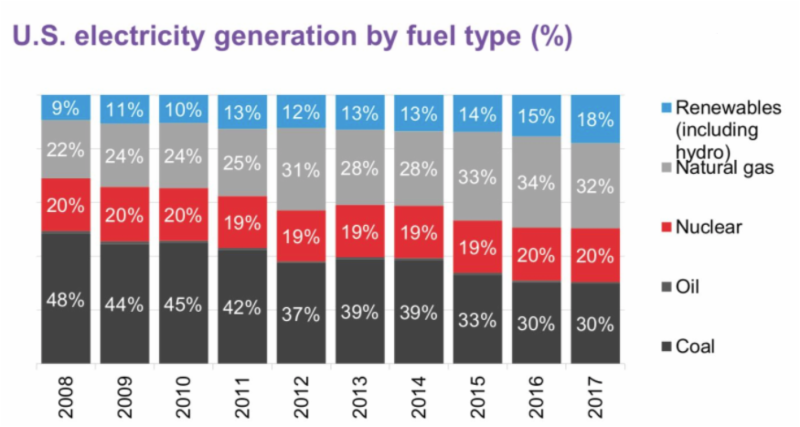
A new report, the 2018 Sustainable Energy in America Factbook, underscores this point. Even in the uncertain climate accompanying the ascension of Trump to the White House in 2017, 18 percent of all electricity in the U.S. was produced by renewable sources, including wind, solar, and hydropower, up from 15 percent in 2016. That, as one energy analyst noted, puts renewables “within striking distance” of the nuclear power sector, which has hovered at 19-20 percent since 2008. Just as impressive, the share of electricity produced by renewables in the U.S. has doubled since 2008, while coal’s share plummeted from 48% to 30%.

The continued drop in the cost of renewables (and natural gas) spells bad news for coal going forward. Solar and wind projects made up about 62% of new power construction in 2017 and 2.9 gigawatts of new renewable energy projects were undertaken last year. In contrast, 12.5 gigawatts of coal plants are slated to shut down in 2018.

“Imagine,” observes the New Republic, “how well solar, wind, and battery technology would fare if Trump had the same enthusiasm for promoting it as he does for promoting coal and oil and gas.” But then Trump wouldn’t be Trump — that’s the unfortunate reality. In the meantime, however, the renewables march forges ahead.

Go Faster and Go Further

As we approach the 100th day of the Trump administration this Saturday, it’s clear that the new president has determined to maintain the fossil fuel regime. In response, hundreds of marches will be held around the country (including in Ithaca), with the main event in Washington, DC. As Bill McKibben notes, “since Trump obviously takes his 100th day seriously, it will be a particularly good day to be around his house reminding him how badly he’s doing.”

The rollback of the Obama administration’s energy and climate policies, which had their own limitations, means that the U.S. will send up to 900 more megatons of greenhouse gases into the atmosphere each year. According to a recent report, that will increase the world’s annual greenhouse gas emissions by almost 2 percent at a time when we need to be making dramatic cuts in these emissions.

69cc2523-482f-4126-8724-dbec52b56132

Trump’s advisors are divided about whether the U.S. should abandon the Paris Agreement, but even the strongest advocates for not doing so want to renegotiate the terms of the accord. In any event, it certainly appears as if we’re handing over leadership on this critical issue to China and Europe. In terms that Trump might understand, such a failure of leadership will do permanent damage to our nation’s brand. But much more than a marketing blunder is at stake;  the fate of human civilization rests on not going down this road.

The one bright light is that the transition to a clean energy economy seems to have reached a tipping point that will carry it forward regardless of any policy shifts. In particular, despite President Trump’s rhetoric, It’s too late to bring back coal or the associated mining jobs, not just because natural gas has become too cheap for coal to be competitive. The costs of wind and solar have dropped so significantly in the last several years that they, too, have become cheaper than goal. This new reality is apparent in the recent decision of the Kentucky Coal Museum to install solar on its roof as a cost-saving measure. Yes, that’s right: the Kentucky Coal Museum is going solar.

The numbers tell an even more impressive story. As the chart above indicates, renewable energy capacity grew 9.3 percent in 2015, the fifth year in a row that the rate has been above 8 percent. In the first quarter of 2016, renewables made up 99 percent of the new electricity production capacity in the U.S., and from Q1 2015 to Q1 2016 they increased from 14 percent of electricity to 17 percent. In contrast, coal dropped during that same period from 36 percent to 29 percent.

The global growth in solar has been especially explosive. For the first time since 2013, solar outpaced wind in 2016. The primary driver has been the astonishing reduction in the cost of utility-scale solar: it fell 62 percent from 2009 to 2015 and is projected to drop another 57 percent by 2025.

At the same time, renewables have become a key source of new employment around the world. Renewable energy jobs rose by 5 percent in 2015 to 8.1 million and there were an additional 1.3 million jobs in large-scale hydropower. In another sign of the historic transition taking place, the American solar industry now employs more workers than coal: 209,000 compared to about 150,000 jobs.

So we’re moving in the right direction; that’s the good news. The not-so-good news, however, is that we need to move a lot faster and go a lot further. According to the International Renewable Energy Agency (IRENA), we need to double the share of renewables in the world’s energy mix by 2030 to keep global warming below 2°C. Overall, we need to reduce greenhouse gas emissions by 2.6 percent per year on average to meet the Paris target.

Accomplishing this task is not impossible, but it’s going to take a lot of work. And, clearly, we can’t count on the federal government to make it happen; it’s up to us. All the more reason we need to take to the streets on Saturday and make our voices heard.